

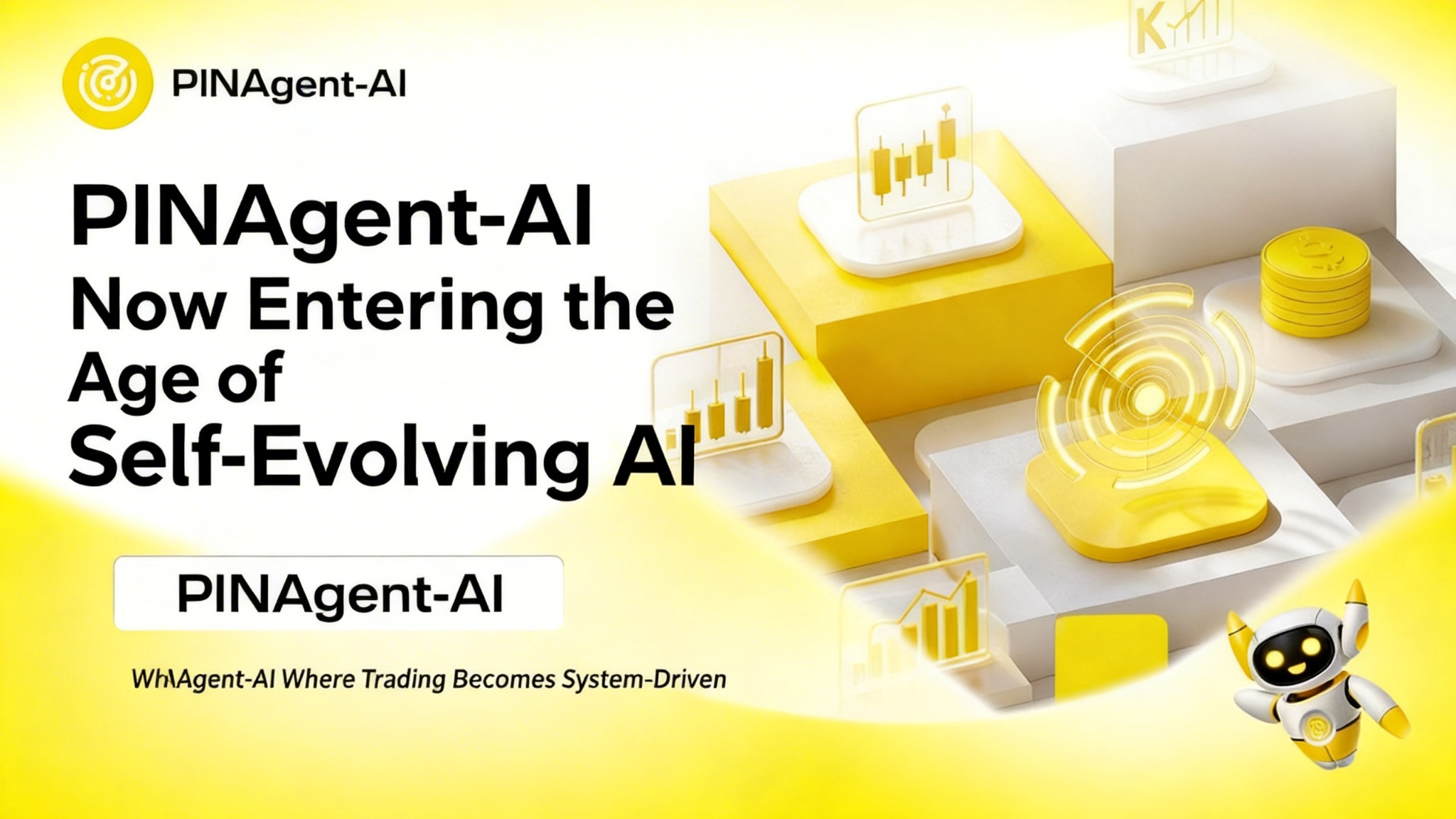
AI is reshaping the underlying structure of the financial markets. From early quantitative strategies to data-driven trading and now to intelligent decision-making systems, the core competitive edge in trading has shifted—from “who makes better judgments” to “whose system is more advanced and evolves faster.”
The recent rise of OpenClaw has pushed the industry into a new phase once again. AI is no longer just a tool—it is becoming an autonomous agent capable of continuous operation, ongoing learning, and dynamic evolution. This trend is rapidly expanding from general AI applications into the domain of financial trading.
Against this backdrop, PINDex is approaching a major upgrade. PINAgent-AI is moving beyond a traditional strategy signal system and entering a new stage: an AI trading system that can understand markets, participate in trading, and continuously evolve through experience. This is not just a product upgrade—it represents a fundamental shift in the trading paradigm.
From a “Signal Tool” to a “Full Trading Decision System”
For a long time, most trading products have revolved around signals—providing entry and exit points, suggesting long or short positions. While this approach worked in earlier market environments, increasing complexity has made single-point signals insufficient.
Market trends, capital flows, on-chain structures, volatility drivers, and risk exposure now collectively define real trading decisions.
The upgrade of PINAgent-AI breaks through the limitations of isolated signals. Instead of offering simple buy/sell prompts, it builds a comprehensive decision-making framework. The system integrates trend analysis, on-chain behavior insights, capital flow tracking, structural opportunity identification, and risk management into a closed-loop decision logic.
This means users are no longer presented with isolated trade suggestions, but with a full reasoning process that explains why a trade exists, why it should be executed, and what risks are involved. Trading evolves from “seeing price points” to “understanding the market.”
From “Market Observation” to “On-Chain Alpha Capture”
Traditional trading largely focuses on price—analyzing charts, indicators, and historical data. However, in the on-chain era, real opportunities often emerge before price movements become visible.
Capital flows, wallet behaviors, liquidity shifts, and structural transitions form the earliest sources of Alpha.
PINAgent-AI’s upgrade focuses heavily on this layer. Through deep on-chain analysis, the system can identify short-cycle, high asymmetric return opportunities, including early-stage structural opportunities in new assets, arbitrage windows driven by capital movements, short-term trends from liquidity shifts, and mispriced risk-reward scenarios in volatile environments.
As a result, trading is no longer reactive to price—it becomes proactive in anticipating structural changes. In other words, PINAgent-AI is not just following the market; it is attempting to understand it ahead of time.
From “Strategy Execution” to “System-Level Coordination”
In traditional setups, strategy and execution are often disconnected. Users receive signals, make their own decisions, place orders manually, and adjust positions independently—introducing inefficiencies and human error.
Within the PINDex ecosystem, however, PINAgent-AI is not a standalone tool. It is deeply embedded in the trading infrastructure itself.
With the upgrade, PINAgent-AI will operate in closer coordination with PINDex’s order book matching engine, liquidity systems, and the PINAgent-MM market-making protocol. Strategies are no longer just suggestions—they are progressively integrated into execution, interacting directly with market liquidity, trading behavior, and risk controls.
This transforms trading from a series of isolated decisions into a system-level process. AI is no longer just assisting—it becomes part of the trading architecture itself.
From “Static Models” to “Self-Evolving Trading AI”
While the previous improvements enhance capability, the core of this upgrade lies in introducing evolution.
The rise of OpenClaw has redefined how the industry views AI. Instead of static, one-time deployed models, AI is now seen as a continuously operating system—one that absorbs information, adjusts behavior, and improves over time. It doesn’t just execute tasks; it learns from them.
PINAgent-AI’s upgrade aligns with this shift. Future versions of the system will no longer rely on fixed strategies, but will continuously refine decision-making logic based on market data, trading outcomes, and behavioral feedback.
It will learn which strategies perform best in current conditions, identify emerging risks, detect structural changes, and adapt accordingly.
This introduces a critical transformation: trading systems are no longer static. They become adaptive, constantly moving toward the optimal solution for current market conditions rather than relying on historical assumptions.
Why This Upgrade Changes How Users Participate in Trading
As trading enters the era of self-evolving AI, the biggest shift is not a single gain—it is a change in participation.
Users no longer need to repeatedly learn complex strategies, monitor markets constantly, or filter overwhelming information streams. Instead, decision-making is gradually delegated to the system, allowing AI to handle market interpretation, opportunity identification, and execution.
The role of the user shifts—from executor, to system user, and ultimately to system beneficiary.
This is why trading is increasingly moving toward systemization, automation, and intelligence. In a market dominated by algorithms, human advantages are diminishing, while system advantages continue to expand.
PINDex Is Opening a New Gateway to Trading

The upgrade of PINAgent-AI is not isolated—it forms a closed-loop system within the broader PINDex ecosystem. Users can deposit funds and connect them to the AI-driven execution system, where strategies participate in market making, arbitrage, and structural opportunity capture, generating ongoing returns.
At the same time, a significant portion of platform profits is used to buy back and burn $PIN, linking system performance directly to token value.
In this structure, the evolution of AI not only impacts trading outcomes but also drives the growth of the entire ecosystem. The stronger the system, the more efficient execution becomes; the more active the market participation, the stronger the buyback and deflation mechanism—ultimately reflected in token value.
This positions PINAgent-AI not just as a tool, but as the core engine of value within the ecosystem.
The Next Phase of Trading Belongs to Evolving Systems
Looking back, trading has evolved from manual decision-making to quantitative strategies and then to AI-assisted systems. Each stage has reduced human dependency and increased system dominance.
Now, with the emergence of self-evolving AI, trading is entering a new phase.
In this phase, success is no longer determined by a single strategy, but by whether a system can continuously adapt to market changes. It is no longer about who makes better judgments—but whose system evolves faster.
PINAgent-AI’s upgrade represents a critical step into this new era.
As trading enters the age of self-evolution,the real gap is no longer information—it is the system itself.


All Comments