Cointime

Download App
iOS & Android

North Korean hackers used AI-enabled social engineering in Zerion attack

Validated Individual Expert

Crypto wallet Zerion revealed that North Korean-affiliated hackers used AI in a long-term social engineering attack to steal about $100,000 from the company’s hot wallets last week. 

The Zerion team released a post-mortem on Wednesday, where it confirmed that no user funds, Zerion apps or infrastructure were affected and that it had proactively disabled the web app as a precaution. 

While the amount was relatively small in crypto hacking terms, it is another incident of a crypto worker being targeted for an “AI-enabled social engineering attack linked to a DPRK threat actor,” Zerion said.

It is the second attack of this nature this month, following the $280 million exploit of the Drift Protocol, which was the victim of a “structured intelligence operation” by DPRK-affiliated hackers. The human layer, not smart contract bugs, has now become North Korea’s primary point of entry into crypto firms.  

AI is changing the way cyber threats work

Zerion said the attacker gained access to some team members’ logged-in sessions and credentials, as well as private keys to company hot wallets. 

“This incident showed that AI is changing the way cyber threats work,” the company said. 

It confirmed that the attack was similar to those that had been investigated by the Security Alliance (SEAL) last week.

SEAL reported that it had tracked and blocked 164 domains linked to the DPRK group UNC1069 in a two-month window from February to April.

It stated that the group operates “multiweek, low-pressure social engineering campaigns” across Telegram, LinkedIn and Slack. Malicious actors impersonate known contacts or credible brands or leverage access to previously compromised company and individual accounts.

“UNC1069’s social engineering methodology is defined by patience, precision, and the deliberate weaponization of existing trust relationships.”

Google’s cybersecurity unit Mandiant detailed in February the group’s use of fake Zoom meetings and a “known use of AI tools by the threat actor for editing images or videos during the social engineering stage.”

DPRK’s social engineering is evolving

Earlier this month, MetaMask developer and security researcher Taylor Monahan said North Korean IT workers have been embedding themselves in crypto companies and decentralized finance projects for at least seven years.

“The evolution of the DPRK’s social engineering techniques, combined with the increasing availability of AI to refine and perfect these methods, means the threat extends well beyond exchanges,” blockchain security firm Elliptic said in a blog post earlier this year. 

“Individual developers, project contributors, and anyone with access to cryptoasset infrastructure is a potential target.”
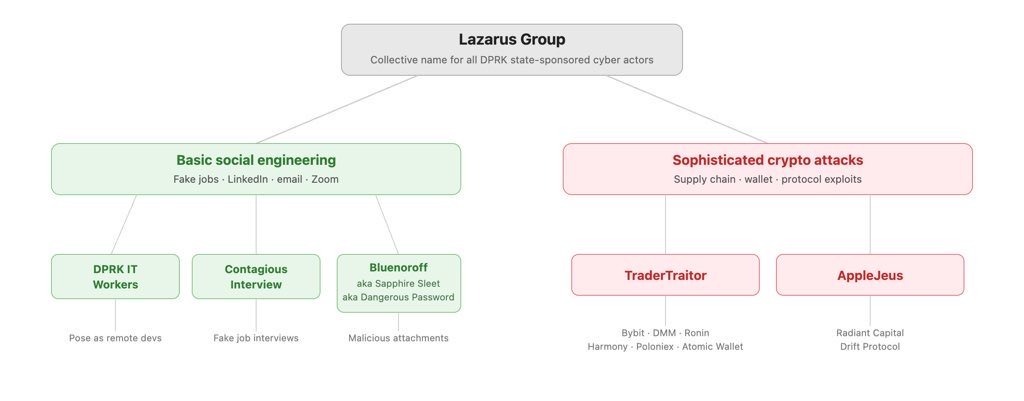
  There are two types of DPRK attack vectors, one more sophisticated than the other. Source: ZachXBT
Comments

All Comments

Recommended for you

  • Trump: Bombs Will Explode if Ceasefire Agreement Expires

    On April 20, according to PBS, U.S. President Trump stated on Monday that if the ceasefire agreement with Iran expires on Tuesday, there will be a large number of bombs exploding. Trump made this remark during a call with White House reporter Liz Landers, focusing on the issue of the Iran war, while a U.S. delegation was preparing for further peace negotiations. When asked whether Iran would still participate in the talks scheduled to take place in Islamabad, Trump replied, "I don't know. I mean, they should show up. It's arranged. We'll see if they come. If they don't, that's fine too." When asked about his expectations for the negotiations, Trump stated, "Very simple, Iran absolutely cannot have nuclear weapons."

  • U.S. Vice President Vance and Delegation to Arrive in Islamabad Today

    On April 20, according to the New York Post: U.S. Vice President Vance and the American delegation will arrive in Islamabad today.

  • BitMine Increases ETH Holdings by Over 100,000, Total Holdings Exceed 4.97 Million ETH

    As of April 19, Eastern Time, BitMine's total cryptocurrency and cash holdings, including the 'Moon Landing Plan,' amount to $12.9 billion. BitMine holds 4,976,485 ETH (an increase of 101,627 ETH from last week), which represents 4.12% of the total Ethereum supply of 120.7 million ETH. Additionally, it holds 199 BTC, shares in Beast Industries worth $200 million, $107 million in Eightco Holdings (NASDAQ: ORBS), and $1.12 billion in unsecured cash. As of April 20, 2026, the total amount of staked ETH by BitMine is 3,334,637 ETH, valued at $7.7 billion based on a price of $2,301 per ETH.

  • Strategy Acquires 34,164 Bitcoins for $2.54 Billion Last Week

    On April 20, Strategy purchased 34,164 Bitcoins last week for a total of approximately $2.54 billion, at a unit price of about $74,395, achieving a 9.5% return on Bitcoin from 2026 to date. As of April 19, 2026, Strategy holds a total of 815,061 Bitcoins, valued at approximately $61.56 billion, with a unit price of about $75,527.

  • Binance Wallet to Launch 46th TGE Project OpenGradient (OPG)

    On April 20, Binance Wallet will launch the 46th exclusive TGE project OpenGradient (OPG). The subscription period is from April 21, 17:00 to 19:00 (UTC+8), and users must participate using Binance Alpha Points and meet the corresponding qualifications. According to the official announcement, OPG tokens will be available for collection and trading starting at 19:00 (UTC+8) on the same day. Additionally, 23,000,000 OPG tokens are reserved for future activities, with specific rules to be announced later.

  • CoinShares: $1.4 Billion Inflows into Digital Asset Investment Products Last Week

    On April 20, CoinShares reported that inflows into digital asset investment products reached $1.4 billion last week, marking the highest weekly inflow since January and achieving positive growth for the third consecutive week. Bitcoin saw inflows of $1.116 billion, bringing the total inflows for the year to $3.1 billion. The price of Bitcoin has surpassed the $76,000 mark, indicating a significant technical breakthrough after two months of range-bound trading. In contrast, inflows into Bitcoin short products were only $1.4 million, suggesting that while there is still hedging demand, it remains limited. Ethereum attracted $328 million in inflows, the strongest week since January, bringing its total inflows for the year to $197 million, while XRP and Solana recorded outflows of $56 million and $2.3 million, respectively.

  • Sources: Bank of Japan Unlikely to Raise Interest Rates in April Meeting

    On April 20, sources familiar with the Bank of Japan's thinking revealed that the central bank is unlikely to raise interest rates next week. The diminishing hope for a swift end to the Middle East conflict has left Japan's economic and price outlook fraught with uncertainty. Although the final decision still carries some uncertainty and will depend on the progress of peace negotiations between the U.S. and Iran, the sources indicated that the bank prefers to maintain the status quo this month to allow more time to assess the impact of the conflict. One source stated, 'Given the current level of uncertainty, the Bank of Japan may consider it feasible to hold steady this month.' Another source echoed this sentiment. A third source noted that the Bank of Japan is unlikely to raise rates, as the market has already fully priced in the possibility of no rate hike this month. These sources mentioned that even if the Bank of Japan keeps rates unchanged next week, it is likely to signal readiness to raise rates as early as June, given the escalating inflationary pressures.

  • Hong Kong SFC Announces New Regulatory Framework for Trading Tokenized Investment Products in Secondary Market

    On April 20, the Hong Kong Securities and Futures Commission (SFC) announced a new regulatory framework to promote the trading of tokenized investment products recognized by the SFC in the secondary market, aiming to enhance digital asset trading activities in Hong Kong and support the further development of the ecosystem. The first batch of products is expected to primarily consist of tokenized money market funds. The SFC will review the operation of these products and will consider expanding the range of products in due course.

  • Hackers impersonated eth.limo team to hijack its domain: Post-mortem

    EasyDNS CEO Mark Jeftovic said the social engineering attack was highly sophisticated and the company is conducting further investigation to determine how the breach occurred.

  • Saylor teases 'bigger' BTC buy days after floating semi-monthly dividends

    Strategy’s Michael Saylor posted “Think Even Bigger” on Sunday, coming just a week after it disclosed $1 billion of Bitcoin buying.