

Cointime

Download App
iOS & Android

Tokenization makes finance more efficient but introduces risks: IMF

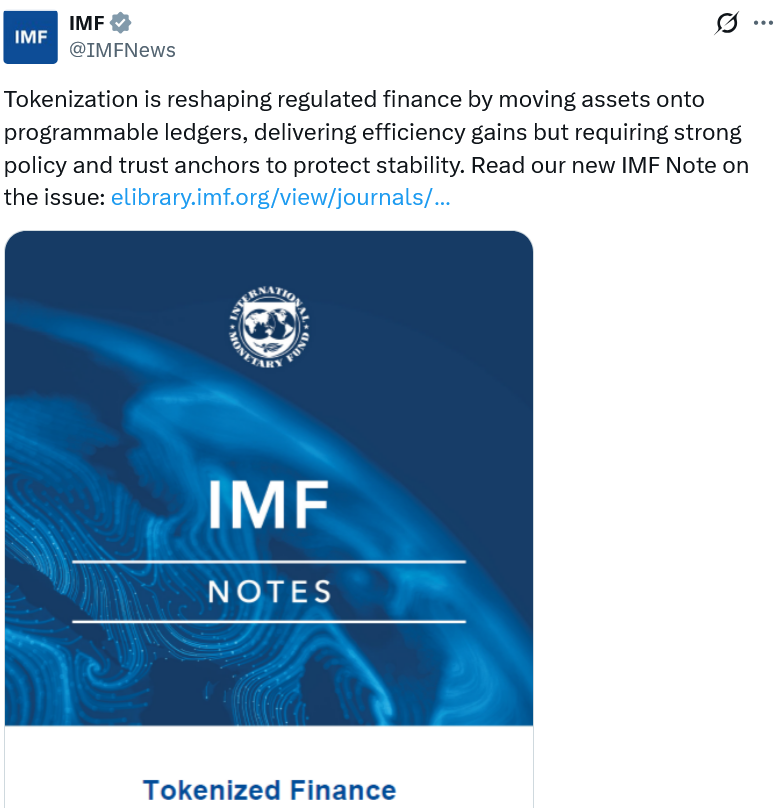
The International Monetary Fund said tokenization has the potential to remove friction and boost transparency in finance, but warned that the technology could also create challenges that affect financial stability.

"The net effect of tokenization on financial stability is uncertain,” the IMF said in a 23-page report on Thursday, stating that “atomic settlement and enhanced transparency reduce some traditional risks, but speed and automation introduce new ones.”
  Source: IMF

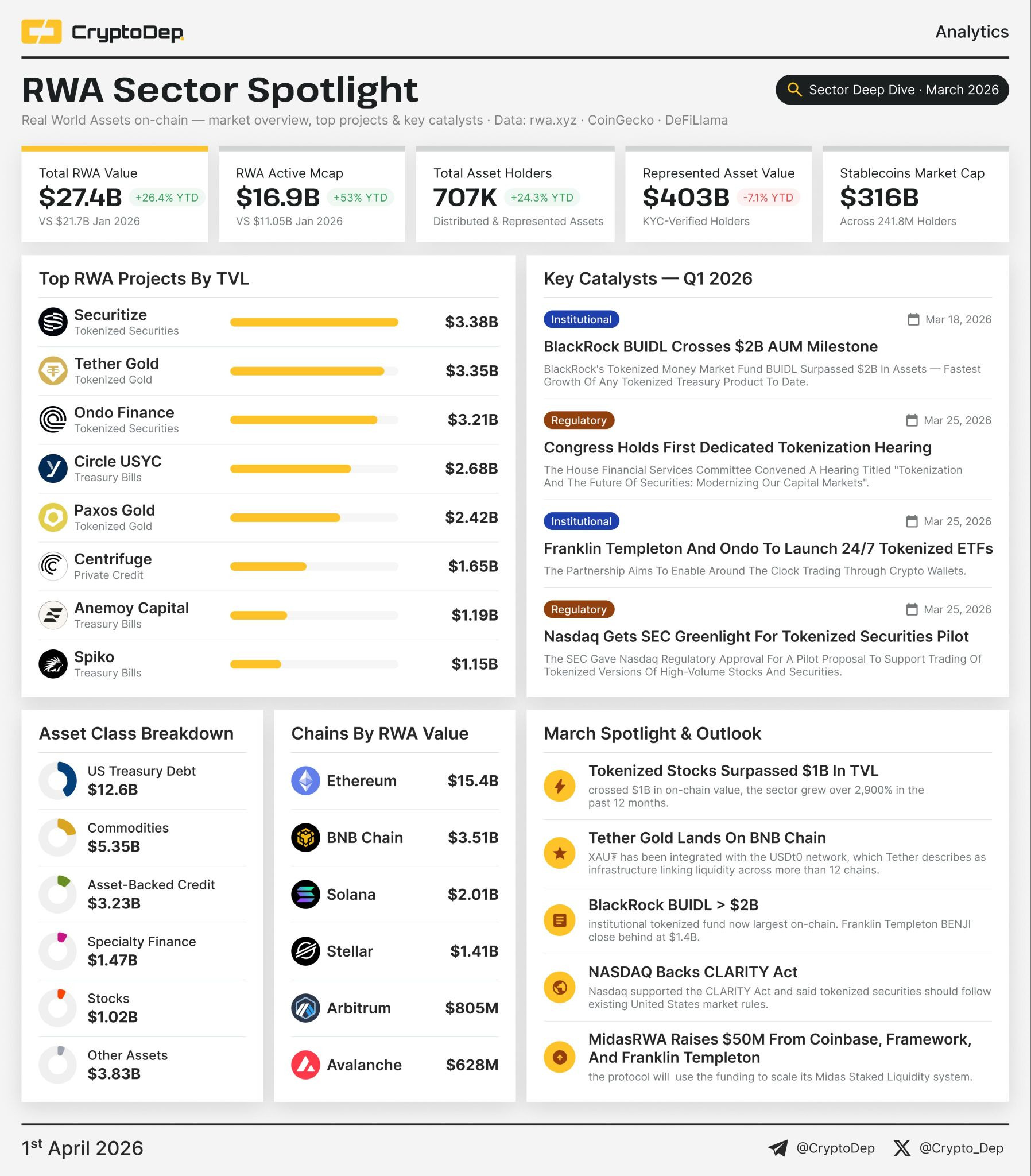
More than $27.6 billion worth of real-world assets, minus stablecoins, is currently tokenized onchain, data from RWA.xyz shows. Boston Consulting Group estimated in 2022 that the tokenization market could rise to $16 trillion by 2030, while McKinsey & Co in 2024 predicted a more conservative $2 trillion over the same time frame.

The IMF acknowledged that tokenization expands how securities and other financial products are issued, traded, settled and managed but said it shifts risks from the banking system to shared ledgers and smart contract code.

“Stress events in tokenized markets are likely to unfold faster than in traditional systems, leaving less time for discretionary intervention."

The agency also said tokenization offers opportunities in emerging markets, such as faster cross-border payments and financial inclusion but added that it “raises the risk of volatile capital flows, rapid currency substitution, and erosion of monetary sovereignty.”

Wall Street advocates for tokenization

Blockchain tokenization has been pushed by Wall Street leaders such as BlackRock CEO Larry Fink, who is among those seeking to tokenize everything from stocks and bonds to money market funds and real estate.

The biggest RWA tokenization platform by total value locked is Securitize — the tokenization platform behind the BlackRock USD Institutional Digital Liquidity Fund — at $3.38 billion, according to CryptoDep, citing data from April 1.

Tether Gold and Ondo Finance are close behind at $3.35 billion and $3.21 billion, respectively.
  Source: CryptoDep

The New York Stock Exchange’s parent, Intercontinental Exchange, is also taking action, announcing in January that it would launch a tokenization platform for 24/7 trading and instant settlement of stocks and exchange-traded funds with a blockchain post-trade system.

However, the IMF said legal challenges present another obstacle, stating that without legal clarity over ownership records and settlement finality, tokenized markets risk being “fragmented and peripheral.”

The crypto industry has been developing solutions to address this problem, such as the Ethereum ecosystem’s ERC-3643 permissioned token standard, which ensures that only certain investors have access to tokenized products.

Coinbase Asset Management launched tokenized shares for the Coinbase Bitcoin Yield Fund on Ethereum layer 2 Base on March 20, with the help of financial services firm Apex Group, which implemented the ERC-3643 standard to ensure that tok


Comments

All Comments

Recommended for you

  • U.S. July Nonfarm Payrolls Fall by 23,000, Missing Market Expectations

    On August 7, U.S. nonfarm payrolls decreased by 23,000 in July, compared with market expectations of an increase of 80,000, and the previous value was an increase of 57,000.

  • US May and June Nonfarm Payroll Additions Revised Down by 103,000 Combined

    On August 7, the US Bureau of Labor Statistics: May nonfarm payroll additions were revised down from 129,000 to 63,000; June nonfarm payroll additions were revised down from 57,000 to 20,000. After the revisions, the combined additions for May and June were 103,000 lower than previously reported.

  • U.S. Rate Futures Market Sees Lower Odds of Fed September Hike

    On August 7, the probability of a Fed rate hike in September as priced by U.S. interest rate futures declined.

  • New York Gold Futures Top $4,400 per Ounce

    New York gold futures topped $4,400 per ounce, up 2.36% on the day.

  • Japan Finance Minister: FX Market Affected by Moves Not Driven by Actual Demand

    Japanese Finance Minister Satsuki Katayama said she and U.S. Treasury Secretary Bessent agreed that the foreign exchange market has been affected by moves not driven by actual demand.

  • BTC Breaks Through $65,000

    Market data shows BTC has broken through $65,000, currently reported at $65,007.44, with a 24-hour increase of 0.6%. The market is highly volatile, please exercise risk control.

  • Brent Crude Drops 2.00% Intraday to $81.07/Barrel

    Brent crude oil fell 2.00% during the day, now at $81.07 per barrel. (Jin Shi)

  • Trump: Data Centers May Be More Important Than Oil

    August 7 news, U.S. President Trump said in an interview with Punchbowl News, "I saw the other day that Texas seems to be opposed to building data centers. I think that's a mistake. I'm not taking a position—I just think it's a mistake, because there are other communities that want to build data centers. When a community is willing to accept data centers, it means a lot of money will flow into that community. I don't think they're ugly. Some of the data centers I've seen are the most incredible buildings I've ever seen. They are very important to the economy. If Texas says no to data centers, that's a mistake, because data centers may be more important than oil."

  • Trump to Meet with Mining Executives

    On August 7, according to CCTV International News, US President Trump will convene executives from some of the world's largest mining companies at the US State Department on August 7 local time, in an effort to take action to 'secure critical mineral supplies for the US and its allies.' Reuters reported that the US urgently needs critical minerals to replenish weapons inventories depleted during the war against Iran. During the more than five-month war with Iran, the US military expended large quantities of precision-guided missiles and air defense interceptors. US defense officials and lawmakers have warned that given existing production capacity constraints, replenishing some stockpiles could take years—although the Trump administration has denied reports of a so-called 'severe shortage of ammunition stockpiles.' According to Pentagon officials and defense companies, supplies of minerals such as rare earths, tungsten, germanium, and scandium are essential for manufacturing precision-guided missiles, fighter jets, armored vehicles, infrared sensors, and other advanced weapons systems. Expected attendees include industry giants such as global mining giant Rio Tinto Group, Australia's BHP, US Freeport-McMoRan, US Mountain Pass Materials, US Rare Earths, US Energy Fuels, and Canada's Metals Company. According to sources, the Trump administration plans to announce multiple deals and memorandums of understanding.

  • US Regulators Systematically Review Chinese AI Firms' Third-Country Computing Power Leasing

    August 7 news, according to Bloomberg, people familiar with the matter revealed that the U.S. government department responsible for investigating chip export control violations is reviewing Chinese AI companies' leasing of computing power in third countries to obtain Nvidia advanced chips.