

A cross-chain bridge is a protocol that connects blockchains and testnets and enables users to transfer their tokens, data and other assets from one network to another, including both 1 and 2 level chains and sidechains. It also allows transfer of smart contract instructions between blockchains.
They may differ in protocol or execution models, but any bridge aims at building a convenient and secure connection, helping avoid complications with digital assets transaction deployment and reduce transaction fees on non-scalable blockchains, and allowing dApp deployment on several platforms simultaneously to raise profit. Also custom cross-bridge dApps are created and applied to make the work easier.
An example of how it works:
Tokens are transferred to the bridge from one of the chains. Having received the asset, the bridge creates a wrapped token copy on the other blockchain and sends it to the appointed wallet address. Then the wrapped token can be sent back to the bridge, in the case of asset withdrawal.
The tokens will be burnt after the transfer (in the initial chain) or withdrawal, and in the latter case the tokens will be unblocked and become available for the users on the initial blockchain.
How do cross-chain bridges help?
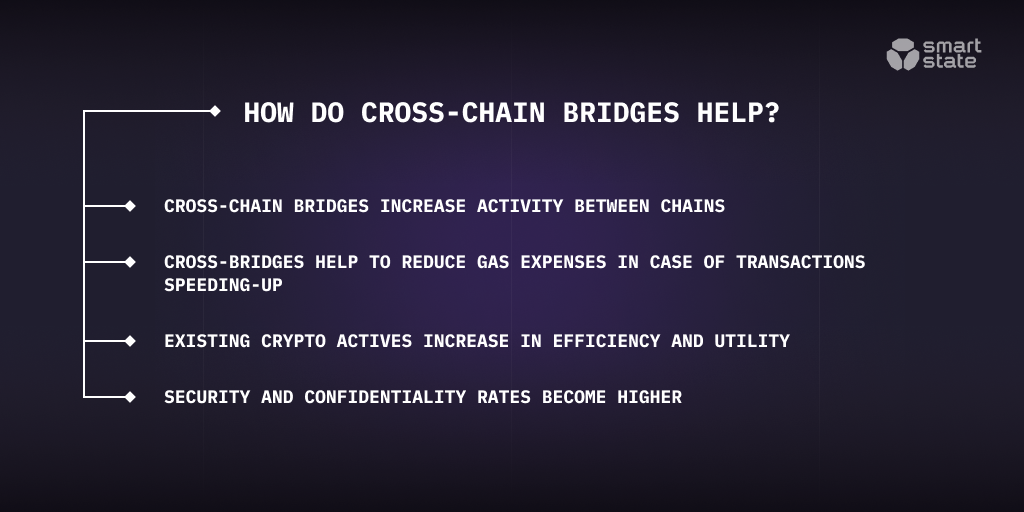
How do cross-chain bridges help?
- Cross-chain bridges increase activity between chains, which offer diversified asset compliance, raising the level of security. Without them, investors have to pay higher commission fees and spend extra time dealing with numerous stock exchanges
- Cross-bridges help to reduce gas expenses in case of transactions speeding-up
- Existing crypto actives increase in efficiency and utility
- Security and confidentiality rates become higher
When are cross-bridges mostly used?
- To make token transfer between the Ethereum and L2 network, equipped with compatible assets (it can be for simplifying the investment process, withdrawal of assets or reducing time or operational complexity) more convenient
- When the commission fees on Ethereum are too high
- Operating with thin capitalization assets, supported by single blockchains, and an increased number of assets, supported by the chain bridges
- When investors are willing to use cross-chain bridges investing in newly created chains, aiming at reaching a head mine, but have to evaluate the security mechanisms of these new chains
- In case of arbitral trading at Optimism, Arbitrum, Polygon, etc.
Cross-chain bridge types
There are two major groups that cross-chain bridges can be divided into:. ‘centralized’ and ‘decentralized’. Each has its pros and cons. The major difference between these two types of bridges lies in the difference of validator motivation, in other words, the way how the correctness of validator activity during the transaction process is enforced.
Centralized cross-chain bridges. Users, involved in operations with a centralized cross-chain bridge, have to confide their data and assets to a third party (the bridge owner). This party acts as a mediator or agent, receives users’ assets from one chain and creates wrapped tokens in another.
Pros:
- time-saving
- easy and convenient for newbies, who are not yet familiar with the subject matter
Cons:
- Users depend on the third party and have to trust them all the rights to operate with their assets and data. So there is always a high possibility of scam or other criminal activity.
Decentralized cross-chain bridges. These feel more secure since the user doesn’t have to put their thrust in a third party. In plain words, a decentralized cross-chain bridge has some form of a pool of assets, operated by a group of validators. The more validators come into action, the higher the decentralization is. The user transfers assets into the pool, the validators check the transaction and then the pool mints wrapped tokens in another chain.
Pros:
- higher security and privacy. There is no single person or party to control assets and activity
Cons:
- very attractive for attackers. Decentralized cross-chain bridges suffer from attacks much more often
Categories of Cross-chain Bridges
Cross-chain bridges fall under one of the following categories:
- One asset and two (or more) chains. Only one type of coins can be transferred from one blockchain to another by means of this bridge (for instance, WBTC can transfer BTC only from Bitcoin network to Ethereum)
- A number of assets and two chains. These bridges allow users to transmit various types of currencies between two appointed chains (for instance, Rainbow is able to send ETH and various ERC-20 from Ethereum to Near). Also there are such bridges, like Optimism, which bind together Ethereum and popular L2 solutions
- A number of assets and one chain, connected to several others. A number of various tokens can be transmitted by means of those bridges (for instance, Wormhole)
- Several assets and several chains. Such bridges can be integrated with various dApps to achieve additional, extra liquidity from several networks (for instance, RenBridge, executing Ren protocol, which connects BTC, BCH and the like with a number of chains, including Avalanche)
- A number of assets, several chains and one application. This type of bridge can be called the most flexible and useful one, as long as they can be connected to almost any blockchain as additional modules. However, they can suit only one specific application type (stock exchanges, credit services, etc.) (for instance, Multichain (formerly Anyswap)).
How to choose the best cross-chain bridge
It is not at all easy to find the best chain bridge in a wide range of similar structures, resembling one another from the first glance. However, some vital criteria can help to single out the better ones.
- Security. First and foremost criterion, which everyone connected with assets and data is searching for. The higher is the security rate and attack repulse and resistance statistics, the more reliable bridge is
- Reasonable transfer costs compared to the transaction speed
- Reasonably high liquidity rate
- Stable TVL with a reliable execution environment, improving steadily without harsh booms and boosts. It is also necessary in this case to take into account the method of testing internetwork data and the method of internetwork fund operating
It goes without saying that the users’ feedback and high ratings in popular serious crypto journals add ‘confidence points’ to the bridge.
About SmartState
Launched in 2019 and based in Dubai, SmartState is one of the leading DeFi security auditing firms. We conduct security tests and check the code core, smart contracts and blockchain for all types of errors, vulnerabilities and other issues.
Although SmartState gave a start to operations with smart contract auditing of DLT-projects, from the very beginning, we made our services surpass the classic purview of smart contract audit and security testing. We specialize in manual testing, so the SmartState’s tech team of white-hat security professionals measure up a project’s git and offer guidelines and recommendations for its further advancement. Security audit reports review the threats and vulnerabilities with which codebases may be exploited in the future, as the network achieves scalability and expands to accommodate more use cases and functionality.


All Comments