


Soulbound token (SBT), also known as non-transferable token, is a type of NFT asset that is issued in a single copy and is permanently linked to a single blockchain address. How does it work? Is it any good? Let’s take a look!
The SBT token cannot be sent or transferred to another blockchain address. A non-transferable token is only issued once and is only accessible to the owner of the address.
The non-transferable token is a component of the Web3 technology direction and serves as a link between users, blockchain services, and the DAO.
Although there are few real-world examples of SBT use, it has the potential to become a popular way to confirm the identity or other data of its owner.
What is a soulbound token (SBT) in simple words?
Soulbound is a non-fungible token that can only be sent to one address and cannot be moved or sold. An NFT of this type grants the owner exclusive rights and opportunities. The token can also be used to confirm compliance with any conditions and as proof of community involvement.
The idea of SBT belongs to the founder of Ethereum Vitalik Buterin, who first outlined it in his blog in January 2022.

Buterin drew attention to the practice of releasing rare artifacts that can only belong to one player in the online game World of Warcraft. He proposed that this principle be applied to non-fungible tokens: NFT can only be issued for a specific blockchain address and must be permanently linked to it.
To obtain such a token, you may be required to fulfill certain conditions or tasks. In exchange, SBT can offer its owner exclusive features or benefits. A soulbound token, for example, can be used to confirm the existence of a diploma of education or a certificate of course completion, or as a “entrance ticket” to a club or community.
Buterin developed the idea of SBT in a new article entitled “Decentralized Society: Finding Web3’s Soul”, which was published in May 2022 together with economist and social technologist Glen Weyl, lawyer Puja Ohlhaver.
The work describes a model of a new decentralized digital society based on Web3 technologies, blockchain, and non-transferable tokens, with the creation of an analogue of the “social rating” in China and “digital karma.”
The examples of soulbound tokens
Buterin used the POAP project, which produces exclusive NFT for participants of thematic events, as an example of SBT in the same publication. Adidas hosted one of these giveaways, releasing a collection of POAP tokens in November 2021.

Following that, the company used these tokens to gain access to the NFT collection created in collaboration with the projects Bored Ape Yacht Club (BAYC), GMoney, and PunksComic. However, Buterin pointed out that POAPS are flawed due to the possibility of resale.
In September 2022, Binance Account Bound was the first non-transferable token released by the Binance exchange. (BAB). A BAB can be created by any user who has completed identity verification (KYC) on the platform. The SBT is then bound to the address and serves as a confirmation certificate that third-party applications can use. If desired, the token’s owner may destroy it and re-issue it after 72 hours.
Where are soulbound tokens (SBT) used?
SBT technology is not yet widely used in the cryptocurrency industry. However, possible applications are mentioned above in the work of Buterin, Weyl, and Ohlhaver.
Social rating and lending
In the future, it will be possible to obtain a cash loan or another type of loan based on social rating and reputation. It can be written numerically in SBT, which will serve as an indestructible way for the borrower to prove his credit history. In the future, specialized SBT-based products may also appear in DeFi applications.
DAO and Communities
SBT can be used as an integral part of the management mechanism in decentralized organizations (DAO). One of these application options, based on SBT tokens, is already being proposed for inclusion in an Ethereum-based second-level solution called Optimism.
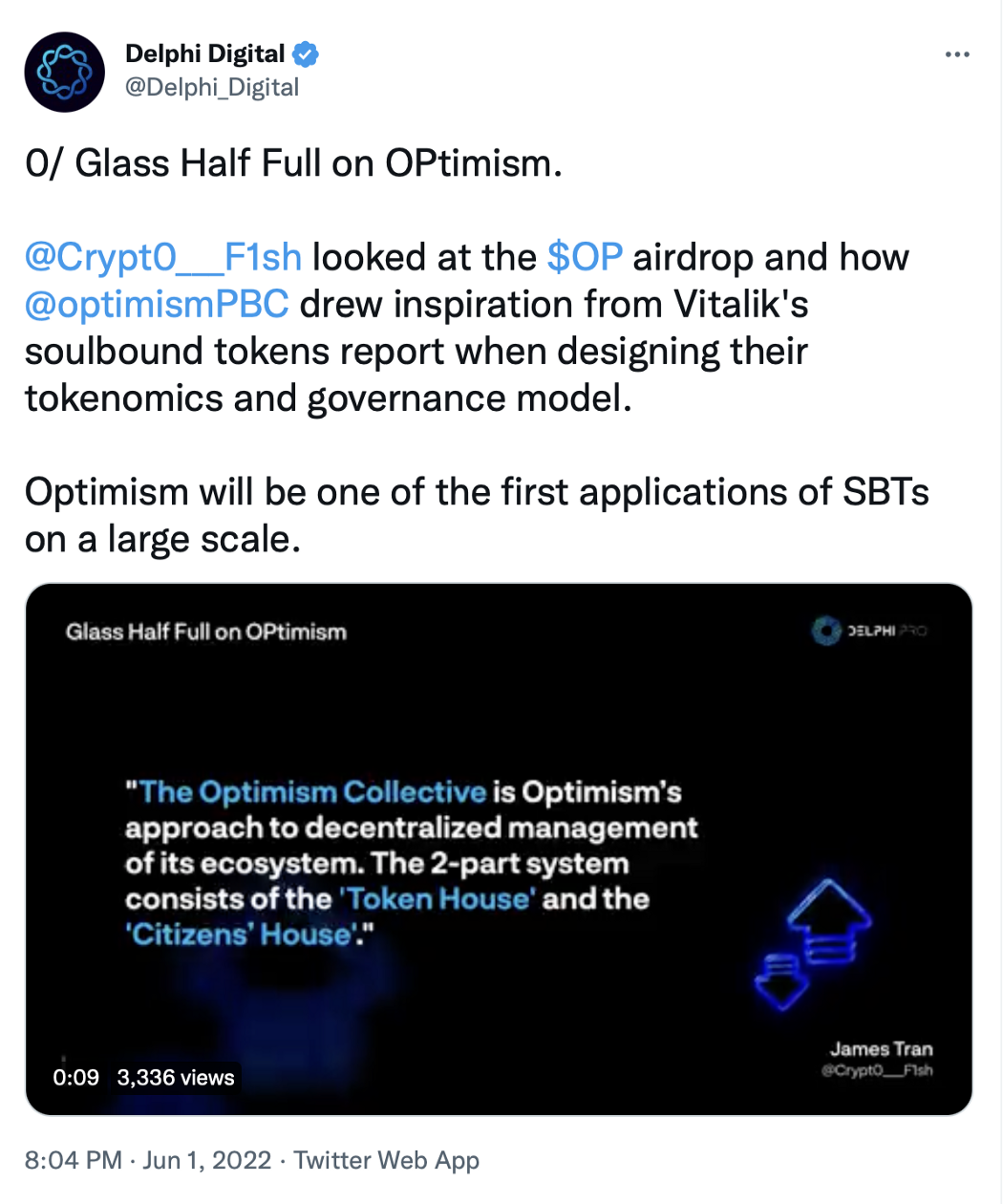
According to the proposal, non-transferable tokens can serve as a way to access separate “chambers” of the DAO of Optimism, each with its own functions and limitations.
Airdrops and marketing
Airdrops, a popular mechanism in the crypto industry for encouraging and activating the community by distributing cryptocurrencies, can now be fine-tuned thanks to soulbound tokens. Additionally, SBT can be used for other marketing activities, as demonstrated by Adidas, which used soulbound tokens as a “VIP ticket.”
Ownership
Creators of digital art and content can create SBT as a certificate confirming authorship of an item for collectors and ordinary buyers. This method of application is not limited to the art industry and can be used in any situation where it is required to confirm the identity of the owner, for example, in a diploma of education or a certificate of ownership of real estate.
Proof of identity
The use of soulbound tokens can make it easier to gain access to DeFi market products and Web 3 services. The user can only confirm his identity once in one application, then issue SBT as confirmation and use it in any other applications that recognize this method of verification.
The risks to use soulbound tokens (SBT)
The use of cryptocurrencies and blockchain applications is fraught with dangers such as hacking, identity theft, protocol errors, and user inattention.
In addition to the potential benefits, the use of soulbound tokens may pose some risks, the magnitude of which is unknown. One possible risk is intentional hacking of the address to which SBT is linked in order to use its properties as the owner.
Uncertain and novel risks include vectors of user privacy attacks, abuse of social rating systems, communities, and DAO built on or using non-transferable tokens.


All Comments