

Cointime

Download App
iOS & Android

What Are Cryptocurrency Trading Bots and How Do They Work?

This digest breaks down what is bot trading, how it works and whether you should dive in. Moreover, it unveils the definition of trading bot types along with their pros and cons. Read on if you want to understand the automated trading essentials.

What Are Crypto Trading Bots?

By definition, a crypto trading bot or robot is a piece of software working automatically. Unlike traders, bots perform automatically when pre-built conditions are satisfied. Operating with almost no downtime, these bots analyze the market based on technical indicators, price levels and volatility to decide whether to trade. Which is why such trading systems are widely used on the crypto market and take up to 80% of the whole volume traded.

How Does a Trading Bot Work?

Reliable trading bots revolve around a clear trading strategy, which should be fully formalized — the rules for opening, maintaining, and closing trades are defined and programmed. In general, once a bot detects a trigger, it will either notify you or make a buy/sell decision based on the rules defined in advance. To monetize a trading opportunity, bots use the following steps:

  • Analyze market data
  • Evaluate market risks
  • Decide whether to buy or sell
  • Enter/close a trade

Most robots trade a 15-minute, an hour, or a daily timeframe, blindly following the pre-built algorithm. This way, bots completely eliminate the human factor and emotions. For example, the robot can check the price deviation from the set hourly interval and buy/sell the asset.

Even though complex robots use a wide range of tools to process a large number of crypto quotes and provide more accurate signals; as a result, some indicators dominate across various bots. A bright example is the Moving Average (MA) technical indicator.
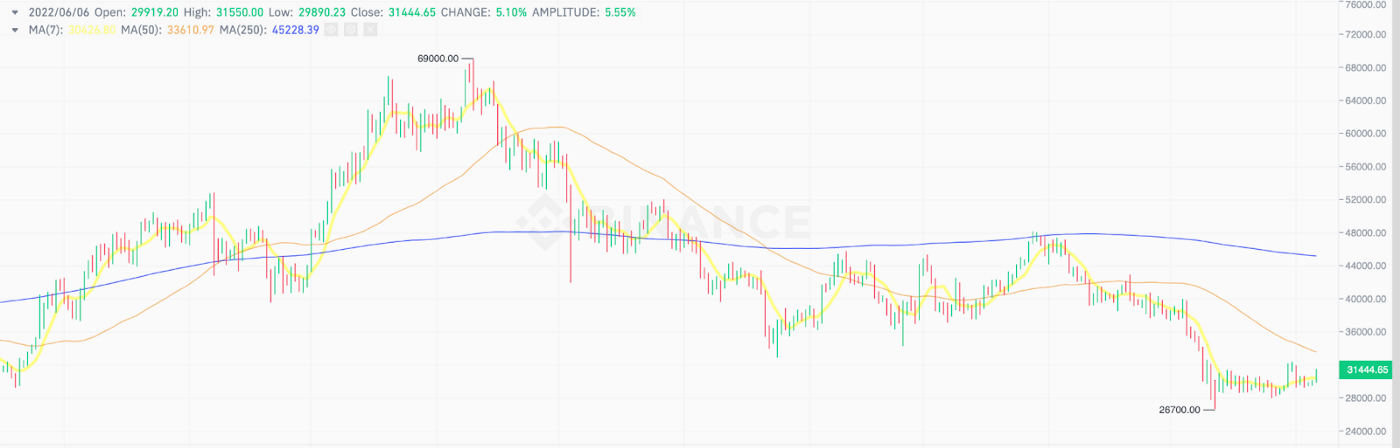
Alt: Moving average BTC

Most robots would buy an asset once its price falls below the average and sell once the quote crosses the average from above. The specific frame depends either on your risk management or the provider’s strategy. As a rule, robots with higher returns (hence, risks) use short frame moving averages like 7-day MA, shown yellow, while less risky robots stick to extended frames like the 50-day MA, shown orange, or the 250-day MA, shown blue.

Types of Bots

All crypto robots have pretty much the same backbone, but each robot has specific nuances that should be considered, as they vary in terms of if/then conditions set to execute trading strategies. Therefore, types of bots and types of trading strategies often correlate and are used interchangeably. The most common types of bots include:

  • Arbitrage bots. Arbitrage is a market opportunity based on price imbalances across markets. Simply put, buy lower and sell higher. Arbitrage bots monitor price changes automatically and enter a trade blazingly fast.
  • Trend bots. As the name states, these bots follow the main trend by evaluating an asset’s momentum. Rising trends cause long positions while market dips entail shorts.
  • Market Making bots. These bots focus on order book spreads to make profits. The logic is pretty straightforward — whenever an asset is traded actively, spreads widen. The bots monitor markets to spot the biggest spreads.
  • Lending bots. Bots lend assets to margin traders, assuming the latter will pay back the interest rate. The clear benefit is automation, as a trader can rely on software rather than setting parameters manually.

Some traders also address high-frequency trading (HFT) bots that can make thousands of deals per second, but such bots are hardly suitable for retail users. HFT bots must have a minimum ping — the time interval during which the signal sent from the operational server passes through the network to another server and comes back. Ideally, the servers should share adjacent locations, as a closer distance means a faster data transfer rate. Estimated expenditures can hit multiple digits and fit trading organizations rather than stand-alone traders.

Advantages of Crypto Trading Bots

Trading robots have multiple benefits to offer. Here’s the list of key advantages.

  • Bootstrap your efficiency. Robots use backtesting tools, data insights & analysis features, advanced risk evaluation, and more to maximize your trading efficiency.
  • Trade 24/7, no downtime. Algorithms do not need any rest and work continuously with no need for breaks, which means they monitor markets and have a higher chance to monetize opportunities you’d otherwise miss.
  • Tame your emotions. Imagine controlling the main risk related to trading. Bots follow pre-programmed patterns to trade automatically, with no strings attached.
  • Trade in a simple way. You don’t have to be a crypto expert in using bots, as most of them have already analyzed and processed tons of data on your behalf. This is a ready-to-go solution if the trading bot provider is reliable.

Disadvantages of Crypto Trading Bots

There are three core factors to consider when it comes to automated trading software disadvantages.

  • Marginal returns might not be the best pick for a veteran trader
  • Some trading bots are designed poorly, resulting in losses for a trader
  • A bigger part of the market already uses bots and you can rarely outperform larger players like exchanges.

Most automated software providers do not provide valuable products, disguising real returns under loads of formal numbers (which is true but is none of the interest to a trader). However, that’s not the case for the whole market. To avoid this risk you might want to deal only with established brands and check your potential profits in advance. Once you calculate returns, you should also jot down fees. The difference would be your tangible profit.

Are Crypto Trading Bots Worth It?

Once you already understand what bot trading is, you might wonder whether bots actually yield returns. The answer is yes if your bot provider is reliable and trustworthy. The trust issue is a big concern for the whole Web3 community, and bots are not an exception, as many providers gloss over lack of returns or inefficient trading strategies.

To pick a good bot, you might want to have a look at some established trading software providers like 3Commas.

FAQ

Are Trading Bots Actually Profitable?

Not all bots are designed equal, as profits trading, bots depend on the strategy picked. Some reliable bots like 3Commas can make money steadily, especially over the long run.

How Much Does a Trading Bot Cost?

The price majorly depends on functions provided by the bot — more functions entail a higher price. On average, a monthly subscription for a reliable bot starts from $15, while lifetime offers vary significantly across the board.

Is a Trading Bot Worth It?

A trading bot can be valuable if you use several strategies and allocate your capital accordingly. Depending on your initial capital, bots can make huge annual profits on your behalf.

What Is The Best Trading Bot?

Depending on your needs, some bots fit better than others. However, you might want to narrow down your selection to reliable bots only. An example of such a bot is 3Commas.

How Do Bots Make Money?

Bots implement various technical indicators and algorithms to check the market and adjust their behavior accordingly, based on the pre-built logic sets. A wide range of tools allows bots to trade quite effectively, making money in an automated manner.

How Do You Set Up a Trading Bot?

Settings depend on the software provider and may vary slightly across the market. Generally, you should visit the website and follow the clear instructions provided.

How Do You Make a Trading Bot?

You can either build a bot from scratch all by yourself or use presets to avoid coding requirements. For example, 3Commas allows two ways of setting preset bots — adjust their strategies based on your needs manually or automatically.


Comments

All Comments

Recommended for you

  • Bank of Japan Governor Kazuo Ueda: No Immediate Need for Rate Hike

    On April 28, Bank of Japan Governor Kazuo Ueda stated that there is currently no immediate need to raise interest rates. However, if the current supply shocks lead to secondary ripple effects, a rate hike may be necessary. (Jin Shi)

  • Central Political Bureau Meeting: Comprehensive Implementation of 'AI+' Initiative to Develop New Intelligent Economy and Improve AI Governance

    On April 28, the Central Political Bureau of the Communist Party of China held a meeting to analyze and study the current economic situation and economic work. The meeting emphasized the need to accelerate the construction of a modern industrial system and maintain a reasonable proportion of manufacturing. It called for deepening the construction of a unified national market and addressing 'involutionary' competition. The meeting also announced the comprehensive implementation of the 'AI+' initiative to develop a new intelligent economy and improve AI governance. Furthermore, it highlighted the need to deepen state-owned enterprise reform, systematically respond to external shocks and challenges, enhance the security of energy and resource guarantees, and address various uncertainties with the certainty of high-quality development. (Dongxin News Agency)

  • ByteDance, Zhiyu, and Alibaba Selected Among Top 10 AI Influencers by TIME

    On April 28, TIME announced its list of the '10 Most Influential AI Companies of 2026.' Unlike a simple comparison of model capabilities, this list emphasizes the comprehensive shaping power of companies in terms of industry, technological pathways, and social impact. The selected companies include ByteDance, Amazon, Zhiyu, OpenAI, Alphabet, Meta, Anthropic, Alibaba, Mistral, and Hugging Face. Among them, three are domestic companies: ByteDance, Zhiyu, and Alibaba. (Dongxin News Agency)

  • Arthur Hayes: More Concerned About Fed Nominee Waller's Comments on Balance Sheet Than Short-Term Interest Rates

    On April 28, BitMEX founder Arthur Hayes spoke about the Federal Reserve at the Bitcoin 2026 conference, stating, "When Kevin Waller was nominated as the Fed's SEC chairman, everyone started to panic because during his tenure as a Fed governor— I believe from the 2008 financial crisis until the current president— he has been very critical of the Fed's massive balance sheet. He has publicly stated that he believes the Fed's balance sheet is too large and that he needs to find ways to shrink it while also being able to lower interest rates. Now, if you have read my articles, you know that I am a firm advocate of the idea that the quantity of money is more important than its price. Therefore, I am more concerned about his comments on the balance sheet than the direction of short-term interest rates. So, if the market believes that due to Waller's actions at the Fed, the liquidity of dollars circulating in the system will decrease, then they will be bearish on Bitcoin and other risk assets. This is the discussion we see in the media about a hawkish Fed emerging after Waller takes over in May. Now, I don't think so. I believe that essentially the Fed will replace reserves, treasury bonds, and repos and put them into the commercial banking system, and they will do this with the help of new regulations concerning how banks hold assets on their balance sheets and how much capital they need to hold against those assets. Finally, I think the most important point to understand about what Waller will or will not do at the Fed is that he has a very substantial hard constraint, which is that he needs to work with Treasury's Scott Bessen to ensure that any actions he takes regarding the Fed's balance sheet do not impair Bessen's ability to sell billions and trillions of dollars in bonds.

  • SEC Chair: Reg GG Crypto to Allow Private Sector Token Sales Soon

    On April 28, U.S. SEC Chair Gary Gensler stated in an interview at the Bitcoin 2026 conference that the agency will continue to advance other exciting initiatives, such as truly allowing companies to conduct on-chain experiments, build tokenized securities, and trade on-chain within the United States. We plan to release innovative exemption regulations in the coming weeks. Additionally, we will permit the private sector to raise funds through on-chain token sales, which we refer to as 'Reg GG Crypto.' These initiatives are in preparation and will be launched soon. Currently, there is a bill titled the 'Clarity Act' under consideration in Congress. We do need Congress to provide regulations in this area. We are ready, willing, and able to explain their regulations and translate them into rules that people can rely on and pursue their innovative ideas. It is important to emphasize that this is happening domestically in the U.S., so they do not have to go overseas. This is the core idea that truly matters here.

  • SEC Chair Discusses Clarity Act: Codified Law Provides Greater Assurance for the Future

    On April 28, during the Bitcoin 2026 Conference, SEC Chair Gary Gensler spoke about the Clarity Act, stating that the U.S. Securities and Exchange Commission has considerable operational flexibility under the regulations. However, we are constrained by existing authorities, which, despite some amendments over the years, fundamentally remain rooted in the framework established in the 1930s. This is why having a piece of legislation is so important; it can shield future developments from adverse impacts, allowing us to leverage new authorities and the flexibility provided by the Act. We can collaborate with the Commodity Futures Trading Commission to coordinate and clarify definitions, and further develop from there. But again, nothing provides greater assurance for the future than codified law, coupled with sound judicial opinions that engrave the provisions of the law in stone through the mechanisms of the entire court system. Therefore, all of this is very important, but we are focused on efforts to simplify processes, enhance efficiency, and assist innovators in their endeavors, enabling them to operate with certainty rather than being stifled by those who jealously guard the existing ways of doing things. However, we must ensure that we remain at the forefront of innovation in the United States.

  • Meta Prepares to Withdraw Acquisition of Manus; Investors Including Tencent Plan to Cooperate

    On April 28, the Wall Street Journal reported, citing informed sources, that after the Office of Foreign Investment Security Review under China's National Development and Reform Commission made a legal decision to prohibit foreign investment in the Manus project, Meta is preparing to withdraw from the acquisition deal. According to sources, if Meta proceeds with the withdrawal process, several former Asian investors in Manus, including Tencent, Sequoia China, and ZhenFund, have planned to cooperate.

  • US Spot Bitcoin ETF Sees Net Outflow of $263.2 Million Yesterday

    On April 28, according to monitoring data from Farside Investors, the US spot Bitcoin ETF experienced a net outflow of $263.2 million yesterday.

  • US Spot Ethereum ETF Sees $50.4 Million Net Outflow

    On April 28, according to monitoring data from Farside Investors, the US spot Ethereum ETF experienced a net outflow of $50.4 million yesterday.

  • Bank of Japan Maintains Interest Rate, Meeting Expectations

    On April 28, the Bank of Japan kept its target interest rate unchanged at 0.75% for the third consecutive meeting, in line with market expectations.