

Cointime

Download App
iOS & Android

Venture Capital Investments Into Blockchain Continue To Free-Fall: Report

Validated Media

Cointelegraph Research has analyzed all the deals and trends from venture capital in the blockchain industry during the fourth quarter of 2022. The second half of 2022 saw a dramatic decline in capital inflows across all five major sectors of the blockchain industry: decentralized finance (DeFi), centralized finance (CeFi), nonfungible tokens (NFTs), infrastructure and Web3. The first half of 2022 brought in just under $30 billion of investment, while the second half only saw $7.3 billion — a dramatic plunge.

As the crypto industry moves into 2023, Cointelegraph Research has looked at the data from its Venture Capital Database, which contains comprehensive details on deals, mergers and acquisition activity, investors, crypto companies, funds and more. Using this database, Cointelegraph Research crunches the numbers to find the most important trends in the industry. Its latest report explores Q4 2022 and how it relates to the broader picture of 2018 through 2022.

Investments declined starting April 2022

After the fallout from the collapse of Terra in the first part of 2022, the blockchain industry could not seem to attract venture capital back into investing in this industry as it did in 2021 and the start of 2022. There was $30.5 billion invested in 2021, and 2022 was on pace to double that — right up until April 2022, when everything began to decline. September saw a brief bounce in capital investment, but it did not sustain as the year ended, with the last three months staying below $1 billion in investments.
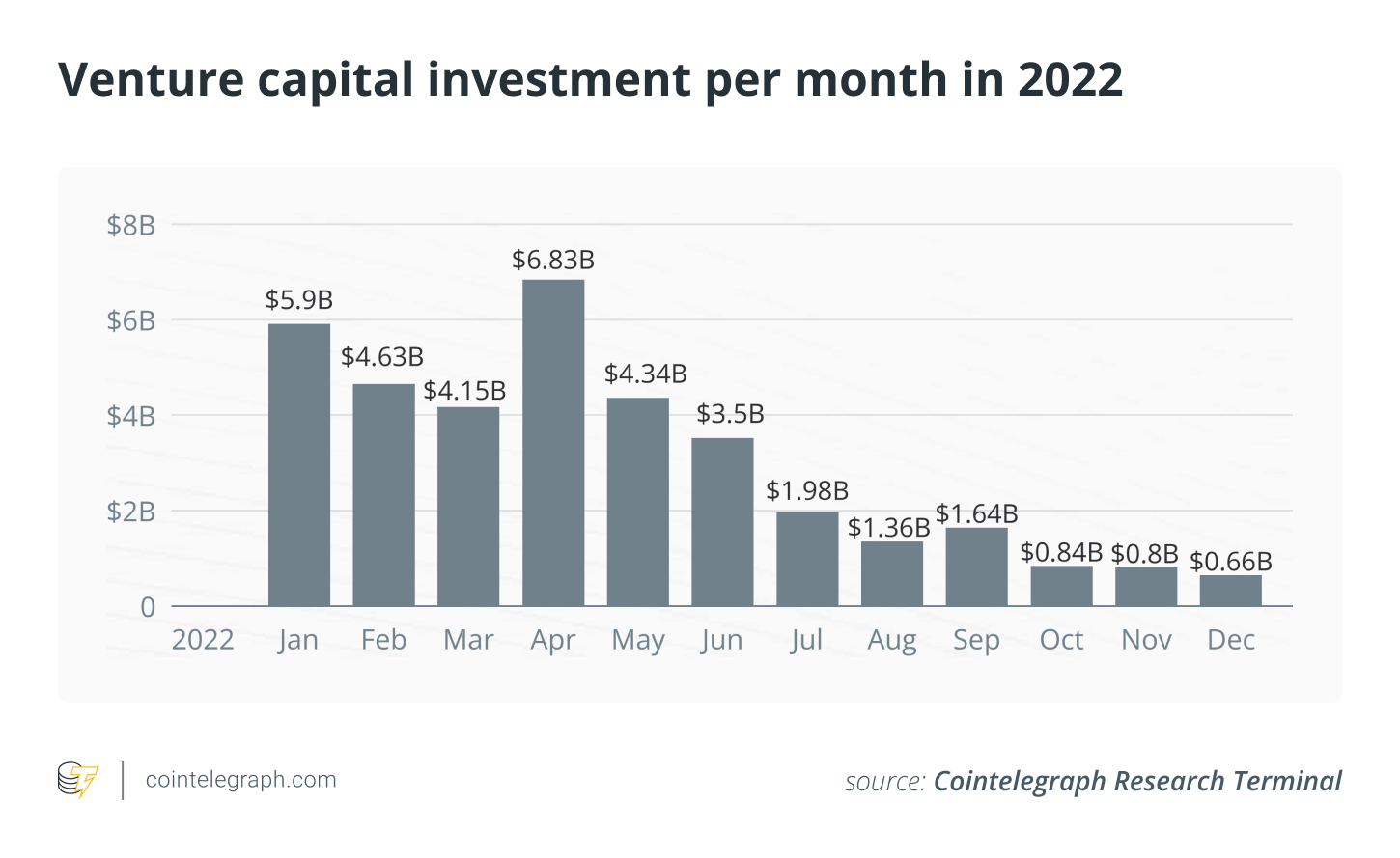
The number of deals also dropped considerably, down to just 182 in Q4. While previous months saw large deals that were always over the $100 million mark, there were only five in Q4 above $100 million. The focus for those 182 deals stayed within the Web3 sector — which comprises subcategories like metaverse, GameFi, identification and a host of others — followed by infrastructure and DeFi. NFTs and CeFi were the least popular in terms of the number of deals, but just looking at those numbers can be misleading.

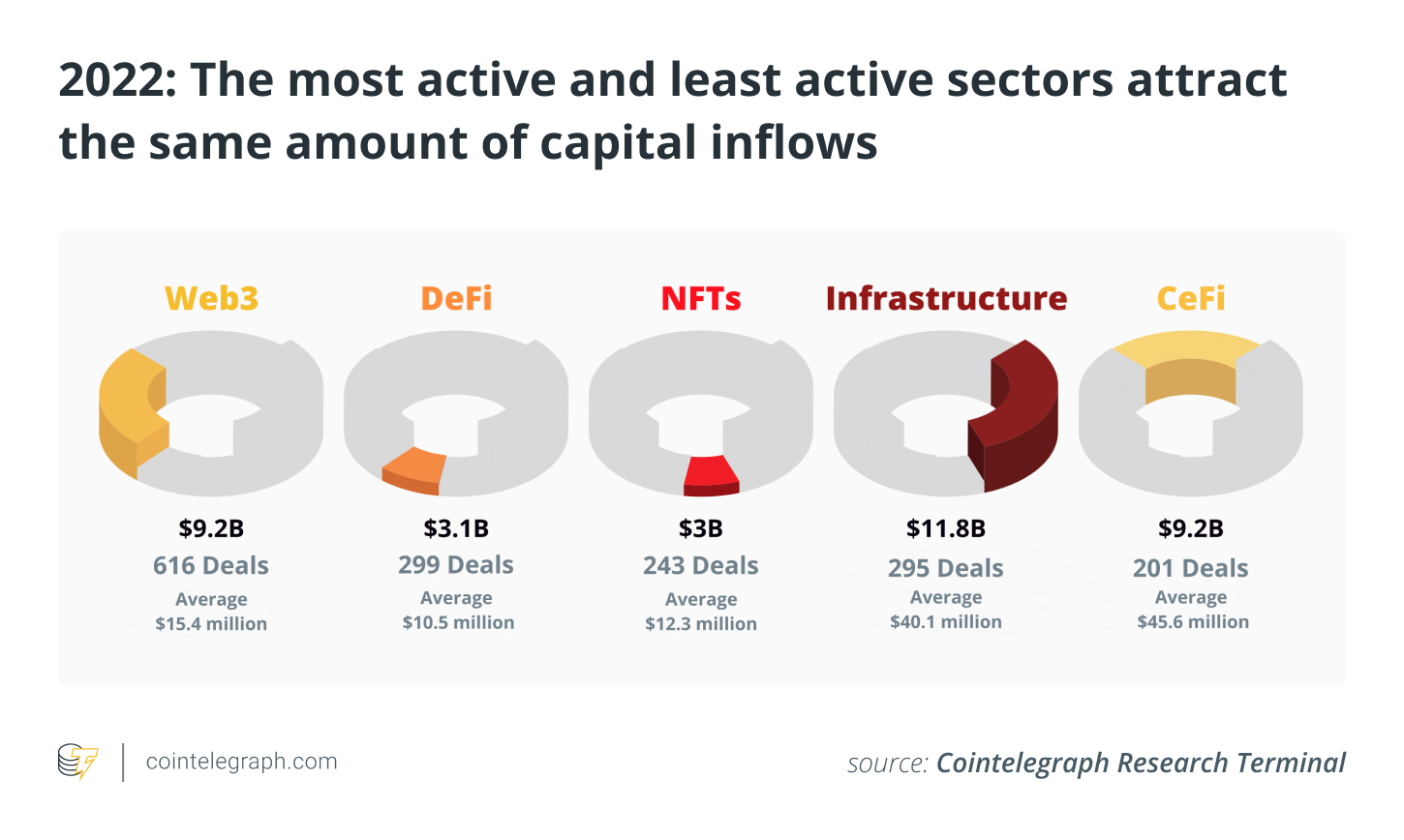
The most active and least active sectors tie for investment

Web3 was the most popular sector of the blockchain industry for investment, with 616 individual deals, while CeFi was the least popular, with 201 deals. Yet, both sectors brought in a total of $9.2 billion in 2022. The average deal for Web3 was $15.4 billion, compared with CeFi’s average of $46.6 million. Blockchain and crypto projects looking for VC or investment funding in the future may want to pay attention to which sector they fall into so they can better prepare.
This report pulls from Cointelegraph Research Terminals’ expansive database along with analysis from Michael Tabone, senior economist for Cointelegraph Research. Tabone has an extensive background in economics, business, finance, cryptocurrency, blockchain technology and emerging technologies. Besides working for Cointelegraph Research, he is a Ph.D. candidate completing his dissertation, which is focused on the theory and application of DAOs.

Keychain Ventures is a crypto investment firm that invests in different funds in the blockchain space. Keychain Ventures, along with Cointelegraph Research, will be presenting quarterly interviews with VC firms as well as crypto and blockchain projects that have recently gone through a funding round. These interviews will reveal various viewpoints on investment practices from all parties involved.

The opinions expressed in this article are for general informational purposes only and are not intended to provide specific advice or recommendations for any individual or on any specific security or investment product.


Comments

All Comments

Recommended for you

  • US Official: Ukraine Agrees to Avoid Strikes on Non-Russian Tankers and Black Sea Oil Facilities

    On August 8, according to a US official, Ukraine has agreed not to target certain non-Russian tankers and Black Sea infrastructure vital to Kazakhstan's crude oil exports. This follows ship attacks last month that caused loading disruptions. The US official said Ukraine has set up contact points so commercial shipping companies can communicate information and ensure safe passage. The commitment was reached after meetings between senior US government leaders and Ukrainian leadership, marking a potentially significant step toward increasing regional oil shipments. Previously, activity in the region had cooled significantly due to several recent attacks near the Caspian Pipeline Consortium terminal in Russia's Novorossiysk. (Jin Shi)

  • U.S. July Nonfarm Payrolls Fall by 23,000, Missing Market Expectations

    On August 7, U.S. nonfarm payrolls decreased by 23,000 in July, compared with market expectations of an increase of 80,000, and the previous value was an increase of 57,000.

  • US May and June Nonfarm Payroll Additions Revised Down by 103,000 Combined

    On August 7, the US Bureau of Labor Statistics: May nonfarm payroll additions were revised down from 129,000 to 63,000; June nonfarm payroll additions were revised down from 57,000 to 20,000. After the revisions, the combined additions for May and June were 103,000 lower than previously reported.

  • U.S. Rate Futures Market Sees Lower Odds of Fed September Hike

    On August 7, the probability of a Fed rate hike in September as priced by U.S. interest rate futures declined.

  • New York Gold Futures Top $4,400 per Ounce

    New York gold futures topped $4,400 per ounce, up 2.36% on the day.

  • Japan Finance Minister: FX Market Affected by Moves Not Driven by Actual Demand

    Japanese Finance Minister Satsuki Katayama said she and U.S. Treasury Secretary Bessent agreed that the foreign exchange market has been affected by moves not driven by actual demand.

  • BTC Breaks Through $65,000

    Market data shows BTC has broken through $65,000, currently reported at $65,007.44, with a 24-hour increase of 0.6%. The market is highly volatile, please exercise risk control.

  • Brent Crude Drops 2.00% Intraday to $81.07/Barrel

    Brent crude oil fell 2.00% during the day, now at $81.07 per barrel. (Jin Shi)

  • Trump: Data Centers May Be More Important Than Oil

    August 7 news, U.S. President Trump said in an interview with Punchbowl News, "I saw the other day that Texas seems to be opposed to building data centers. I think that's a mistake. I'm not taking a position—I just think it's a mistake, because there are other communities that want to build data centers. When a community is willing to accept data centers, it means a lot of money will flow into that community. I don't think they're ugly. Some of the data centers I've seen are the most incredible buildings I've ever seen. They are very important to the economy. If Texas says no to data centers, that's a mistake, because data centers may be more important than oil."

  • Trump to Meet with Mining Executives

    On August 7, according to CCTV International News, US President Trump will convene executives from some of the world's largest mining companies at the US State Department on August 7 local time, in an effort to take action to 'secure critical mineral supplies for the US and its allies.' Reuters reported that the US urgently needs critical minerals to replenish weapons inventories depleted during the war against Iran. During the more than five-month war with Iran, the US military expended large quantities of precision-guided missiles and air defense interceptors. US defense officials and lawmakers have warned that given existing production capacity constraints, replenishing some stockpiles could take years—although the Trump administration has denied reports of a so-called 'severe shortage of ammunition stockpiles.' According to Pentagon officials and defense companies, supplies of minerals such as rare earths, tungsten, germanium, and scandium are essential for manufacturing precision-guided missiles, fighter jets, armored vehicles, infrared sensors, and other advanced weapons systems. Expected attendees include industry giants such as global mining giant Rio Tinto Group, Australia's BHP, US Freeport-McMoRan, US Mountain Pass Materials, US Rare Earths, US Energy Fuels, and Canada's Metals Company. According to sources, the Trump administration plans to announce multiple deals and memorandums of understanding.