


Main Takeaways
- As 2022 draws to a close, we look at both the landmark advancements and the learnings of Binance and the larger ecosystem.
- From major scaling solutions to crypto adoption statistics, read about our industry’s milestones this year.
Surely, in 2022 the skies above the crypto ecosystem were often gloomy. But these clouds came with more silver linings than most people realize.

“Too many people miss the silver lining because they're expecting gold.” – Maurice Seitter
It’s been a tough year for crypto and blockchain. The markets haven’t been kind to digital asset investors, and on top of that, we’ve experienced severe breaches of trust, leading to a severe blow to the public and regulators’ perception of the industry. It’s already clear that recent events have rattled investor confidence and left long-term ramifications that will take a significant amount of time for the industry to mend.
However, it is very, very far from being all doom and gloom. While the media has shone an unforgiving light on most of the industry’s misfortunes, we shouldn’t let negative sentiment hijack the meaningful steps we’ve taken in 2022 – and there have been plenty.
Beyond the market fluctuations and bankruptcies, we look deeper at what the crypto space has achieved this year in terms of building products and services, expanding their accessibility, introducing new solutions to old problems, and learning important lessons.
BUIDLing – The Prelude to Mass Adoption
Better scalability
For years, the industry has been trying to find solutions to address blockchain scalability, i.e., the capacity to grow while accommodating increasing demand. Within what is described as the Blockchain Trilemma, scalability is one of a blockchain's three desirable properties, the others being security and decentralization. To achieve optimal performance levels without compromising these properties, developers have proposed scaling solutions to take transaction processing to higher speeds.
Why is scalability such a profound problem for the industry? A blockchain network incapable of processing vast amounts of data typically incurs more network fees and is inefficient, providing little to no motivation for users to adopt it. In other words, scalability is one of the key drivers of a thriving blockchain ecosystem.
In preparation for mass adoption, Ethereum transitioned from a proof-of-work consensus algorithm to one that uses proof-of-stake. This scaling solution, known as The Merge, is arguably the biggest scalability upgrade that the industry has seen since Bitcoin’s Taproot. Executed on September 15, 2022, the transition is a key waymark on Ethereum’s scaling roadmap. Also, thanks to The Merge, Ethereum’s energy consumption dropped by an estimated 99.95%.
To help educate users on the main ideas and technicalities of The Merge, a technologically complex solution, Binance rolled out a series of The Merge articles, glossary terms, and even a roadmap for future scaling solutions proposed by Ethereum to keep the community caught up.
BNB Chain also launched zkBNB TestNet to improve BNB Chain’s scalability with significantly reduced transaction costs and introduced 20 new validators onto BNB Smart Chain to become more decentralized.
Increased accessibility of crypto services and resources
Despite the market downturn, many blockchain projects continued contributing to the foundations of a crypto-powered future by expanding access to and reducing friction in digital asset-related services. The lack of access to crypto is a barrier to adoption that the industry has been working hard to clear: without as wide access as possible, there can be no adoption.
Binance’s yearlong efforts to increase accessibility include expanding the languages supported on Binance to 40, issuing 1.7 million Binance Cards in the EEA region, and supporting more than 100 fiat currencies with Binance P2P. Currently, we welcome more than 600,000 Binance NFT users weekly and process an average of $2 billion worth of crypto daily.
BNB Beacon Chain, a constituent part of the decentralized, community-driven BNB Chain, also became open-source to make it more accessible for developers to build and contribute to the ecosystem.
Security and compliance
It became glaringly obvious this year that, in order to push the industry forward, digital asset service providers must massively improve compliance and security measures to better protect users from bad actors in the crypto space. The year was also marked by unprecedented levels of regulators and policymakers’ engagement with the digital asset ecosystem worldwide.
By the end of 2022, Binance bumped up the number of registrations, licenses, and authorizations it has secured to 14, which includes major economic hubs like Dubai and France. You may view the entire list here.
In order to strengthen our compliance operations, we’ve also grown our compliance team to over 750 experts, an increase of more than 500% compared to 2021.
We also worked tirelessly on sharpenening our security and identity verification protocols. Today, only users who have verified their identity via government-issued documents can transact in digital assets on the Binance platform – a strict yet necessary approach to make everyone in our ecosystem safer.
The BNB Chain community launched AvengerDAO to protect users from possible exploits and scams.
Global Adoption: What's the Progress?
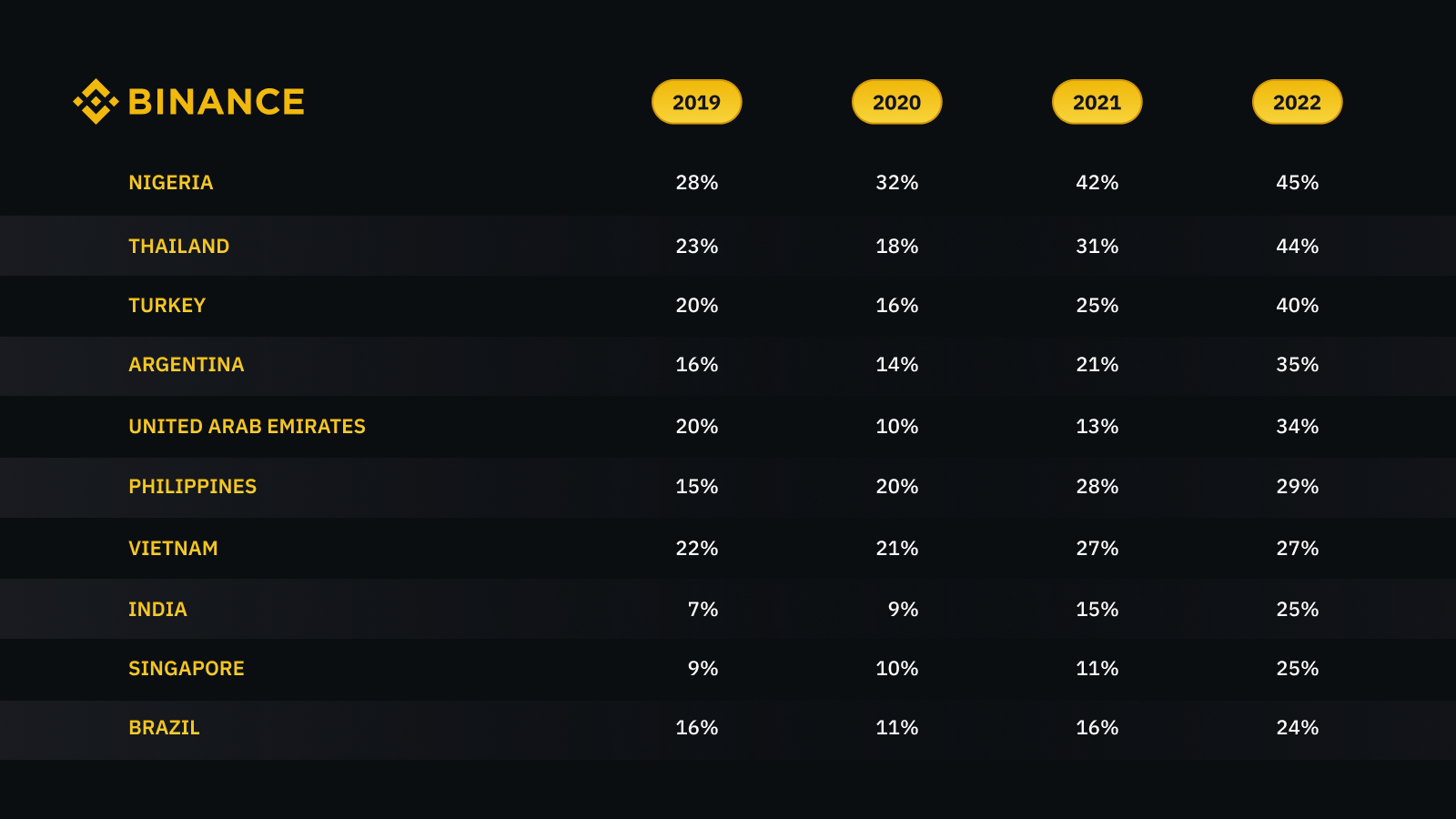
Share of respondents who indicated they either owned or used cryptocurrencies. Source: Statista
Despite the challenging market conditions and setbacks in terms of sentiment and trust, on the fundamental level, global adoption marches on – both on the level of retail users and institutions adding blockchain-based tools and services to their arsenal.
Recent numbers from data hub Statista suggest steady growth in crypto ownership and use in the majority of the 56 countries surveyed compared to last year. If we stack these numbers up against those of 2019, some countries’ adoption rates have doubled, or even tripled.
According to Chainalysis’ 2022 Global Crypto Adoption Index, emerging markets with massive untapped user bases are continuing to dominate the list. Among the top 20 countries adopting crypto at the greatest pace this year were India, Nigeria, Kenya, with Vietnam claiming its spot at number one.
2022’s market events have not fazed institutions who seem to believe in the resilience and intrinsic value of crypto and blockchain technology. Beyond fluctuations in asset prices and dismal news, the industry continues to add disruptive innovations and partnerships.
A study by Binance Research found that many traditional institutions were getting on the crypto bandwagon or continuing to leverage crypto and blockchain technology this year. These include the likes of KPMG, Robinhood, JPMorgan, Rakuten, CVSHealth, Tencent, Fidelity, Baidu, Tesla, Stripe, Commerzbank, Instagram, Cloudfare, PayPal, American Express, Accenture, Christie’s, BlackRock, Nasdaq, McDonald’s, Google Cloud, Mastercard, Sony, Nike and many more.
A glance at the plethora of sectors that continue to adopt blockchain technology is illuminating. The list of use cases – and ultimately intrinsic value – of crypto continues to grow.
Three Key Learnings of 2022
The industry needs to remain agile and responsive to disruptive events.
Much of the industry’s focus has been on driving adoption and improving technology. This approach could lead many companies to overlook the possibility of disruptive events on the industry scale catching the, flat-footed. In light of unforeseen crises of 2022, it’s clear that crypto platforms have to put in even more effort to mitigate critical implications of events, foster trust, and refine processes.
Companies can start by being more transparent, optimizing risk management protocols, and enhancing user trust. CZ’s Six Principles offer one such framework for centralized crypto exchanges.
Crypto and blockchain technology can make real-world difference on a global scale, especially amid crises that disrupt the traditional financial system.
This year, the Ukraine government turned to crypto to crowdfund millions of dollars to help its displaced citizens. One user contributed a CryptoPunk NFT to the Aid For Ukraine campaign, which was then sold to raise $100,000 for Ukraine.
Binance also launched the Refugee Crypto Card and donated 10 million dollars, supported by a crypto-based cash assistance program, to aid humanitarian efforts in the country. The country was ranked fourth in the world for crypto adoption last year, according to a Chainalysis report. Thanks to Ukraine’s openness to crypto – including clearer regulations and fraud protection – connecting communities in need with international financing was successful.
Millions of people in the beleaguered region and beyond who found themselves displaced or simply abandoned by traditional banks and payment systems turned to crypto to exercise their fundamental rights to pay for their basic needs and move their money around.
Crypto adoption did not halt, irrespective of global events.
Once again, one of the brightest silver linings of 2022 has been the continuous adoption of crypto. According to several respectable data sources, global adoption levels remained well above those observed during the 2021 bull market – a strong indicator of our industry’s growth irrespective of the market’s transitory dynamics.
BNB Chain also reported an average of 968,000 Daily Active Wallets, compared to 740,000 in 2021. This metric shows the number of unique wallet addresses that have participated in an on-chain transaction. Thus, this data is a telltale sign of crypto adoption within the BNB Chain ecosystem.
What’s Next?
The crypto industry has grown unprecedentedly over the past few years. Regardless of the negative events that have transpired in 2022, we’ve achieved milestones that were unimaginable just a couple of years ago. While the fruits of our labor may not always be apparent, we have come far through relentless infrastructure building, product launches, and improvements to transparency, security, and compliance, among other efforts.
As the world’s largest crypto exchange by trading volume, Binance is responsible for ensuring our users’ safety. We continue to draw on past learnings, pursue dialogue with policymakers, and urge others in the industry to do the same to stay on track with sustainable and secure growth of the crypto industry.



All Comments