

Cointime

Download App
iOS & Android

The minimal definition of user agency

So, here’s a provocation from Rabble, who also happened to be a founding engineer at Twitter:
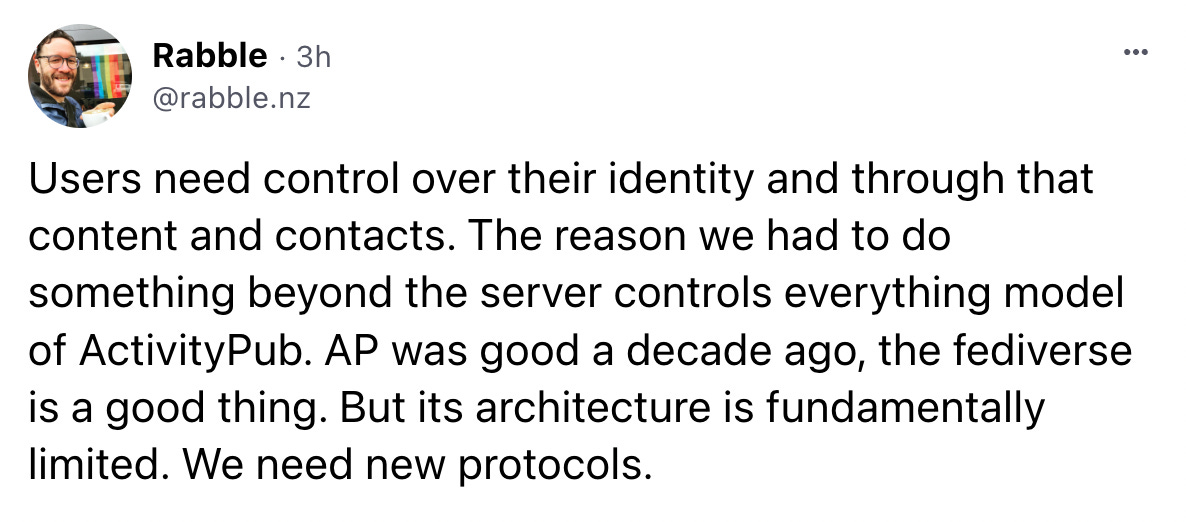
This is a great minimal definition of user agency!

  • Own your ID
  • Own your content
  • Own your contacts

Why do you need all three?

  • If you don’t own your content, you’re stuck. Owning your content is necessary for agency! However, it is not sufficient, because…
  • If you own your content, but don’t own your contacts, then you will lose your entire social graph when you switch services. Network effect will keep you locked in.
  • If you own your content and contacts, but don’t own your ID, you don’t really own anything. Why? IDs are upstream of access. Specifically, this is about who owns your name, and the cryptographic keys that secure your ID, under the hood. If your name is owned by an authority, you lose it if you leave. If your keys are owned by an authority, they are in control. They can lock you out of your stuff, snoop on your private messages, delete your account, or refuse to let you move it elsewhere. So self-sovereign IDs and keys are crucial for agency.

When you own your ID, content, and contacts, you have agency, because you have credible exit. You can seamlessly change services and bring everything important with you, like switching carriers for your mobile phone.

The minimal definition of user agency: own your ID, your content, and your contacts.

User agency is a core goal for us at Subconscious. It’s why we built Noosphere, a protocol for thought.

Noosphere is sort of like “what if Roam/Notion/LogSeq, but a protocol”. A worldwide decentralized thought graph, made up of individual graphs called spheres.

Your sphere is like your inventory on Noosphere. It’s a data structure that contains your content and contacts.

Spheres are published to IPFS, a decentralized network. This decouples your data from any particular app or domain. Your sphere can live anywhere or everywhere at once, and is accessible from any IPFS peer. If a service tries to lock you in, you can always get your content through another node in the decentralized network.

Your sphere is signed with a key that you control. This decouples auth from any particular app or authority. Using your cryptographic key, it’s possible to prove content is secure, no matter where it lives on the network, or what service is hosting it. You own your keys, you own your identity, you own your content.

A decentralized name system ties everything together, keeping your ID portable. In apps and on the web, names are rooted to a particular service, such as facebook.com/alice. If you change services, you lose your name and everything else. On Noosphere, your keys belong to you, and your account name stays the same, no matter where your content happens to live. You can change providers without losing your ID or breaking your links.

With Noosphere, we’re aiming to build a worldwide decentralized repository for thought, belonging to everybody. A decentralized graph, where you own thoughts, and have agency to move your data between services and apps. If that sounds like your jam, come build with us!

GitHub: subconsciousnetwork/noosphereLicense: Apache/MIT

Subconscious is our tool for thought, powered by Noosphere protocol.Sign up for the Subconscious Beta


Comments

All Comments

Recommended for you

  • US Official: Ukraine Agrees to Avoid Strikes on Non-Russian Tankers and Black Sea Oil Facilities

    On August 8, according to a US official, Ukraine has agreed not to target certain non-Russian tankers and Black Sea infrastructure vital to Kazakhstan's crude oil exports. This follows ship attacks last month that caused loading disruptions. The US official said Ukraine has set up contact points so commercial shipping companies can communicate information and ensure safe passage. The commitment was reached after meetings between senior US government leaders and Ukrainian leadership, marking a potentially significant step toward increasing regional oil shipments. Previously, activity in the region had cooled significantly due to several recent attacks near the Caspian Pipeline Consortium terminal in Russia's Novorossiysk. (Jin Shi)

  • U.S. July Nonfarm Payrolls Fall by 23,000, Missing Market Expectations

    On August 7, U.S. nonfarm payrolls decreased by 23,000 in July, compared with market expectations of an increase of 80,000, and the previous value was an increase of 57,000.

  • US May and June Nonfarm Payroll Additions Revised Down by 103,000 Combined

    On August 7, the US Bureau of Labor Statistics: May nonfarm payroll additions were revised down from 129,000 to 63,000; June nonfarm payroll additions were revised down from 57,000 to 20,000. After the revisions, the combined additions for May and June were 103,000 lower than previously reported.

  • U.S. Rate Futures Market Sees Lower Odds of Fed September Hike

    On August 7, the probability of a Fed rate hike in September as priced by U.S. interest rate futures declined.

  • New York Gold Futures Top $4,400 per Ounce

    New York gold futures topped $4,400 per ounce, up 2.36% on the day.

  • Japan Finance Minister: FX Market Affected by Moves Not Driven by Actual Demand

    Japanese Finance Minister Satsuki Katayama said she and U.S. Treasury Secretary Bessent agreed that the foreign exchange market has been affected by moves not driven by actual demand.

  • BTC Breaks Through $65,000

    Market data shows BTC has broken through $65,000, currently reported at $65,007.44, with a 24-hour increase of 0.6%. The market is highly volatile, please exercise risk control.

  • Brent Crude Drops 2.00% Intraday to $81.07/Barrel

    Brent crude oil fell 2.00% during the day, now at $81.07 per barrel. (Jin Shi)

  • Trump: Data Centers May Be More Important Than Oil

    August 7 news, U.S. President Trump said in an interview with Punchbowl News, "I saw the other day that Texas seems to be opposed to building data centers. I think that's a mistake. I'm not taking a position—I just think it's a mistake, because there are other communities that want to build data centers. When a community is willing to accept data centers, it means a lot of money will flow into that community. I don't think they're ugly. Some of the data centers I've seen are the most incredible buildings I've ever seen. They are very important to the economy. If Texas says no to data centers, that's a mistake, because data centers may be more important than oil."

  • Trump to Meet with Mining Executives

    On August 7, according to CCTV International News, US President Trump will convene executives from some of the world's largest mining companies at the US State Department on August 7 local time, in an effort to take action to 'secure critical mineral supplies for the US and its allies.' Reuters reported that the US urgently needs critical minerals to replenish weapons inventories depleted during the war against Iran. During the more than five-month war with Iran, the US military expended large quantities of precision-guided missiles and air defense interceptors. US defense officials and lawmakers have warned that given existing production capacity constraints, replenishing some stockpiles could take years—although the Trump administration has denied reports of a so-called 'severe shortage of ammunition stockpiles.' According to Pentagon officials and defense companies, supplies of minerals such as rare earths, tungsten, germanium, and scandium are essential for manufacturing precision-guided missiles, fighter jets, armored vehicles, infrared sensors, and other advanced weapons systems. Expected attendees include industry giants such as global mining giant Rio Tinto Group, Australia's BHP, US Freeport-McMoRan, US Mountain Pass Materials, US Rare Earths, US Energy Fuels, and Canada's Metals Company. According to sources, the Trump administration plans to announce multiple deals and memorandums of understanding.