

Cointime

Download App
iOS & Android

Telegram Blockchain Numbers, Crypto Wallets and DEX

Validated Individual Expert

The latest Telegram update was launched on Dec 6. Its main feature is the possibility for users to buy and use blockchain powered numbers for registration instead of usual mobile phones.

Today starts a new era of privacy. You can have a Telegram account without a SIM card and log in using blockchain-powered anonymous numbers available on the Fragment platform [Telegram auction platform],” — says an announcement in company’s blog.
Log in without SIM GIF. Source: telegram.org

FYI: Durov is not a new comer in the blockchain world. TON, layer-1 blockchain, was developed by Telegram CEO Durov and his brother back in 2018. TON was abandoned by Durov under regulatory pressure in 2020, but the open-source community has kept it alive and now it is not only “fully live operational”, but has at least two forks managed by two competing communities. In August 2022 TON official website went back to live and Durov started developing crypto services.

Blockchain-based auction platform, Fragment, which is based on The Telegram Open Network, was launched around one month ago. On Fragment, people can buy and sell usernames using Toncoins, the network’s native coin. According to a recent post in Durov’s channel, “Fragment has been an amazing success, with 50 million USD worth of usernames sold there in less than a month”. Now the auctioneer has expanded beyond usernames — blockchain based numbers are already available. At the moment of writing the most expensive number — +8 888 888 — costs more than 63,000 USD, but less “attractive” numbers can be bought for approximately 100 USD. A random number can be bought for only 9 TON which is 16 USD.
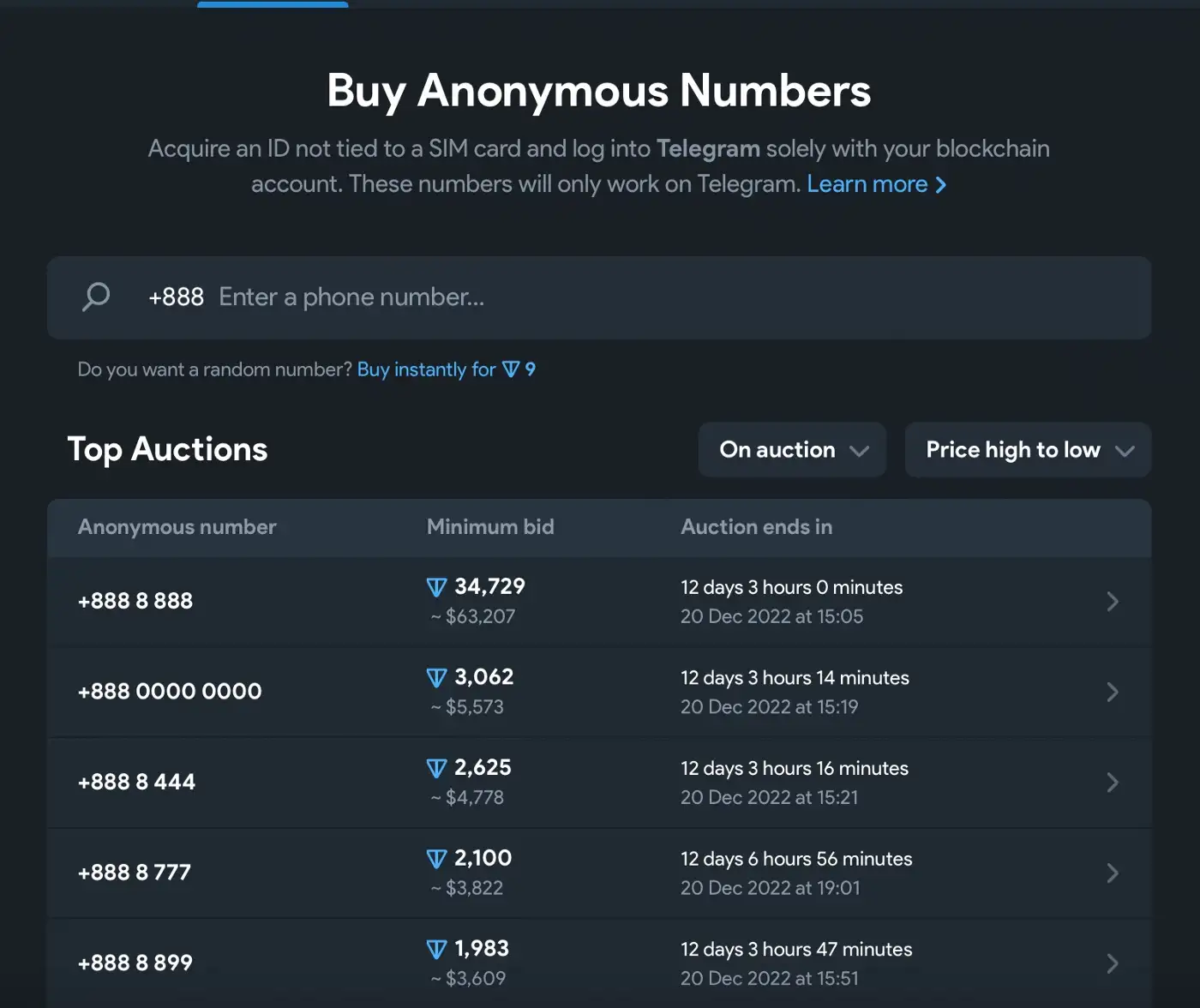
Numbers auction on Fragment. Source: fragment.com

In the same post, Durov refers to the FTX collapse and claims that the blockchain industry got too centralised and now needs to go back to decentralization — and he’s ready to take part. This is what he says about Telegram’s future plans:

“Telegram’s next step is to build a set of decentralized tools, including non-custodial wallets and decentralized exchanges for millions of people to securely trade and store cryptocurrencies. This way we can fix the wrongs caused by the excessive centralization, which let down hundreds of thousands of cryptocurrency users”.

As well established exchanges become less and less reliable, so it’s the right time to launch the project — new blood can be a success. Blockchain numbers also look like a breathe of fresh air, and even if they won’t grow from just a means of getting confirmation codes for Telegram, they will definitely attract users’ attention and money. Besides Telegram monetization (Telegram Premium and ads) which started this year seems to be going great, and it means that its team has enough sources to develop more instruments. Let’s observe how it goes!

Comments

All Comments

Recommended for you

  • Saudi Arabia Depletes 86% of Patriot Missile Stockpile

    According to British media reports, within the first 38 days after the outbreak of the war, Saudi Arabia launched approximately 2,400 PAC-3 (Patriot-3) interceptor missiles, accounting for about 86% of the country's total stockpile of 2,800 missiles. By April of last year, Saudi Arabia had only about 400 interceptor missiles remaining. Other Gulf Arab states also consumed missile reserves on a similar scale, highlighting the military crisis facing the region. (Jin Shi)

  • Experts: The Strait of Hormuz 'Will Never' Return to Pre-War Status

    Ali Akbar Dareini, a researcher at the Iranian Strategic Studies Center, stated that Iran and Oman are about to reach an agreement on the future management of the Strait of Hormuz, with the main obstacle being U.S. pressure on Oman to adopt a position more aligned with Washington. Dareini emphasized that Iran considers future control of the strait crucial for its national security. In recent months, the U.S. has conducted strikes against Iran, which Iran claims were launched from bases in the region. Dareini noted that the ongoing negotiations between Iran and Oman present the U.S. with a 'good opportunity to extricate itself from this quagmire' by recognizing Iran and Oman as the countries that will determine the 'future' of the Strait of Hormuz. 'However, the Strait of Hormuz will never return to its pre-war status,' he continued. 'The geopolitical landscape of the region has changed.'

  • Iran: Negotiations with Oman Unrelated to Reopening of Strait of Hormuz

    On August 8, a spokesperson for the Islamic Revolutionary Guard Corps of Iran stated that the reopening of the Strait of Hormuz is unrelated to negotiations between Iran and Oman, but rather depends on whether the United States fully accepts Iran's conditions and ceases interference in regional negotiations. "Once the United States accepts Iran's conditions, the Strait will undoubtedly reopen." (CCTV News)

  • Whale Shorting $102 Million in Bitcoin Faces Partial Liquidation, Remaining Liquidation Price Around $65,300

    On August 8, TheDataNerd reported that a whale using 40x leverage to short $102 million in Bitcoin recently faced partial liquidation, incurring a loss of $1.46 million over the past week. Currently, the margin call has reduced the short position to approximately $60 million, with an opening price of $64,212.5 and a liquidation price of $65,310.2.

  • BTC Falls Below $65,000

    Market data shows BTC has fallen below $65,000, currently reported at $64,999.23, with a 24-hour increase of 1.01%. Market volatility is high, please exercise risk control.

  • Hedge Fund AISituational Awareness's Mysterious $400 Million Investment Targets Chip Startup Source Foundry

    On August 8, sources revealed that the hedge fund Situational Awareness, managed by former OpenAI researcher Leopold Aschenbrenner, made a mysterious $400 million investment in the chip manufacturing startup Source Foundry just days after facing imminent collapse. Previously, Bloomberg reported that the hedge fund invested in a private company backed by Sequoia Capital, but did not disclose the name of the specific company. The Wall Street Journal had earlier reported that the recipient of the investment was Source Foundry, unveiling the target of this mysterious funding deployment by Situational Awareness.

  • US Spot Bitcoin ETF Sees $101.79M Net Inflow Yesterday

    On August 8, according to Trader T's monitoring, US spot bitcoin ETFs saw a net inflow of $101.79 million yesterday.

  • US Official: Ukraine Agrees to Avoid Strikes on Non-Russian Tankers and Black Sea Oil Facilities

    On August 8, according to a US official, Ukraine has agreed not to target certain non-Russian tankers and Black Sea infrastructure vital to Kazakhstan's crude oil exports. This follows ship attacks last month that caused loading disruptions. The US official said Ukraine has set up contact points so commercial shipping companies can communicate information and ensure safe passage. The commitment was reached after meetings between senior US government leaders and Ukrainian leadership, marking a potentially significant step toward increasing regional oil shipments. Previously, activity in the region had cooled significantly due to several recent attacks near the Caspian Pipeline Consortium terminal in Russia's Novorossiysk. (Jin Shi)

  • U.S. July Nonfarm Payrolls Fall by 23,000, Missing Market Expectations

    On August 7, U.S. nonfarm payrolls decreased by 23,000 in July, compared with market expectations of an increase of 80,000, and the previous value was an increase of 57,000.

  • US May and June Nonfarm Payroll Additions Revised Down by 103,000 Combined

    On August 7, the US Bureau of Labor Statistics: May nonfarm payroll additions were revised down from 129,000 to 63,000; June nonfarm payroll additions were revised down from 57,000 to 20,000. After the revisions, the combined additions for May and June were 103,000 lower than previously reported.
