


Morgan Stanley’s research report shows that global tech giants’ investment in AI hardware infrastructure is advancing toward the trillion-dollar level. However, the extremely high costs of hash power construction and operations keep centralized cloud service prices elevated, making them unaffordable for the vast majority of small and medium-sized developers.
Addressing the industry pain points of hash power monopoly and difficulty in application implementation, SuperStrike — backed by the underlying StrikeBit AI ecosystem and capital support — officially announces that its four core business segments — SuperLine, SuperPay, the decentralized on-chain platform, and the prediction market — are about to launch formally. This marks the ecosystem’s transition from pure technology development into a new stage of practical applications and business self-sustainability.
I. Industry Dilemmas: High Hash Power Costs and Difficulty in Application Implementation
In today’s technology and crypto markets, the industry faces two very clear pain points:
1. Excessively high hash power costs in the AI sector: Centralized cloud providers hold pricing power. Whether for model training or daily operations, expensive server rental fees place enormous financial pressure on startup teams.
2. Web3+AI projects lack real usage: Most crypto AI projects that appeared in recent years remain at the level of concept hype or simple Q&A bots. They lack daily high-frequency usage scenarios and cannot generate continuous business revenue, resulting in tokens lacking solid underlying value support.
To solve these two problems, it is necessary to establish a commercial closed loop that can both schedule hash power at low cost and connect to daily high-frequency applications.
SuperStrike inherits StrikeBit AI’s technical accumulation in modular agent protocols. Through its own S-MAP architecture, it first decomposes complex hash power and algorithms into standardized modules, then connects this hash power to daily scenarios such as social networking, payments, trading, and hedging via the four upcoming businesses.
II. Breakdown of the Four Businesses: Covering Daily High-Frequency Usage Scenarios
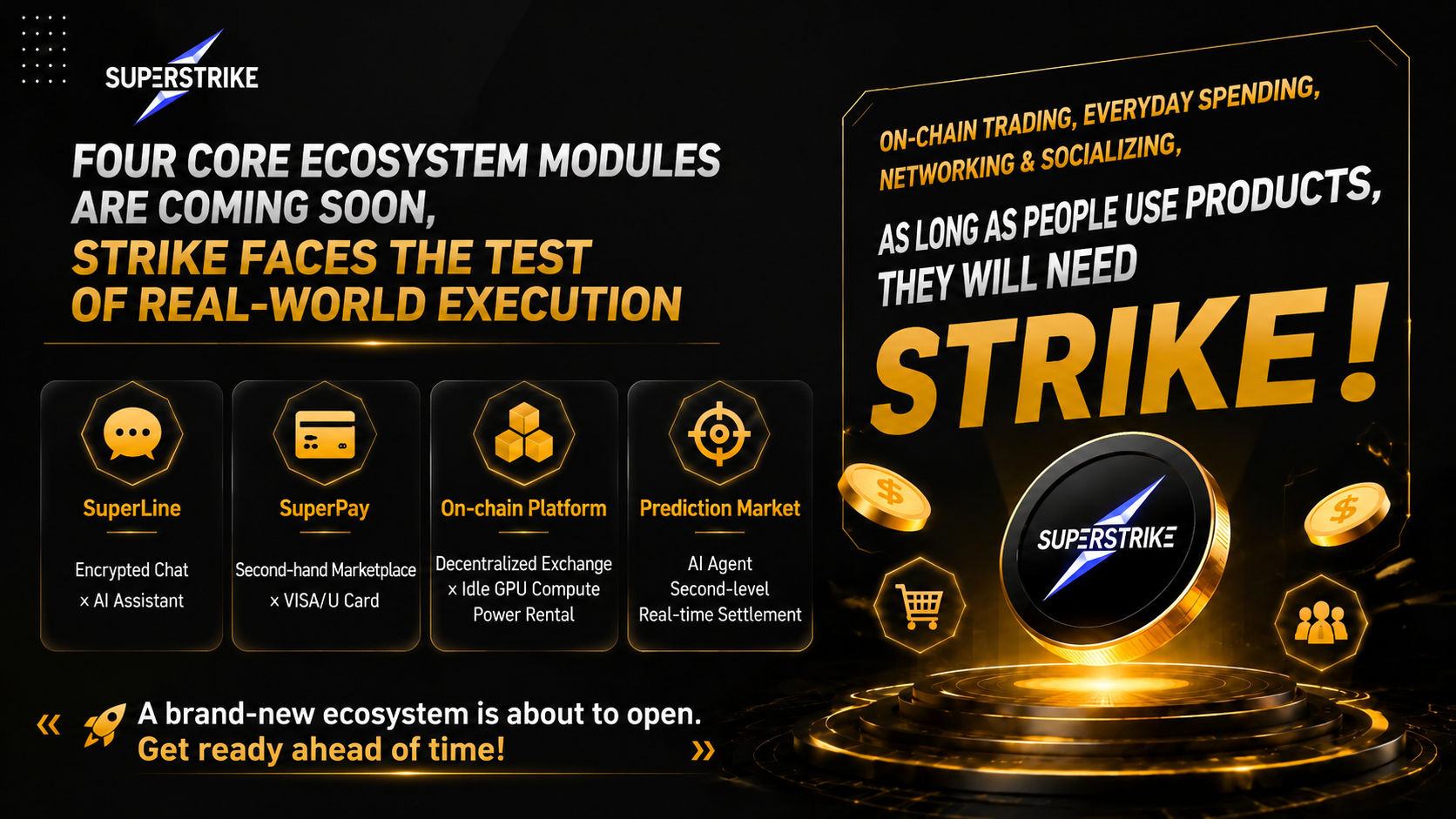
The four business segments about to launch are laid out across traffic, consumption, trading, and risk management:
1. SuperLine (Crypto Privacy Social Platform)
● Functional positioning: Built on zero-knowledge proofs and decentralized routing technology to address crypto users’ concerns about privacy leakage in daily communications.
● Business integration: SuperLine directly integrates an AI smart assistant into the chat software. Users do not need to leave the chat interface — they can simply type or use voice to let the AI assistant analyze on-chain data, manage asset portfolios, or even execute trading strategies, achieving “chat to use.”
2. SuperPay (Second-Hand Goods Mall & U-Card Payment System)
● Functional positioning: Enters the second-hand luxury and idle goods trading market to create a Web3 version of a second-hand trading platform.
● Business integration: Launches a “consumption-as-incentive” rebate mechanism so that merchants and buyers can receive ecosystem incentives during transactions. At the same time, SuperPay connects to global VISA and crypto U-card channels, supporting real-time USDT transfers and fiat settlement, and directly links to 40 million offline POS machines and online merchants worldwide, enabling digital assets to be used directly for everyday card-swipe consumption.
3. Decentralized On-Chain Platform (Trading & GPU Hash Power Market)
● Functional positioning: Includes basic financial services such as DEX trading and lending.
● Business integration: The platform has established a market for idle hash power and model trading. Individuals and data centers can list idle GPU hash power for rental, while developers can buy and sell datasets and models on the platform, forming a hash power trading marketplace.
4. Decentralized Prediction Market (Event Gaming & Hedging Center)
● Functional positioning: Covers various popular events including macroeconomics, industry hotspots, and sports competitions.
● Business integration: Introduces SuperStrike’s AI agents as referees to automatically capture real-time data across the entire web for result verification and rapid settlement. Investors can not only participate in viewpoint predictions but also use the platform to hedge risks for their existing assets.
III. Synergistic Effects: How Do the Four Segments Drive Each Other?
These four segments are not independent single-point products but a system that interconnects at the underlying hash power and fund flow levels:
● Social drives traffic: Users establish an entry point on the SuperLine social side and directly use the AI assistant to allocate assets on the on-chain platform or participate in hedging on the prediction market;
● Yields convert into consumption: Money earned on the prediction market and on-chain trading can be transferred to SuperPay with one click for offline card-swipe spending;
● Continuous hash power consumption: Execution of social commands, trade settlement, data verification, and hash power rental all continuously consume underlying hash power throughout the process.
This synergy ensures that traffic enters from the social side, generates business on the trading and prediction sides, and finally completes real expenditure on the consumption side — the entire process continuously produces real transaction volume.
IV. Background & Resources: Technical Source, Investment Institutions & Trading Platforms
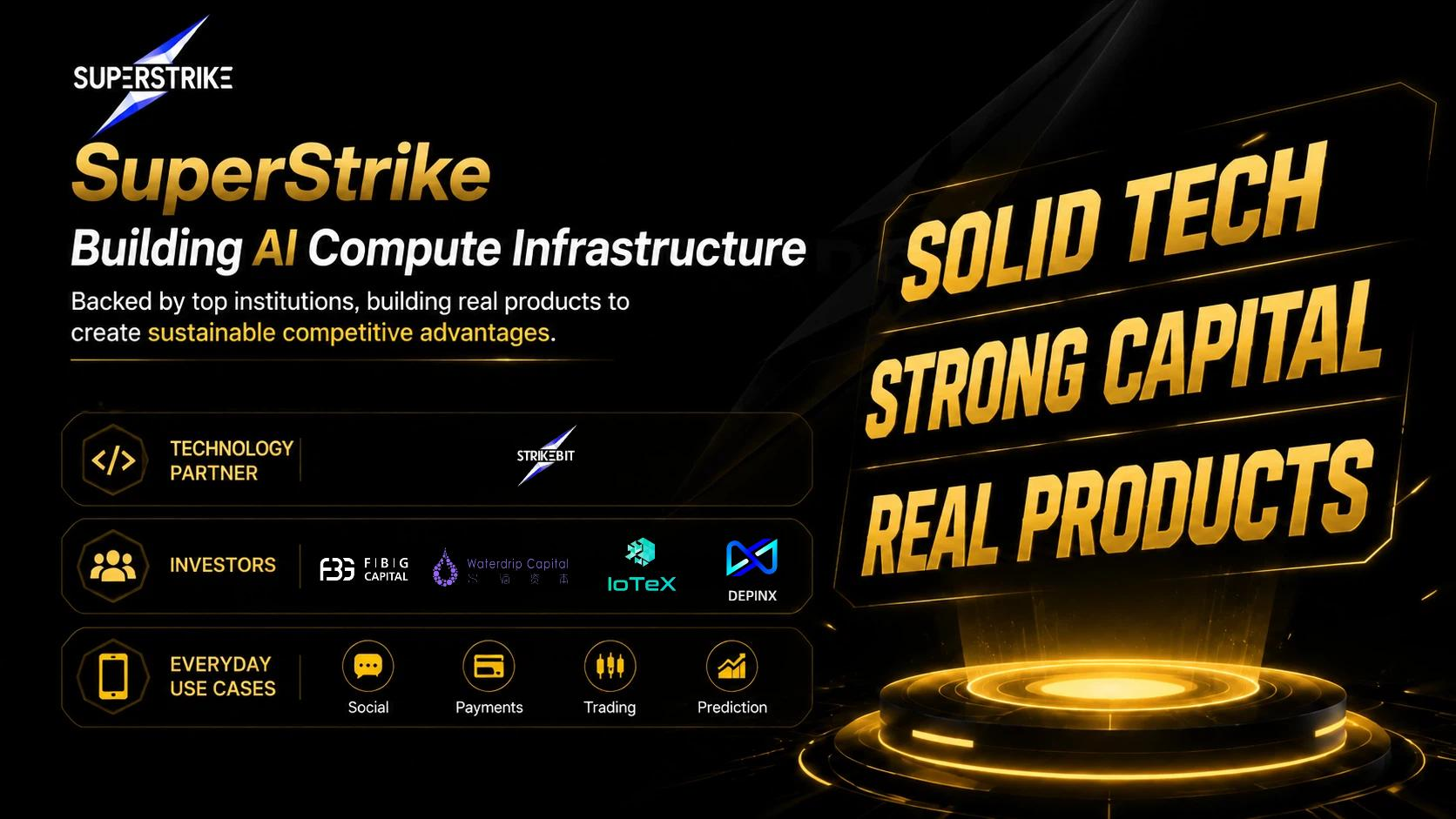
For a project to truly build its businesses, it cannot do without underlying technical sources and industry resource support:
Technical support from StrikeBit AI: SuperStrike relies on StrikeBit AI’s technical accumulation in decentralized AI assembly, enabling it to schedule globally dispersed computing nodes and hardware resources, providing the four business segments with lower-cost and more stable hash power support.
Investment and support from professional institutions: In the hash power and decentralized hardware track, SuperStrike and its underlying ecosystem have received investments from well-known institutions and track leaders including FBG Capital, Waterdrip Capital, DePIN X, and IoTeX. These institutions have provided substantial support for SuperStrike’s implementation in hardware facilities, overseas market expansion, and industry resources.
Trading platform and liquidity planning: As the four business segments go live and gradually generate business volume, token liquidity layout is also advancing. Leveraging the industry resources of investment institutions, STRIKE is actively connecting and advancing listings on major global mainstream crypto exchanges (CEX) to facilitate trading for global users.
V. Practical Support for STRIKE Token Value
In the SuperStrike ecosystem, the native token STRIKE is positioned as the fundamental Gas fee across the entire hash power and business network. The launch of the four businesses will bring direct changes in supply and demand for the token:
1. Real business consumption demand emerges: Calling the AI assistant on SuperLine, merchant store-opening staking on SuperPay, GPU rental on the hash power market, and event settlement on the prediction market all require deduction or consumption of STRIKE. The more people use the products, the greater the actual buy-side demand for the token.
2. Staking and reduced circulation: With the launch of new businesses and node construction, a portion of STRIKE will be staked in hash power pools and liquidity mechanisms (withdrawals have a verification buffer period), reducing sell pressure on the secondary market. At the same time, fees collected during business operations will be burned proportionally, creating deflation.
3. Clear fundamental support: In the past, many token prices mainly relied on market sentiment. After SuperStrike’s four businesses go live, STRIKE’s actual value will be linked to network-wide trading volume, card-swipe consumption amounts, and hash power rental frequency, providing clear fundamental support.
VI. Summary & Outlook: From Technology Development to Practical Business Implementation
In today’s crypto market and AI sector, the stage of driving market movements by storytelling is passing. The industry is entering a new phase that values actual products and business revenue.
The successive launch of SuperStrike’s four business segments demonstrates how the project combines Web3 and AI into a commercial closed loop. From the social stickiness and traffic brought by SuperLine, to the everyday card-swipe consumption realized by SuperPay; from the idle hash power rental provided by the on-chain platform, to the risk hedging offered by the prediction market — these four segments together form a complete business system.
Looking ahead, on the technical foundation of StrikeBit AI, combined with support from institutions such as FBG Capital, Waterdrip Capital, DePIN X, and IoTeX, as well as subsequent connections to mainstream trading platforms, SuperStrike’s hash power infrastructure will gradually attract more multinational users and overseas capital. STRIKE will also evolve from a pure trading voucher into an indispensable hash power consumption payment tool across the full suite of businesses.
Against the backdrop of continuously growing global hash power demand, projects that can truly connect daily consumption, financial trading, and hash power buying/selling remain rare. The launch of SuperStrike’s four businesses is only the beginning. As actual business operations ramp up, its long-term commercial value deserves continued market observation.


All Comments