

SuperStrike: Web3 + AI Super Agent Financial Infrastructure
SuperStrike is a next-generation intelligent financial ecosystem built for the Web3 + AI era. It is positioned as a super agent financial infrastructure centered around the concept of an AI autonomous economy. Evolved from the StrikeBit AI Modular Agent Protocol S-MAP, SuperStrike aims to push AI agents beyond simple tools and transform them into autonomous assets capable of carrying value, coordinating resources, and participating in ecosystem growth.
Within the SuperStrike ecosystem, users are not merely joining a single product. They are entering a network powered by AI strategies, on-chain assets, node consensus, platform tokens, and global community expansion. SuperStrike is designed to help every user access an AI-driven intelligent financial gateway, allowing them to secure an early position in the emerging convergence of Web3 and AI.
3D Node Matrix: Genesis, Global, and Consensus Nodes
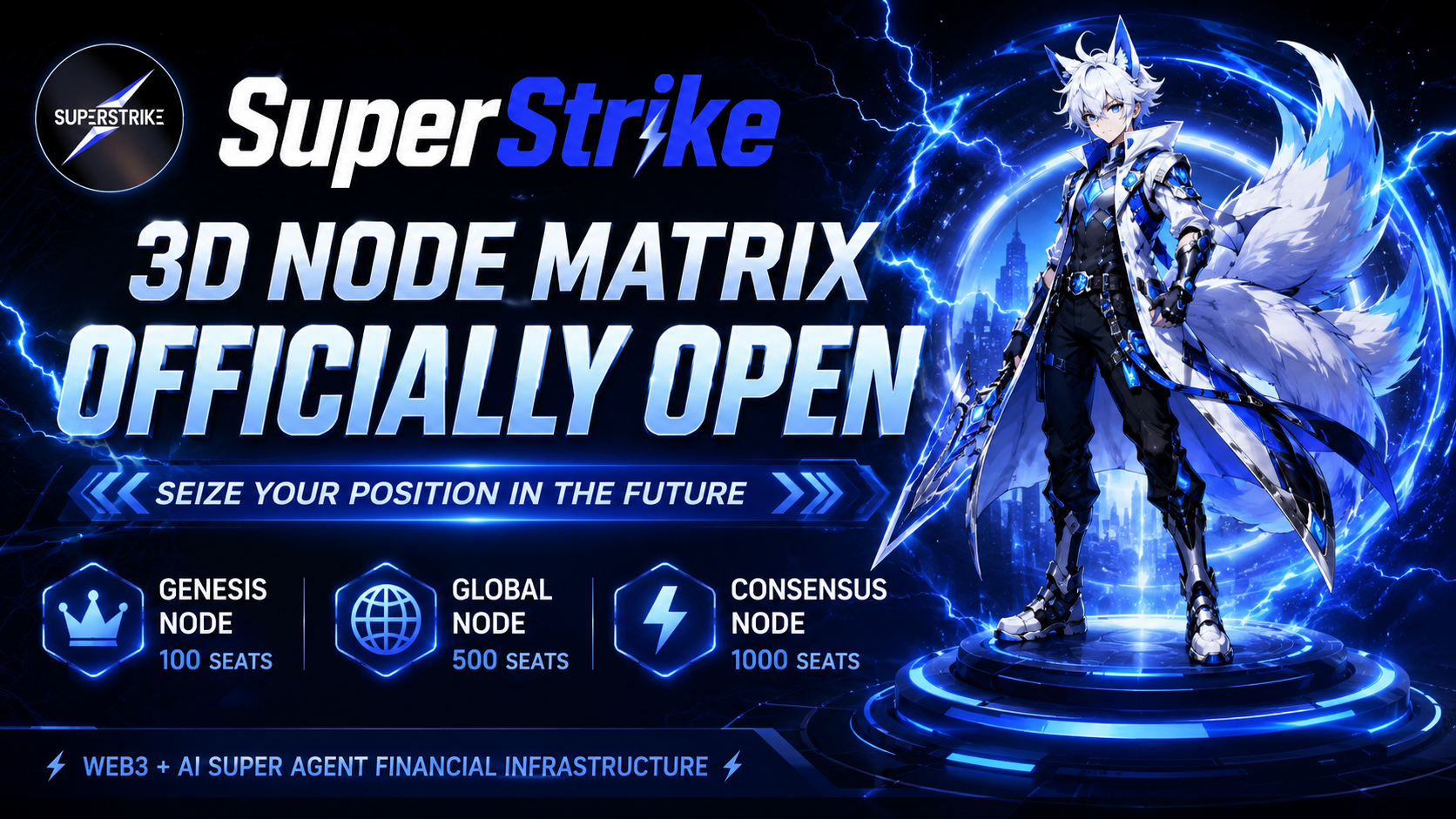
The SuperStrike 3D Node Matrix is now officially open, featuring three major node categories: Genesis Nodes, Global Nodes, and Consensus Nodes. Each node type carries a different participation threshold and ecosystem value, forming a layered structure that connects core builders, global contributors, and consensus participants.
Genesis Nodes are limited to 100 seats and represent the early core positions within the ecosystem. They are designed for participants with strong community-building capabilities and long-term conviction. Global Nodes are limited to 500 seats, serving as a broader gateway for ecosystem builders who support global expansion and community growth. Consensus Nodes are limited to 1,000 seats, providing more users with access to ecosystem rewards and long-term participation. Together, these three node types form SuperStrike’s global node network, supporting ecosystem traffic, consensus, governance, and value circulation.
Ecosystem Feedback: A Node Is More Than an Identity
The core value of the SuperStrike node matrix is not only its scarcity, but also its deep connection with ecosystem growth. Node participants may access corresponding level benefits, order-cycle rewards, fee-sharing mechanisms, and long-term links to the expansion of the global community, the development of the AI autonomous economy, and the utility of the $STRIKE ecosystem.
In the ecosystem feedback model, node participants act as key connectors for consensus building, community growth, ecosystem collaboration, and value distribution. As the SuperStrike global community continues to expand, node seats may become important bridges connecting users, assets, AI strategies, and on-chain finance. The earlier users enter the node matrix, the greater the opportunity to secure a stronger position in the future ecosystem map and participate in SuperStrike’s journey from early launch to global consensus expansion.
AI Autonomous Economy: From Asset Deposit to Intelligent Strategy Participation
The SuperStrike user participation path is built around asset deposits, AI staking-cycle selection, settlement mechanisms, and ecosystem withdrawal rules. Users participate through a 50% USDT + 50% STRIKE asset structure and may select different AI staking cycles based on their own needs, including 10 days, 30 days, 90 days, 180 days, and 360 days.
The key point is that SuperStrike is not a simple single-point yield model. Instead, it forms a complete ecosystem loop through AI strategies, platform token utility, node rewards, VIP computing-power levels, and ecosystem fee mechanisms. As the platform token, $STRIKE is used not only for VIP level upgrades, but also for yield withdrawal, ecosystem governance, and dividend rights, further strengthening the value alignment between users, nodes, and the platform.
Why Pay Attention to the SuperStrike Node Matrix Now
The convergence of Web3 and AI is pushing financial ecosystems from manual operation toward intelligent agent collaboration. SuperStrike aims to build an ecosystem infrastructure powered by AI agents, on-chain assets, node networks, and global communities. The opening of the 3D Node Matrix gives users a clear early-stage entry point and allows them to join SuperStrike’s global consensus network through node participation.
For those who believe in AI autonomous economies and Web3 financial infrastructure, the SuperStrike node matrix is not just a seat offering. It is an early positioning opportunity within a growing ecosystem. Genesis Nodes, Global Nodes, and Consensus Nodes together form SuperStrike’s growth engine, giving participants the chance to grow alongside global community expansion and witness the next stage of AI-native financial evolution.
Conclusion: Follow SuperStrike and Activate Global Consensus Growth
The key words behind SuperStrike are Web3, AI, nodes, consensus, and ecosystem feedback. Powered by the S-MAP protocol, supported by the $STRIKE ecosystem token, and expanded through the 3D Node Matrix, SuperStrike is building a super agent infrastructure for the era of AI autonomous finance.
Scarcity comes first, and value follows early positioning. SuperStrike is more than lightning; it is a long-term energy source connecting global users, AI agents, and on-chain financial ecosystems. Now that the 3D Node Matrix is officially open, early participants have the opportunity to join the global community and take part in the Web3 + AI consensus expansion.


All Comments