


Not your keys, not your crypto
Self-custody of crypto assets in user wallets has become a talking point as centralized exchanges misuse user funds causing financial troubles in the broader industry. ‘Not your keys, not your crypto’ is a sentence most people have heard but perhaps don’t fully understand. However, understanding what it means and why it matters is vital for anyone planning on engaging with the Web3 revolution.
FTX was a centralized exchange. That means customers with tokens on the exchange were frozen out when it started collapsing and couldn’t withdraw them. The reason is that FTX held custody over its customer’s tokens, holding all assets in the company’s wallets while also controlling the private keys.
FTX freezes out customers to use those tokens to pay debts and stop a mass exodus of customers, which would only compound the situation. If it plays out like the Mt.Gox exchange case, it could take a decade for customers to get anything back. Many lost a lot of money with no recourse or way of getting it back. What’s done is done, but taking preventative steps to avoid more heartbreak is essential. We advise users to learn about crypto self-custody, private keys, and wallets. These are essential aspects for user empowerment in Web3.
Users can interact with all kinds of decentralized applications when they have ownership over their wallets. All your activity, earned collectibles, and crypto coins can be tracked through the user-friendly DappRadar Portfolio Tracker.
But to understand self-custody, it’s crucial first to cover the basics.
What is a centralized exchange (CEX)?
Centralized exchanges resemble traditional financial institutions in the way they operate. They have central control and leverage the services of third parties and intermediaries to execute transactions. Examples of centralized exchanges are Coinbase, Binance, Kraken, etc.
What is a decentralized exchange (DEX)?
A decentralized exchange or DEX is a crypto trading platform that does not rely on intermediaries to help execute transactions between two individuals. No desks or office employees are required for its functioning. User interactions on a DEX happen through smart contracts, which are pieces of software on the blockchain.
Custodial Vs. Non-Custodial
Custodial is when an exchange, dapp, or wallet takes custody of your tokens. I.e., they are looking after them on your behalf – they put them in custody.
The most common scenario is you purchase tokens on an exchange like FTX, BlockFi, or Crypto.com. Those tokens are still on the exchange. They are not in a wallet only you have access to. Essentially, they are not yours – hence the saying, not your keys, not your crypto.
For context, traditional banks are custodial. The bank ultimately controls the funds you deposit. The difference with conventional banks is the plethora of user protection and insurance offered should funds be removed by a third party or in the case of insolvency.
Non-custodial or self-custody refers to a user holding tokens in a blockchain wallet such as MetaMask or a cold storage device such as a Ledger. When the user creates a wallet, these digital keys are given out, meaning total control. I.e., if the user loses those keys, they lose access to their crypto and wallet. There is no reset button or ability to call customer services for help.
Self-custody is genuinely decentralized. Users connect a wallet to a platform like Sushi or Uniswap to perform token swaps. For example, they are swapping a chunk of Ethereum for a piece of USDC. In another example, users can connect their wallet to a blockchain game or purchase an NFT and then store it in their wallet.
The difference is that you connect your wallet and must sign a transaction for every action. Once you have swapped or received your new tokens, they end up in your blockchain wallet, more importantly, in self-custody.
The bottom line is that when your tokens are in self-custody, nobody can touch them. Not the government, not your parents, not the creators of the blockchain wallet, and least of all, not an exchange.
Using your non-custodial crypto wallet, you can interact with decentralized financial services, play-and-earn games, NFT collections, and more. Such a wallet is the gateway to Web3, and by connecting your wallet to DappRadar, you can gain valuable insights into your portfolio. Make a wallet now, use our crypto service to get some tokens, and check your wallet through the DappRadar Portfolio Tracker.
Why would anyone give up custody of their crypto?
After reading the above many might be thinking just this. Moreover, this is an excellent question with several answers.
Firstly, some people need to learn what they are doing. They potentially purchased crypto at the height of the bull run, expecting to become a millionaire. They have yet to look into the inner workings of anything, least of all blockchain wallets. Overall, they were happy to let a friendly mobile app guide them and allow them to move in markets they understood little about.
Secondly, centralized exchanges offer users financial services such as token staking, but to take part, the tokens need to be on the exchange. For example, staking USDC stablecoin on one of the many centralized exchanges can reward users around 3% per annum. But that chunk of USDC is now under the custody of an exchange as it accumulates interest. The money will likely be lost if the exchange is hacked or insolvent during that time.
Exceptions to the rule
Following the collapse of the FTX, Binance’s CEO Changpeng Zhao (CZ) suggested that all exchanges should provide Merkle-tree proof-of-reserves. However, despite Binance initiating the movement, it has not included its liabilities in its proof-of-reserves.
Kraken, Coinbase, and Gate.io became the first exchanges to publish proof-of-reserves, including liabilities, as part of their audits on November 14, 2022. Importantly, in the aftermath, there is a strong movement toward all exchanges being made to release proof-of-reserves with liabilities so that customers can investigate the robustness of a platform before engaging with it.
A Merkle Tree is a cryptographic tool that consolidates large amounts of data into a single hash which acts as a cryptographic seal that summarizes all the inputted data. Merkle Tree, as one of the core technologies of blockchain, can integrate a large amount of data into a single hash and efficiently verify the integrity of the data set.
Therefore, as one of the main applications of Merkle Tree, Proof-of-Reserves not only provides users with fast asset security verification but also improves the transparency of institutional reserves.
What should I do then?
This year has already seen the collapse of LUNA, Three Arrows Capital, Celsius, and now Alameda, and the FTX Exchange. The overriding fear is that more centralized exchanges could collapse as a knock-on effect. As a result, people are starting to understand that they must put their crypto assets in self-custody and use a blockchain wallet to keep funds safe.
Moving tokens off an exchange to a blockchain wallet is straightforward but requires some simple steps.
- Register a blockchain wallet like Metamask if you haven’t already, and safely store the private keys and credentials in written and digital format.
- Use the transfer feature within your exchange application to send tokens from the exchange to your blockchain wallet. You need your new blockchain wallet address, which can be found at the top of the Metamask web or mobile app. Simply click it to copy it.
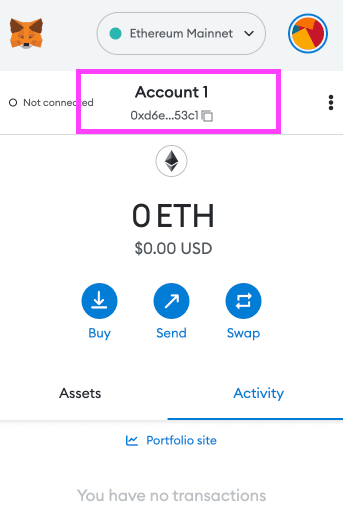
- Enter the address of your blockchain wallet into the transfer section of your exchange app and press send.
N.B. Make sure to check what network your tokens live on. I.e., ETH lives on the Ethereum network, so it’s an ERC-20 token and can only be stored in the Ethereum function of a blockchain wallet. Tokens launched on BNB Chain are called BEP-20 tokens and can only be stored in the BNB Chain function of the wallet.
These different blockchains can be added to Metamask by clicking on the network at the top to reveal a drop-down and clicking add network.
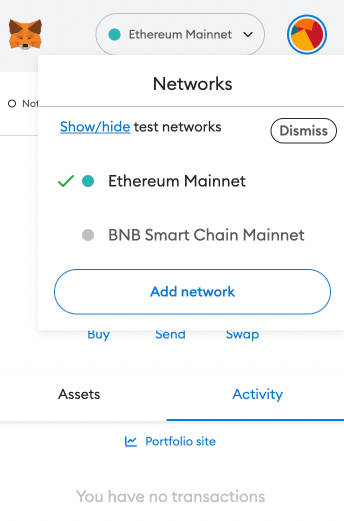
The RPC details required for the most popular networks are below; the Ethereum network is included by default, and you can find more here.
The RPC details required for the most popular networks are below; the Ethereum network is included by default, and you can find more here.
Polygon Network
- Network name: Polygon Mainnet
- Network URL: https://polygon-mainnet.infura.io
- Chain ID: 137
- Currency symbol: MATIC
BNB Chain
- Network Name: Binance Smart Chain
- Network URL: https://bsc-dataseed.binance.org/
- ChainID: 56
- Symbol: BNB
Moving assets off exchanges into a blockchain wallet is a prudent move for those wanting to engage with Web3 in the long term. Learning about self-custody of crypto and NFT assets is vital to becoming a Web3 native. Ultimately, it offers you the highest level of protection from incidents like the collapse of FTX.


All Comments