

Cointime

Download App
iOS & Android

Positioning Ahead Of The January Bitcoin ETF SEC Decisions

Summary: It would seem unlikely that the SEC would reject the Bitcoin Spot ETF applicants on January 10, 2024, after several discussions with those applicants and adjusting their S-1 filings. By Q1 2024, we expect Bitcoin to attempt to break above the 50,000 level. The expectations for a potential Bitcoin Spot ETF approval will likely hit the market between January 8 and January 10, 2024, making the January 12 options expiry attractive from a tactical perspective. Traders appear to price in that Bitcoin prices could swing by +/- 11% until then. Below, we discuss potential trades into the SEC Bitcoin Spot approval period.

Analysis

It would seem unlikely that the SEC would reject the Bitcoin Spot ETF applicants on January 10, 2024, after several discussions with those applicants and adjusting their S-1 filings. There has been considerable time and money spent on these applications and the re-filings, with the applicants rewriting their filings according to the demands set out by the SEC. Recently, we also heard that the applicants have moved closer to the terms set out by the SEC instead of the other way around.

While the SEC had waited until the last day in previous years to provide feedback to applicants, this time, the agency appears to have made an effort to provide feedback well ahead of time to align applicants.

Our view on December 8 of an expected 40,000 to 45,000 range-bound consolidation continues to play out. A key reason is that fiat-to-crypto inflows have paused after $7 billion was pumped through Tether’s minting process during the last eight weeks.

Surprisingly, Bitcoin’s funding rate remains elevated, indicating that leveraged traders have no interest in surrendering their upside positions and instead pay the punitive funding rate. By Q1 2024, we expect Bitcoin to attempt to break above the 50,000 level. The value of our short December 45,000 calls has dropped by -50% while our long January call declined by -20%. A small win.

The expectations for a potential Bitcoin Spot ETF approval will likely hit the market between January 8 and January 10, 2024, making the January 12 options expiry attractive from a tactical perspective. Traders appear to price in that Bitcoin prices could swing by +/- 11% until then. This would appear relatively narrow for such an important event.

We are keeping in mind that Bitcoin rose from 25,000 when BlackRock filed for an ETF on June 16 and prices hovering around 43,000/44,000. As we do not expect any SEC decision before January 8, traders could sell the January 5 expiry straddle with a strike of 43,000 and buy the straddle with expiry on January 12.

However, our preferred strategy would be to close out the calendar spread after Christmas (but before the new year starts), sell a 45,000 strike call for the January 5 expiry for $1,080, and buy a 45,000 strike call for the January 12 expiry for $1,720.

Bitcoin appears to be technically capped at 43,000 despite another positive refiling from BlackRock’s Bitcoin ETF application. This is a clear sign that applicants are almost coached by the SEC, and we struggle to entertain the view that the SEC would go to great lengths only to reject them again.

The Bitcoin technical indicators scream ‘sell-off around the corner’ as reversal indicators signal that the rally has run out of steam. Still, considering that we are so close to the holiday period, where trading volumes tend to be lower, and as we enter the event risk of January, technical signals should be set aside.

Exhibit: Ethereum/Bitcoin 30-day realized volatility spread at its lows
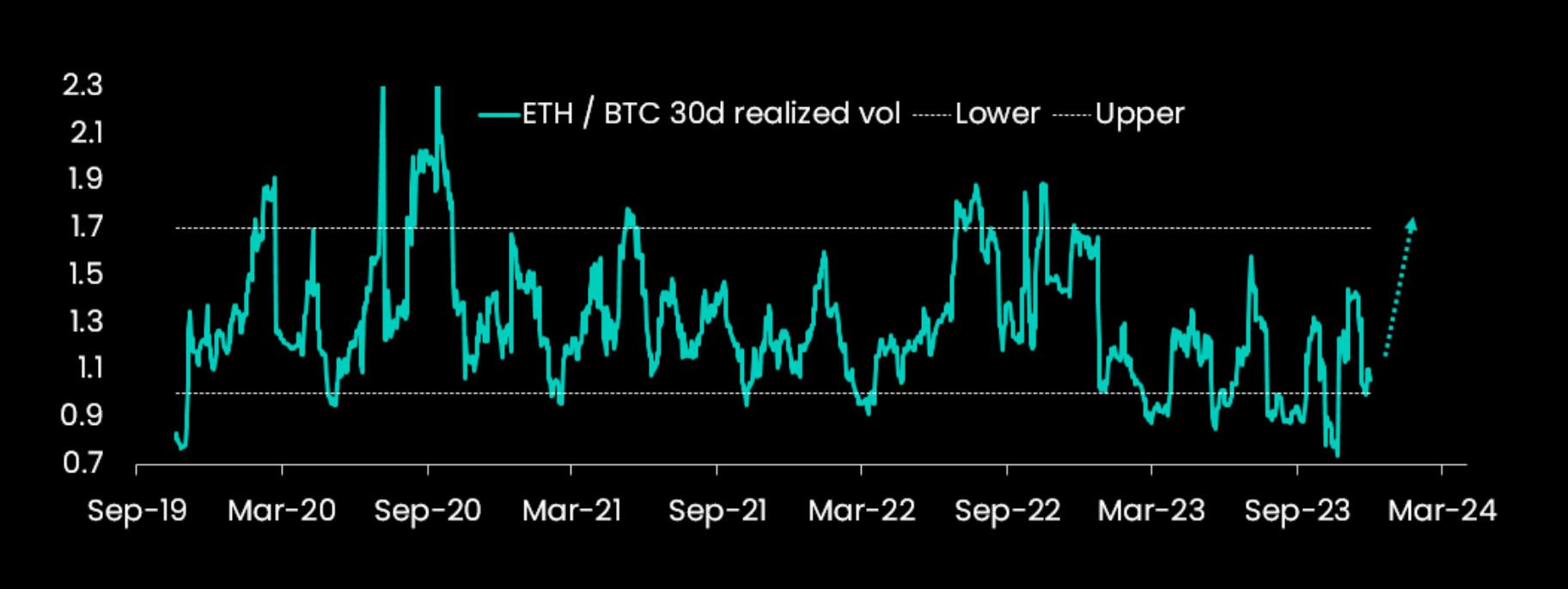
A key question arises if Bitcoin Spot ETFs are approved: will the SEC also approve Ethereum ETFs? This might be the case with a potential approval date of May 23, 2024. A Bitcoin ETF approval might disproportionally benefit Ethereum as the market is forward-looking. While Ethereum’s volatility tended to be higher, traders could currently buy Ether vol for the same price as Bitcoin vol.

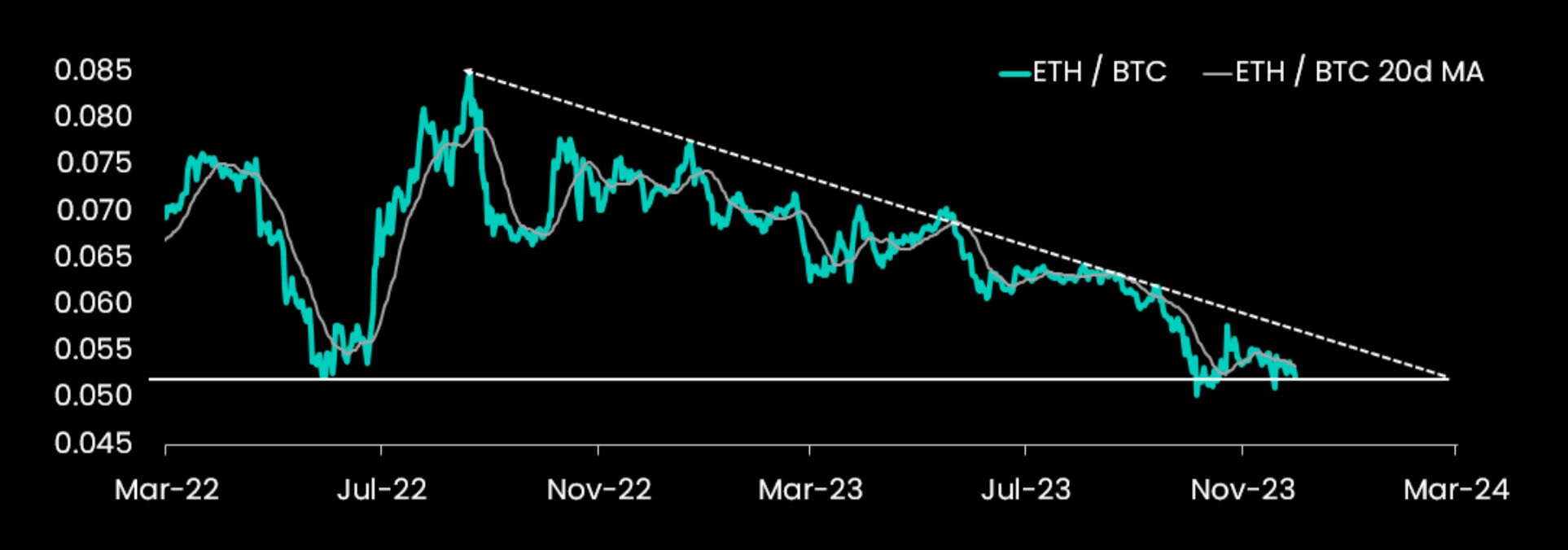
While there is no urgency to focus on Ethereum, traders should monitor if the Ethereum/Bitcoin ratio can break out of the triangle as, historically, higher beta assets – such as Ethereum – have tended to outperform Bitcoin as the bull markets progressed.
Comments

All Comments

Recommended for you

  • U.S. July Nonfarm Payrolls Fall by 23,000, Missing Market Expectations

    On August 7, U.S. nonfarm payrolls decreased by 23,000 in July, compared with market expectations of an increase of 80,000, and the previous value was an increase of 57,000.

  • US May and June Nonfarm Payroll Additions Revised Down by 103,000 Combined

    On August 7, the US Bureau of Labor Statistics: May nonfarm payroll additions were revised down from 129,000 to 63,000; June nonfarm payroll additions were revised down from 57,000 to 20,000. After the revisions, the combined additions for May and June were 103,000 lower than previously reported.

  • U.S. Rate Futures Market Sees Lower Odds of Fed September Hike

    On August 7, the probability of a Fed rate hike in September as priced by U.S. interest rate futures declined.

  • New York Gold Futures Top $4,400 per Ounce

    New York gold futures topped $4,400 per ounce, up 2.36% on the day.

  • Japan Finance Minister: FX Market Affected by Moves Not Driven by Actual Demand

    Japanese Finance Minister Satsuki Katayama said she and U.S. Treasury Secretary Bessent agreed that the foreign exchange market has been affected by moves not driven by actual demand.

  • BTC Breaks Through $65,000

    Market data shows BTC has broken through $65,000, currently reported at $65,007.44, with a 24-hour increase of 0.6%. The market is highly volatile, please exercise risk control.

  • Brent Crude Drops 2.00% Intraday to $81.07/Barrel

    Brent crude oil fell 2.00% during the day, now at $81.07 per barrel. (Jin Shi)

  • Trump: Data Centers May Be More Important Than Oil

    August 7 news, U.S. President Trump said in an interview with Punchbowl News, "I saw the other day that Texas seems to be opposed to building data centers. I think that's a mistake. I'm not taking a position—I just think it's a mistake, because there are other communities that want to build data centers. When a community is willing to accept data centers, it means a lot of money will flow into that community. I don't think they're ugly. Some of the data centers I've seen are the most incredible buildings I've ever seen. They are very important to the economy. If Texas says no to data centers, that's a mistake, because data centers may be more important than oil."

  • Trump to Meet with Mining Executives

    On August 7, according to CCTV International News, US President Trump will convene executives from some of the world's largest mining companies at the US State Department on August 7 local time, in an effort to take action to 'secure critical mineral supplies for the US and its allies.' Reuters reported that the US urgently needs critical minerals to replenish weapons inventories depleted during the war against Iran. During the more than five-month war with Iran, the US military expended large quantities of precision-guided missiles and air defense interceptors. US defense officials and lawmakers have warned that given existing production capacity constraints, replenishing some stockpiles could take years—although the Trump administration has denied reports of a so-called 'severe shortage of ammunition stockpiles.' According to Pentagon officials and defense companies, supplies of minerals such as rare earths, tungsten, germanium, and scandium are essential for manufacturing precision-guided missiles, fighter jets, armored vehicles, infrared sensors, and other advanced weapons systems. Expected attendees include industry giants such as global mining giant Rio Tinto Group, Australia's BHP, US Freeport-McMoRan, US Mountain Pass Materials, US Rare Earths, US Energy Fuels, and Canada's Metals Company. According to sources, the Trump administration plans to announce multiple deals and memorandums of understanding.

  • US Regulators Systematically Review Chinese AI Firms' Third-Country Computing Power Leasing

    August 7 news, according to Bloomberg, people familiar with the matter revealed that the U.S. government department responsible for investigating chip export control violations is reviewing Chinese AI companies' leasing of computing power in third countries to obtain Nvidia advanced chips.
