

Cointime

Download App
iOS & Android

Phishing, deepfakes, supply chain attacks to fuel 2026's biggest crypto hacks: CertiK

Real-time deepfakes, phishing attacks, supply chain compromises and cross-chain vulnerabilities will likely be the root of some of the biggest hacks in 2026, according to CertiK senior blockchain investigator Natalie Newson.

The industry has already lost over $600 million to hacks in 2026, due largely to two North Korea-linked crypto thefts in April, including the $293 million Kelp DAO exploit on Saturday involving a single point-of-trust failure in cross-chain messaging protocol LayerZero’s infrastructure, and the $280 million exploit of the Drift Protocol.

Another DPRK-linked attack involved the use of AI for social engineering. Crypto wallet Zerion revealed on April 15 that North Korean-affiliated hackers used AI in a long-term social engineering attack to steal about $100,000 from the company’s hot wallets.

Newson warned that, in “some aspects,” the acceleration of AI will only worsen crypto attacks.
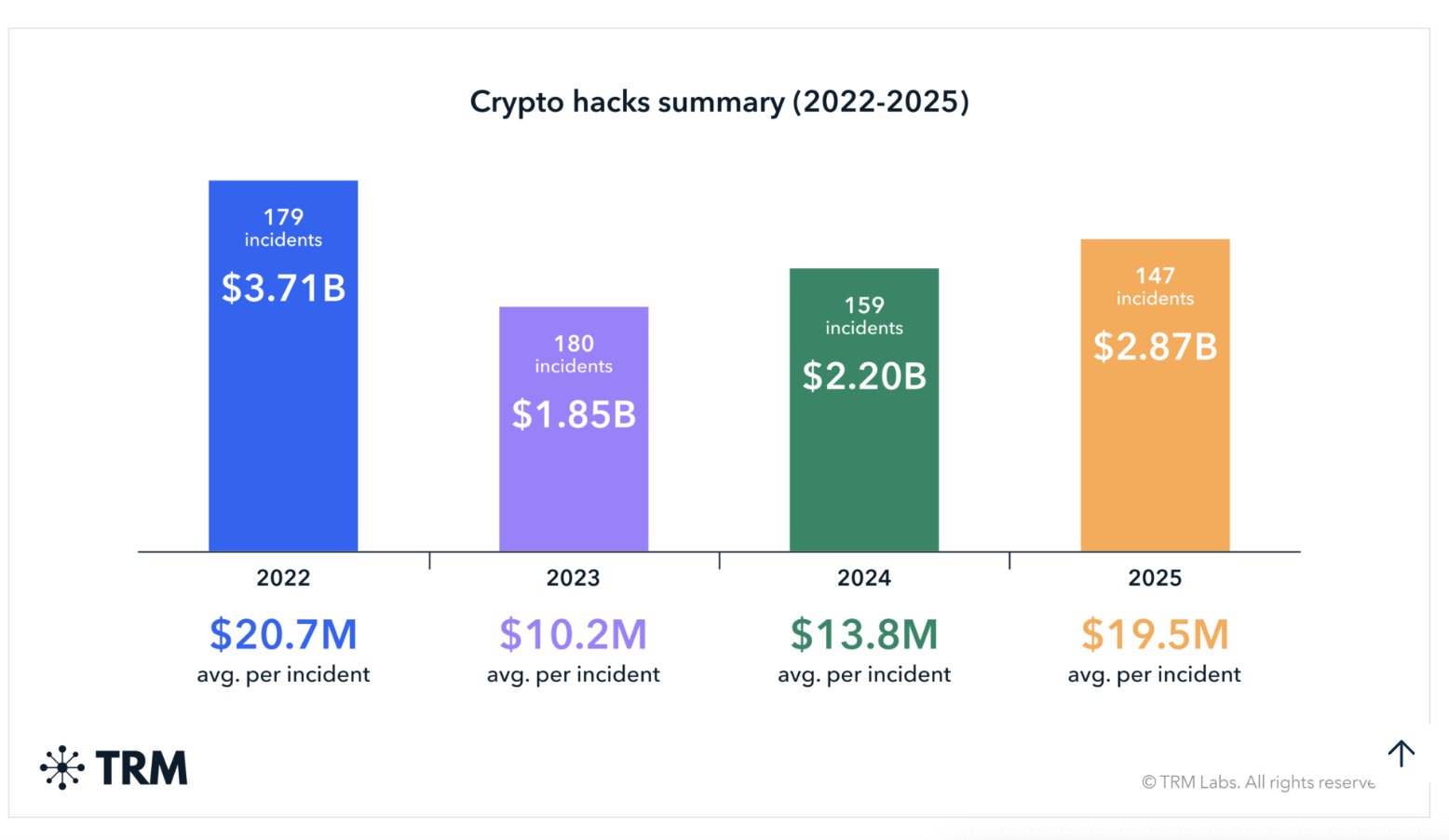
  The average size of crypto hacks rose to $19.5 million in 2025. Source: TRM Labs


 “The best way for investors to protect themselves is to be aware of the current threats they may face... For instance, to protect yourself against phishing, always verify the authenticity of URLs and smart contracts,” Newson said.

Newson said that as exploits become more sophisticated, retail investors should explore storage options outside of crypto exchanges. 

“Using cold wallets can help keep assets that you don’t use regularly safe and allows you to sign transactions without ever exposing your private keys,” she said. 

AI could be used to defend against attacks

“There are now more convincing deepfakes, autonomous attack agents, and ‘agentic AI’ that can autonomously scan smart contracts for bugs, draft exploit code and execute attacks at machine speed," she said.

On April 6, Cointelegraph reported that a threat actor known as “Jinkusu” was allegedly selling cybercrime tools designed to bypass Know Your Customer (KYC) checks at banks and crypto platforms, using deepfakes and voice manipulation.

“At the same time, AI can also be one of the biggest defenses,” said Newson. 

Cointelegraph recently reported that an increase in AI use has led to a flood of bug bounty submissions, both valid and invalid. Anthropic’s AI model Claude Mythos, claimed to have the ability to find vulnerabilities in major operating systems, has been deployed defensively with a release to a limited set of tech firms.

Regulators are escalating in response

CertiK shared with Cointelegraph in December 2025 that crypto hackers stole $3.3 billion in 2025. 

The company said supply-chain breaches emerged as the most damaging threat, accounting for $1.45 billion in losses across just two incidents, including the $1.4 billion Bybit hack in February 2025.

"The Bybit exploit signals that well-capitalized, well-coordinated threat actors are becoming more active across the ecosystem," the report said, predicting a rise in the “sophistication” of supply chain attacks as attackers target more infrastructure providers.

Regulators are responding. On April 9, the US Department of the Treasury’s Office of Cybersecurity and Critical Infrastructure Protection (OCCIP) announced on Thursday that it is expanding its cybersecurity threat identification program to include digital asset companies.
Comments

All Comments

Recommended for you

  • Lazarus-linked macOS malware hits crypto and fintech firms

    Security researchers linked a new “Mach-O Man” malware kit to a Lazarus campaign that steals credentials and accesses corporate systems on macOS.

  • Anthropic's Secondary Market Valuation Reaches $1 Trillion, Surpassing OpenAI

    On April 23, Anthropic's valuation on private equity trading platforms like Forge Global has risen to around $1 trillion, surpassing OpenAI's $880 billion. It is reported that the valuation of this artificial intelligence startup has rapidly increased due to buyers competing to purchase the increasingly scarce secondary market shares of Anthropic. (Dongxin News Agency)

  • BTC Surpasses $78,000

    Market data shows that BTC has surpassed $78,000, currently priced at $78,000.81, with a 24-hour decline of 0.14%. The market is experiencing significant volatility, so please ensure proper risk management.

  • Bitmine Allegedly Acquires 100,000 ETH Worth $233.7 Million

    On April 23, according to monitoring by Lookonchain, three new addresses suspected to be associated with Tom Lee's Bitmine (0xB6a8...9c9E, 0xc2e0...2831, 0x4e5C...276c) received 100,000 ETH from BitGo, valued at $233.7 million.

  • Musk: AI Chip Shortage Expected in the Future

    On April 23, Tesla CEO Elon Musk stated during an earnings call that the company initiated the Terafab chip factory project due to an anticipated severe shortage of AI chips in the future. He remarked, "In terms of industry growth rates, logic chips, and even more so storage chips, we expect to encounter bottlenecks if we do not manufacture chips ourselves. This is the reason for the birth of Terafab." (Dongxin News Agency)

  • US Spot Bitcoin ETF Sees Net Inflow of $331.9 Million Yesterday

    On April 23, according to monitoring by Trader T, the US spot Bitcoin ETF experienced a net inflow of $331.9 million yesterday.

  • US Spot Ethereum ETF Sees Net Inflow of $96.43 Million Yesterday

    On April 23, according to monitoring by Trader T, the US spot Ethereum ETF saw a net inflow of $96.43 million yesterday.

  • U.S. State Department Urges American Citizens to Leave Iran Immediately

    On April 23, the Bureau of Consular Affairs of the U.S. State Department posted on social media that, given Iran's announcement of partial airspace reopening, American citizens in Iran should leave immediately. The post advised U.S. citizens to stay informed about the situation through local media and to consult commercial airlines for information on flights departing Iran. Additionally, U.S. citizens can also travel by land to Armenia, Azerbaijan, Turkey, and Turkmenistan, but should avoid areas along the Iran-Afghanistan, Iran-Iraq, or Iran-Pakistan borders.

  • Tesla: Increasing Investment in AI Computing Power and Advancing New Battery and Material Factories

    On April 23, Tesla's official blog announced that the company is increasing its investment in AI computing power to advance the construction of new battery and battery materials factories. This move is also aimed at further preparing for the production of the third-generation Megapack energy storage system, the Tesla autonomous electric vehicle Cybercab, and the Tesla electric truck Semi.

  • USA: Deploying the Strongest Military Force in History to the Middle East

    On April 23, local time April 22, the U.S. Central Command announced that since the U.S. military began its blockade operations in the waters related to the Strait of Hormuz on April 14, it has requested 31 vessels to turn around or return to port as part of the blockade. The U.S. Central Command also stated that the military is currently deploying the most comprehensive and powerful military force ever seen across the Middle East.
