


As the bubble in the crypto industry gradually dissipates, a surprising trend is emerging. In 2025, total funding for crypto payment companies soared to $2.6 billion, exceeding the combined total of the previous three years. Stripe acquired Bridge for $1.1 billion, and Mastercard acquired BVNK for $1.8 billion. Traditional financial giants are voting with real money, declaring that the payment track has broken away from the broader crypto industry to become one of the few breakthrough applications with genuine, real-world utility.
Amidst this capital frenzy, a new name is emerging: PayStill. It is not just another payment tool; it is an ecological protocol that is redefining the value of payments.
Redefining Payments: From the Endpoint of Value to its Starting Point
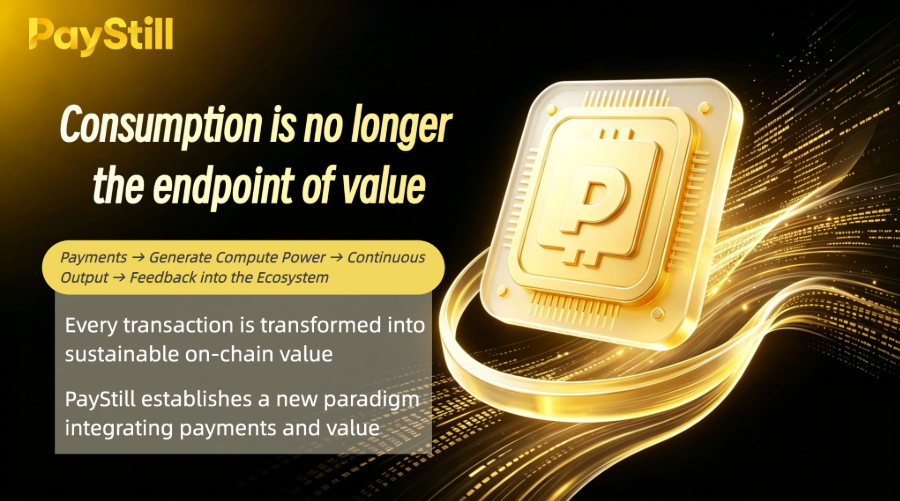
In traditional economic logic, consumption is the endpoint of the value chain: Production → Circulation → Sales → Consumption (Endpoint). PayStill proposes a disruptive paradigm: Consumption is production.
In the world of PayStill, a payment is no longer merely the end of a transaction—a simple clearing of goods and money—but a brand-new starting point for value creation. This shift is built on three core mechanisms:
- Consumption Generates Credit: Every transaction generates verifiable digital rights on-chain, accumulating as "consumption computing power" that continuously yields returns. This isn't a virtual number based on a platform's unilateral promise, like traditional reward points. Rather, it is based on the FUSN Still Protocol's time-weight and irreversible fact-confirmation mechanisms, transforming real consumption into programmable, financialized digital assets on-chain.
- Credit is Circulable: Traditional points are trapped within a single platform's walled garden, but PayStill's value exists as PAYS tokens, which circulate freely worldwide. Users can spend them globally via U-cards, shop in on-chain malls, or cash them out on decentralized exchanges, truly returning the ownership of consumption data to the users.
- Circulation Creates Value Appreciation: The most counter-intuitive design is this: Unlike traditional points that depreciate over time, PAYS tokens appreciate through an extreme deflationary mechanism. The initial supply is 210 million, with a final target of 21 million. The more active the ecosystem and the more frequent the consumption, the faster the burn rate. As the token becomes scarcer, its value automatically rises. This is a mathematical rule hardcoded into smart contracts.
This means PayStill breaks the zero-sum game between consumers and merchants. In the traditional model, consumers spend money to buy goods, and the value transfer is complete. With PayStill, consumers get goods + computing power + continuous yield; merchants get sales + traffic influx + zero fees; promoters get multi-tier rewards; and the public chain ecosystem gains real data backing. One payment, a win-win for all four parties—this is true value aggregation.
The Differentiated Advantages of a Payment Value Aggregator
PayStill positions itself as a "payment value aggregation infrastructure," a designation that highlights its fundamental difference from traditional payment products and other Web3 projects.
Differences from Traditional Payment Products: Self-Built Channels + Consumption Value Appreciation
Bridge provides a stablecoin payment API, and BVNK builds cross-border payment channels; both are essentially tool-layer innovations. Architect Partners hit the nail on the head in their annual report: "Channel distribution is the biggest headache for every stablecoin and related payment company." This is exactly why BVNK was ultimately acquired by Mastercard—it needed access to Mastercard's payment network.
PayStill's breakthrough lies in building a complete, proprietary channel system. Through the DrixPay global payment network, its U-card already covers over 200 countries within the Visa and Mastercard systems, enabling global payments without relying on third parties. Not depending on third parties means not being bottlenecked—this is PayStill's first moat.
More importantly, PayStill is not just a payment channel, but a value aggregation protocol. It converts consumer behavior into FUSN cloud computing power: when users shop in the on-chain mall using PAYS, the merchant's discounted amount is multiplied by 5 to generate cloud computing power. This power generates a daily yield of 0.05% in FUSN native coins. The multi-scenario ecosystem—including on-chain malls, short dramas, games, and social networking—provides real use cases for the token, ensuring it is not purely a speculative asset.
Differences from Traditional Web3 Projects: Real Value Anchoring
The dilemma of traditional Web3 projects is that they spin great narratives but lack real-world implementation. Token prices rely on secondary market speculation without real value backing, and projects operate independently, failing to form synergies. PayStill has chosen a completely different path:
- Driven by Real Scenarios: Based on DrixPay's global payment network, every payment corresponds to the actual circulation of goods. Merchant discounts enter a foundational pool to form a floor price support. This is a verifiable, sustainable business model.
- Gold-Standard Output Mechanism: The asset synthesis model provides stable value anchoring. The output of mining machines is priced in USDT, entirely decoupled from the price fluctuations of PAYS. Whether the token price rises or falls, the USDT yield remains fixed, and the ROI cycle can be precisely calculated. This is highly attractive to investors seeking stable cash flows.
- Four-in-One Synergy: TET traffic, the PayStill protocol, the FUSN foundational layer, and DrixPay scenarios resonate to create value. This isn't merely the stacking of four independent projects; it's a standardized synergy achieved through the ECI (Ecosystem Connection Interface) protocol. Any project can integrate using a "50% old assets + 50% USDT" model, upgrading from a single isolated project to a scalable ecological protocol.
PayStill focuses on how to make every payment create value. These are two entirely different business philosophies.
Ecological Moat: Dual Endorsement + Protocol-Level Value Capture
PayStill is co-initiated by the FUSN financial-grade execution public chain and the DrixPay global lifestyle financial infrastructure, and is backed by a Hong Kong-listed company. This background provides the project with a level of compliance and security that traditional Web3 projects struggle to match.
- FUSN Provides the Technical Foundation: Equipped with financial-grade smart contract execution capabilities, the Still Protocol's time-weight model ensures long-term participants receive continuously growing returns. It supports complex financial primitives like credit periods, lending, and clearing, with preparations for a Nasdaq Pre-IPO launch starting in 2027.
- DrixPay Provides the Scenario Network: Its global payment network covers 200+ countries, with U-cards integrated into the Visa and Mastercard systems. A matrix of applications—on-chain malls, short dramas, games, and social apps—provides real-world use cases, allowing the TET ecosystem's user base to seamlessly plug into PayStill.
- Protocol-Level Value Capture: Unlike application-layer projects that rely solely on user growth, infrastructure protocols capture value by being integrated: every payment made through the PayStill protocol contributes fees, every merchant joining PayStill expands the protocol's consumption scenario coverage, and every public chain integrating PayStill enhances the protocol's cross-chain liquidity.
This architecture parallels the logic of liquidity aggregators in the DeFi space. In DeFi, liquidity aggregators pool liquidity from multiple DEXs to offer users optimal trading routes. PayStill applies this logic to consumer payment scenarios, generating sustainable revenue.
Seizing the Golden Window for Crypto Payments
Currently, PayStill faces three major strategic windows of opportunity:
- Regulatory Level: The Trump administration's pro-crypto policies are driving a clearer regulatory framework for stablecoins, and Circle's IPO sets a benchmark for industry compliance.
- Market Level: Traditional financial institutions like Visa, Mastercard, and Franklin Templeton have done a 180-degree turn, shifting from resistance to a full embrace of crypto.
- Scale Level: Facing a $150 trillion global cross-border payment market, crypto payment penetration is still under 1%, leaving massive room for growth. In 2025, stablecoin transaction volume surged by 72% to hit $33 trillion, and this is just the tip of the iceberg.
PayStill's development roadmap is clear and pragmatic: in 2026, achieve a TVL exceeding $5 million and surpass 100 merchants; in 2027, initiate Pre-IPO preparations and launch cross-chain bridging features; by 2028, become the leading stablecoin payment infrastructure in the Asia-Pacific region.
However, PayStill's ultimate goal is to become an un-acquirable ecological protocol—because it is not a tool, but a value network; not a product, but an open standard.
The Paradigm Shift in Payments
In PayStill's vision, the future of payments should look like this: the credit generated from your consumption on Platform A can be used on Platform B; the consumption of today continues to generate yield tomorrow; consumption credit can pay for your coffee, rent, and flights; and consumption data is owned by the user, rather than monopolized by tech giants.
This is not a utopian fantasy, but a goal that can be progressively realized through thoughtful protocol design, robust economic models, and strict compliance frameworks. What PayStill is building is the standardized infrastructure layer for Web3 consumer finance—making every transaction a value anchor for ecological liquidity.
When payment is no longer merely a transfer of funds, but the starting point of value creation, we are witnessing the dawn of an entirely new era.


All Comments