

Cointime

Download App
iOS & Android

Open sourcing op-viem and op-wagmi

TLDR: Today, we’re open sourcing op-viem and op-wagmi, extensions to the popular developer tools viem and wagmi. We’ve developed these libraries, in collaboration with the community, to empower developers to build faster and easier on OP Stack chains.

Building for OP chains with op-viem and op-wagmi

Base aims to bring the next million builders and billion users onchain, giving builders an easy-to-use, fast, and cheap development platform.

While L2s like Base offer developers cost and speed advantages, they can have their own development challenges. As we started to build on the OP Stack ourselves, we found gaps in tooling that weren't addressed by existing Ethereum development frameworks. That’s why we decided to extend popular Ethereum libraries for developers building on the OP Stack, and are open sourcing them so that anyone can review the codebase and contribute.

Why?

Today, developers building on Ethereum can use a number of libraries to simplify development, including the popular tools viem and wagmi. Viem is a low-level library compatible with any JavaScript code, abstracting the complexity of sending transactions on Ethereum. Wagmi, built on Viem, lets developers build an application’s frontend using modern React idioms.

Although viem and wagmi work out-of-the-box on the OP Stack, they don’t easily support features specific to L2s, such as bridging and cross-layer messaging. Developers looking to build these features into their applications still need to write custom code, making the process more complex and error-prone. For example, if a developer called the bridge contract code incorrectly, user assets could be lost.

With op-viem and op-wagmi, developers can add OP Stack bridging functionality into any application with dramatically less code and time spent. For example, creating a withdrawal proof can now be done via the code below, which replaces a 100+ line implementation of a React hook that would be needed without these libraries.
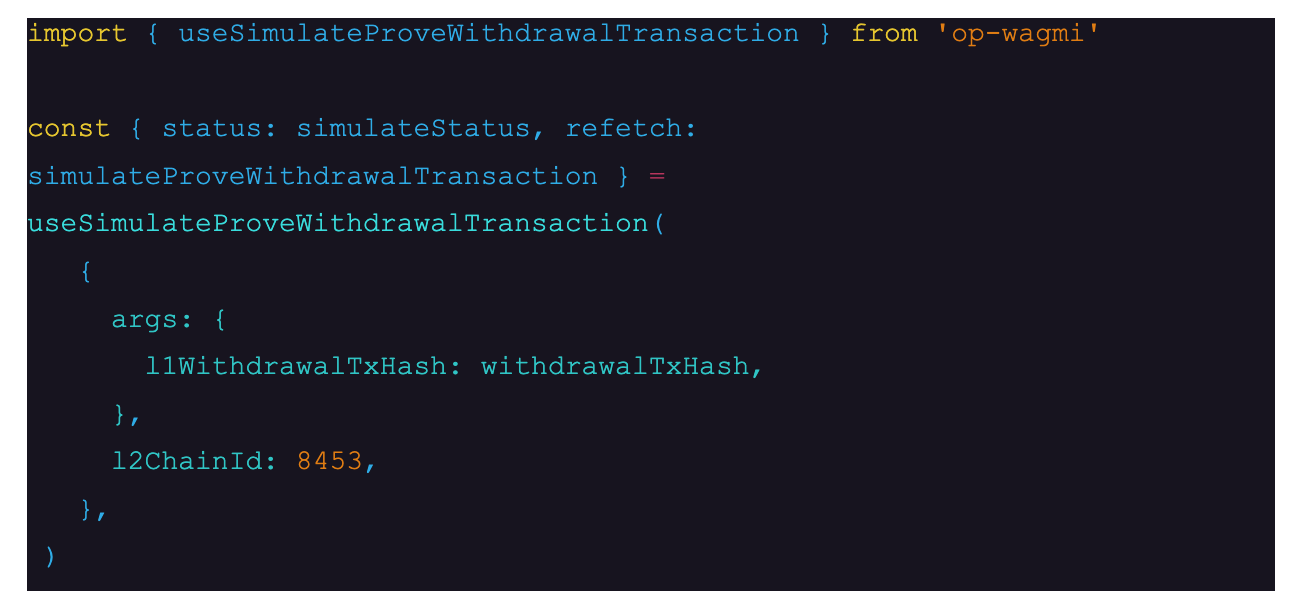
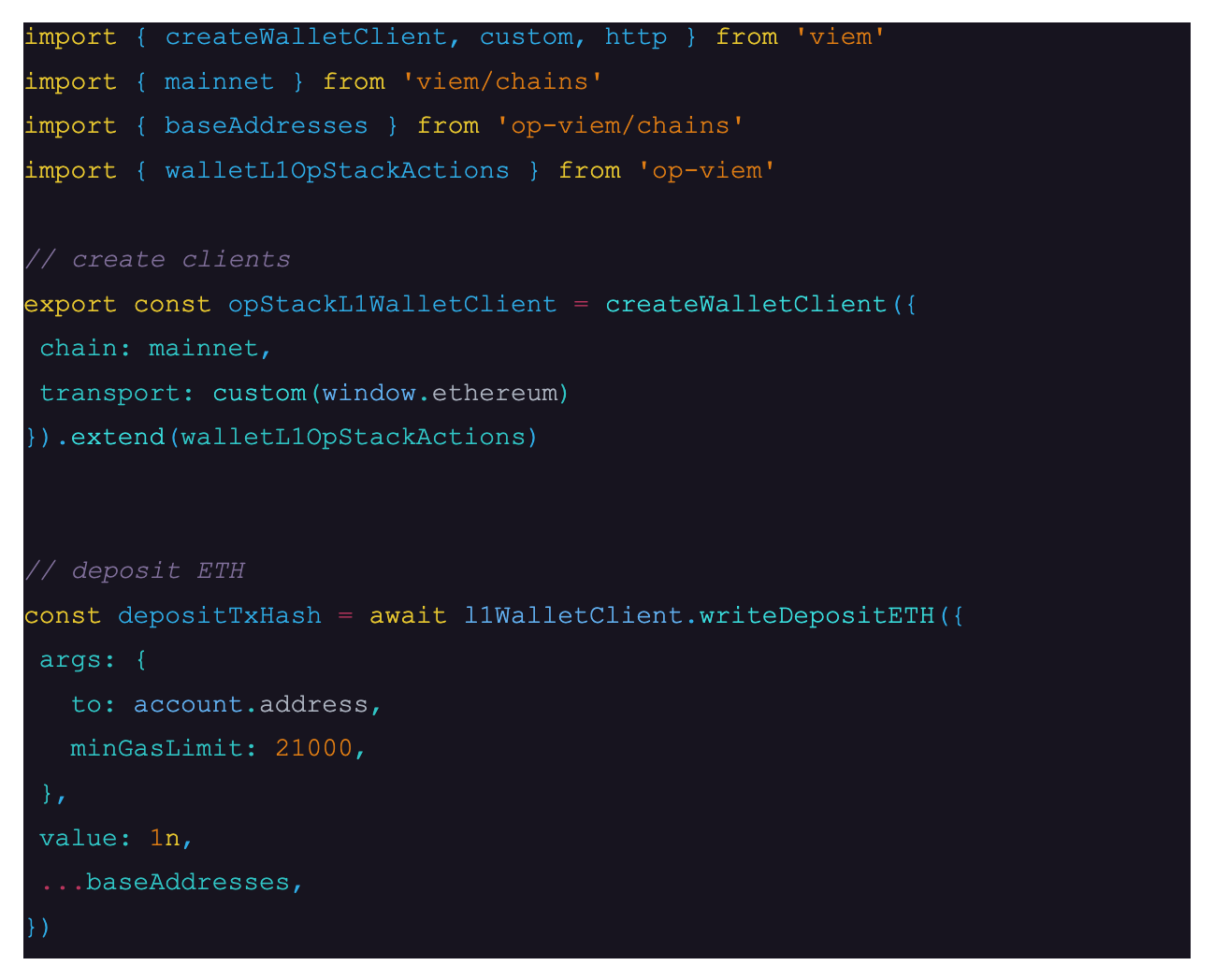
The full-featured React hooks in op-wagmi streamline adding cross-chain functionality to React-based dapps. For JavaScript developers using frontend frameworks other than React, op-viem provides all the building blocks needed to adopt the same functionality to their framework of choice.
Growing the onchain ecosystem, one bridge at a time

L2s enable users to use apps quickly and cheaply. But when users start onchain, they often don't have assets on an L2 right away.

As more and more users get onchain and transact on L2s, developers will need to offer their users a secure and intuitive way to bridge as a critical first step.

With op-viem and op-wagmi, you can build bridging functionality inside your apps with minimal custom code. Op-viem also provides lower-level utilities that can help with things like getting L2 hashes for deposit transactionsgetting outputs on L1 for L2 blocks, and more.

Public goods

Base is committed to building in the open, and in the spirit of empowering the entire ecosystem, we built op-viem and op-wagmi as open-source libraries. Our goal is to not only benefit builders on Base, but everyone who is building on the OP Stack and contributing towards the Superchain vision.

You can check out the code for op-viem and op-wagmi, and contribute any feedback that you might have. We're excited to hear from you and to see what you build!

Spotted a cool project built on Base? Don’t forget to nominate them for a Base Grant!

Comments

All Comments

Recommended for you

  • U.S. July Nonfarm Payrolls Fall by 23,000, Missing Market Expectations

    On August 7, U.S. nonfarm payrolls decreased by 23,000 in July, compared with market expectations of an increase of 80,000, and the previous value was an increase of 57,000.

  • US May and June Nonfarm Payroll Additions Revised Down by 103,000 Combined

    On August 7, the US Bureau of Labor Statistics: May nonfarm payroll additions were revised down from 129,000 to 63,000; June nonfarm payroll additions were revised down from 57,000 to 20,000. After the revisions, the combined additions for May and June were 103,000 lower than previously reported.

  • U.S. Rate Futures Market Sees Lower Odds of Fed September Hike

    On August 7, the probability of a Fed rate hike in September as priced by U.S. interest rate futures declined.

  • New York Gold Futures Top $4,400 per Ounce

    New York gold futures topped $4,400 per ounce, up 2.36% on the day.

  • Japan Finance Minister: FX Market Affected by Moves Not Driven by Actual Demand

    Japanese Finance Minister Satsuki Katayama said she and U.S. Treasury Secretary Bessent agreed that the foreign exchange market has been affected by moves not driven by actual demand.

  • BTC Breaks Through $65,000

    Market data shows BTC has broken through $65,000, currently reported at $65,007.44, with a 24-hour increase of 0.6%. The market is highly volatile, please exercise risk control.

  • Brent Crude Drops 2.00% Intraday to $81.07/Barrel

    Brent crude oil fell 2.00% during the day, now at $81.07 per barrel. (Jin Shi)

  • Trump: Data Centers May Be More Important Than Oil

    August 7 news, U.S. President Trump said in an interview with Punchbowl News, "I saw the other day that Texas seems to be opposed to building data centers. I think that's a mistake. I'm not taking a position—I just think it's a mistake, because there are other communities that want to build data centers. When a community is willing to accept data centers, it means a lot of money will flow into that community. I don't think they're ugly. Some of the data centers I've seen are the most incredible buildings I've ever seen. They are very important to the economy. If Texas says no to data centers, that's a mistake, because data centers may be more important than oil."

  • Trump to Meet with Mining Executives

    On August 7, according to CCTV International News, US President Trump will convene executives from some of the world's largest mining companies at the US State Department on August 7 local time, in an effort to take action to 'secure critical mineral supplies for the US and its allies.' Reuters reported that the US urgently needs critical minerals to replenish weapons inventories depleted during the war against Iran. During the more than five-month war with Iran, the US military expended large quantities of precision-guided missiles and air defense interceptors. US defense officials and lawmakers have warned that given existing production capacity constraints, replenishing some stockpiles could take years—although the Trump administration has denied reports of a so-called 'severe shortage of ammunition stockpiles.' According to Pentagon officials and defense companies, supplies of minerals such as rare earths, tungsten, germanium, and scandium are essential for manufacturing precision-guided missiles, fighter jets, armored vehicles, infrared sensors, and other advanced weapons systems. Expected attendees include industry giants such as global mining giant Rio Tinto Group, Australia's BHP, US Freeport-McMoRan, US Mountain Pass Materials, US Rare Earths, US Energy Fuels, and Canada's Metals Company. According to sources, the Trump administration plans to announce multiple deals and memorandums of understanding.

  • US Regulators Systematically Review Chinese AI Firms' Third-Country Computing Power Leasing

    August 7 news, according to Bloomberg, people familiar with the matter revealed that the U.S. government department responsible for investigating chip export control violations is reviewing Chinese AI companies' leasing of computing power in third countries to obtain Nvidia advanced chips.
