

By: Tanay Ved
Introduction
Fifteen years have passed since Bitcoin's genesis block was mined in 2009, marking the birth of a revolutionary system of money. The introduction of Bitcoin laid the foundation for the emergence of the $1.6T digital asset economy, serving as the inaugural gateway into the world of blockchains and digital assets for many. Now, a decade and a half later, the industry is eagerly awaiting a pivotal moment in the history of Bitcoin: the launch of a spot ETF. As we approach this milestone, we are transitioning into a new phase for the largest crypto-asset and network. In this issue of Coin Metrics’ State of the Network, we delve into the digital asset market structure and examine dynamics leading us into this exciting chapter.
Road to the ETF
The journey toward launching a bitcoin spot Exchange-Traded Fund (ETF) has been lengthy and challenging, but nevertheless an unprecedented one. 2023 marked the commencement of the 'Cointucky Derby', a period characterized by the filing of 11 spot ETF applications from leading asset managers and financial institutions, including BlackRock, Fidelity, VanEck, and others. We saw complex dialogue between the issuers and the U.S. Securities and Exchange Commission (SEC), delving into the operational and structural nuances of the proposed ETFs. These discussions brought to light key aspects such as the selection of ETF custodians, the decision to adopt a cash create model for redemption mechanisms, fee structures, authorized participants facilitating the creation and redemption process, and the consideration of initial capital injections to catalyze inflows.
As we draw closer to the SEC’s January 10th deadline, final amendments to the S-1 filings highlight a competitive fee structure battle with ARK reducing its management fees from 0.8% to 0.25%, positioning itself competitively against Fidelity's 0.39% and BlackRock's 0.2%, while the lowest long term fee comes from Bitwise at 0.24%. It's clear that issuers are prioritizing market share over short-term profits, indicating the likelihood of substantial demand around inflows. The industry's anticipation for the spot bitcoin ETF is palpable, with participants eagerly monitoring every update, and issuers strategically positioning themselves to capture a significant share of AUM.

Source: Coin Metrics Reference Rates & Market Data Feed
This sentiment is mirrored in the price of BTC, which surged 156% in 2023. Trusted spot volumes rebounded during the first quarter, but experienced a plateau in the aftermath of the Silicon Valley Bank crisis in March. However, on the back of ETF anticipation, volumes have started to climb back again—currently averaging around $10B, albeit lower than volumes seen prior to FTX’s collapse. Bitcoin’s liquidity will also remain a crucial factor in enabling efficient trading of the asset, particularly with ETFs on the horizon.
Spot & Futures Exchange Dynamics
The share of BTC spot trading volume across exchanges reveals an increasingly distributed exchange picture. This is reflected in Binance’s dominance contracting from over 75% in Q1, to below 30% as of January 2024. Other exchanges such as Coinbase and Bullish have benefitted from this, resulting in a more even distribution of trading volumes across centralized exchanges.

Source: Coin Metrics Market Data
Several lingering questions persist around the role of exchanges, particularly in light of the cost-efficient structure introduced by the launch of spot ETFs. However, investors will now have another avenue to gain exposure to BTC—helping cater to the risk tolerance of diverse cohorts. While some may seek a safe and cost-efficient method for financial exposure to the asset, making the introduction of ETFs a huge boon, others may prefer the ability to self-custody their bitcoin for which exchanges could serve as a crucial gateway.
Source: Coin Metrics Market Data & Google Finance
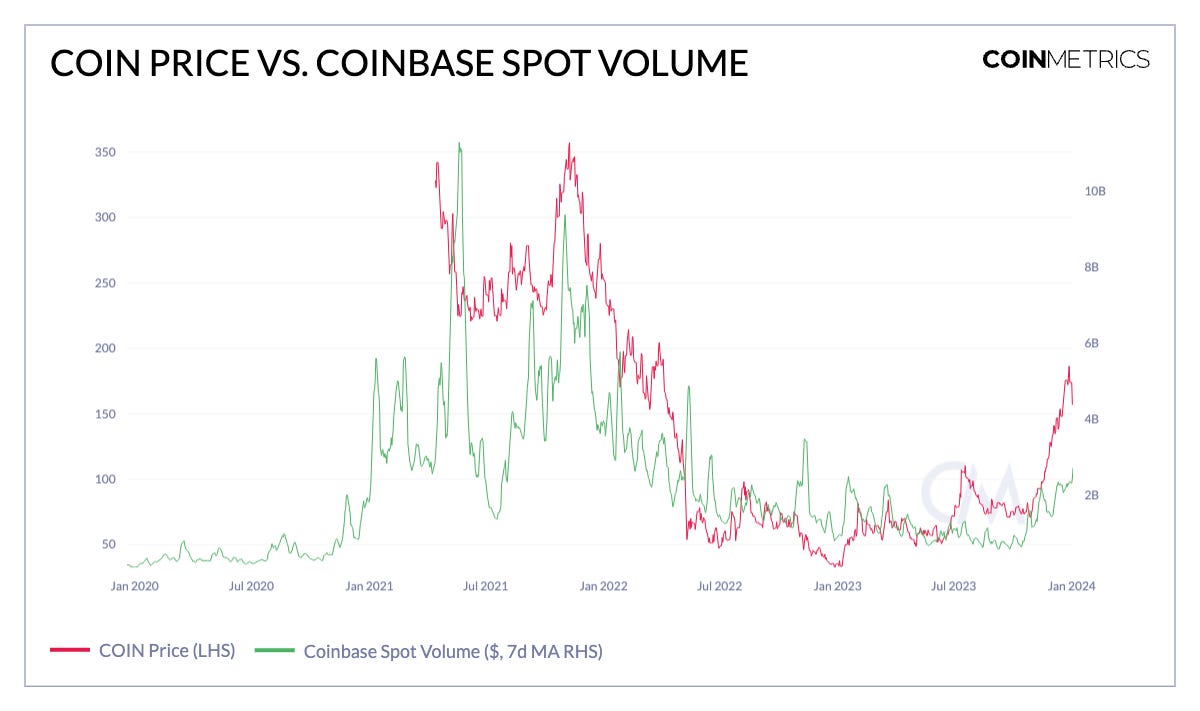
The role of onshore exchanges will also be under scrutiny. However, with Coinbase playing the role of a custodian for a majority of applicants, the largest US exchange is likely to benefit not only from an additional revenue stream to their diverse business model, but also potentially through increased trading volumes as a larger pool of participants enter the fray. With the recent rebound in digital asset markets, average spot trading volumes on Coinbase have already climbed back over $2.5B and are likely to continue growing with sustained market activity.

Source: Coin Metrics Market Data
The derivatives landscape has played a large part in shaping market structure dynamics in the lead up to the ETFs. With futures open interest on the Chicago Mercantile Exchange (CME) surging above its all time high to $5.4B, we’re seeing digital asset markets transition from primarily retail driven to a more institutionally active playing field. This is likely to expand further, as a large cohort of financial advisors, registered investment advisors (RIA’s) and family offices managing trillions of dollars increasingly incorporate BTC into traditional portfolios.
While the week surrounding the ETF may bring heightened short-term volatility, as witnessed with the open interest wipeout on last week's offbeat report that the SEC may reject all ETF applications, the long term outlook paints a different picture.
Volatility & Return Characteristics
The historical volatility of BTC and other crypto-assets has often been a point of criticism, casting them as high-risk investments. While that holds true particularly during their early phases, BTC’s average realized volatility has trended down over the long term, signaling its evolution into a more mature asset. The chart below illustrates a similar trend for ETH and SOL, which having entered the market at a later stage, exhibit greater volatility relative to BTC. Within the crypto-asset universe, it's clear that these assets display varying levels of volatility and maturity, thus influencing their overall market structure and roles in an investment portfolio.

Source: Coin Metrics Market Data
Over a 5 year horizon, putting the risk and return of digital assets in perspective with other assets in the investable universe reveals intriguing insights around their role in a portfolio. Traditional assets like Gold display the lowest potential for risk and returns, leading to its safe haven status and puts the commodity in another universe relative to large-cap technology equities such as Apple (AAPL), Microsoft (MSFT) and Amazon (AMZN), which all exhibit similar characteristics. On the other hand, digital assets illustrated in this chart display distinct characteristics. BTC as the pioneering and largest digital asset—is less volatile than ETH and SOL, but offers greater potential for returns than technology stocks, suggesting its evolution into a mature, yet growth oriented asset. Additionally, its largely uncorrelated nature to traditional assets further accentuates its value in diversifying portfolios and enhances its appeal to investors seeking uncorrelated returns.

Source: Coin Metrics Reference Rates & Google Finance
In amalgamation, these traits cement BTC’s stature as the premier, largest and most liquid digital asset to potentially receive a spot ETF instrument—a testament to its market maturity. With ETH exhibiting similar traits, it's poised to be the next in line to follow.
Conclusion
Bitcoins journey from a novel digital currency to an established, globally recognized network and asset class is on the verge of being fulfilled. The advent of spot ETFs is a major step in this direction, a watershed moment bringing a decade-long quest to an end and a pivotal juncture in market evolution. As we transition into a new phase for the largest crypto-asset, Bitcoin is geared to solidify its importance not only within the realm of the digital asset ecosystem, but also on the global financial stage.


All Comments