


The Collapse of the Old Liquidity Order and the Awakening of Sovereignty
If we define the first five years of DeFi as the “pioneering era of infrastructure,” then looking back from 2026, we must confront a harsh truth: the vast majority of protocol liquidity is still “rented” rather than truly owned.
Within this overlooked old order, both liquidity providers (LPs) and project teams are essentially tenants in the financial system. You cultivate capital and take on risk, yet the ownership of the “land” and the richest yields remain in the hands of centralized entities. When subsidies run out, the borrowed prosperity disappears like a mirage.
The emergence of DMDAO (DeFi Matrix DAO) signals the end of this “liquidity tenancy.” We have built a distributed, profit-autonomous market-making matrix designed to algorithmically redefine ownership boundaries. This is not merely a technological upgrade—it is a paradigm shift toward “liquidity sovereignty”, converting every unit of trading premium from external rent into internal assets that fully flow back to the community.
1. The Hidden Reefs Behind Prosperity: Overlooked “Liquidity Rent”
In the first act of DeFi, project teams and LPs were trapped in a costly and unsustainable loop, which we call the “liquidity rental trap.”
In traditional market-making models, project teams must pay large retention fees to centralized market makers and lend out core tokens to maintain stable trading. Essentially, this is paying high rent for a temporary illusion of liquidity. Meanwhile, ordinary LPs endure impermanent loss, while the richest trading spreads—rightfully belonging to the ecosystem—are quietly extracted by these intermediaries through opaque operations.
When returns fail to cover these heavy “rents,” liquidity evaporates instantly. This dependence on external capital infusion and profit outflow is the hidden reef that has led countless protocols into death spirals. DMDAO exists to break this unfair distribution structure, reanchoring lost value within the protocol itself.
2. Paradigm Shift: From “External Rental” to “Autonomous Value Generation”
The core narrative of DMDAO is transforming liquidity from an expensive consumable into a recyclable, self-growing sovereign asset.
We implement a “profit-autonomous cycle”, which is not just a feature—it is a fundamental reconstruction of DeFi’s underlying logic. In the DMDAO matrix, profits are no longer net outflows from the ecosystem. Traditional market makers extract spreads; DMDAO captures spreads for reinvestment.
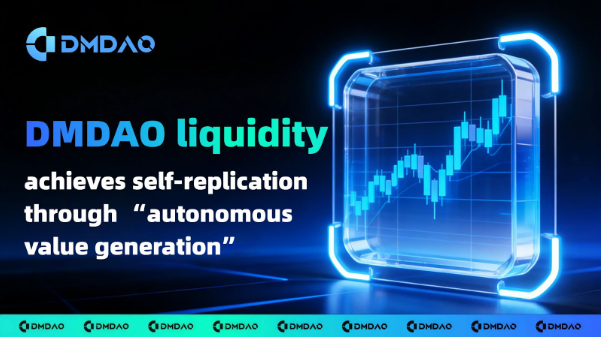
Through algorithmic control, 50% of the protocol’s market-making net revenue is automatically funneled into reinvestment sequences. Mathematical models demonstrate that DMDAO’s liquidity depth does not decay linearly over time; instead, it grows exponentially with transaction frequency. This is a dimensional reduction strike: while other protocols worry about paying next quarter’s market-making rent, DMDAO’s liquidity is already self-replicating through autonomous value generation.
3. Algorithmic Matrix: Making Wall Street Strategies a “Public Utility”
Why can traditional market makers consistently extract value from project teams and communities? Because they control high-barrier algorithmic hedging and structured finance tools. This technical monopoly enforces the “tenant system.”
DMDAO breaks this monopoly entirely. We have built a distributed strategy library, packaging Delta-neutral hedging, dynamic range management, and high-frequency arbitrage hedging into transparent smart contracts. We call this “financial strategy as a public utility.”
For project teams, staking activates the matrix, granting institution-grade trading surface maintenance without expensive service fees. For community members, you are no longer blind token miners; you are a DAO initiator. Through $veDMD governance tokens, you truly control the levels and directions of this sophisticated financial machine. Wall Street extraction tools are now community production tools.
4. The Endgame Solution: Why DMDAO?
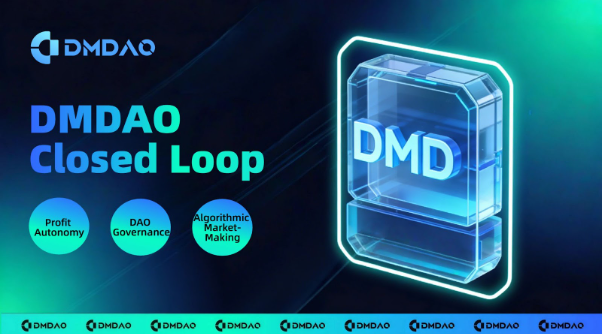
In DeFi’s second act, the competition is no longer about who can subsidize more, but who can achieve higher capital efficiency. DMDAO resolves the three core challenges of DeFi through a closed loop of profit autonomy + DAO governance + algorithmic market-making:
- SustainabilityWe abandon inflation-driven growth illusions, relying instead on real market-making profits. This endogenous power ensures the protocol survives both bull and bear cycles, establishing a genuinely solid value foundation.
- FairnessProfits no longer flow into black boxes—they 100% return to the LPs and token holders who create value. Hardcoded smart contracts guarantee that every trading premium fairly feeds back into every cell of the ecosystem.
- SecurityThe Matrix Shield mechanism provides mathematical-level protection during extreme market conditions. Automated algorithmic hedging establishes a firewall for liquidity providers, minimizing uncertainty.
5. Genesis Opportunity: Join 500 DAO Initiators
Every era begins with the awakening of a few. The old liquidity order is collapsing, and the matrix of the new order has begun.
DMDAO is currently recruiting the first 500 global “DAO initiators.” This is not merely a seat—it is a proof of early investment in future liquidity sovereignty, the ultimate entry ticket to the core equity layer.
You can choose to remain in the black box, being harvested by intermediaries, or join DMDAO and become an owner of liquidity sovereignty.
Red pill or blue pill? The choice is yours. Enter the matrix and reshape the future.


All Comments