

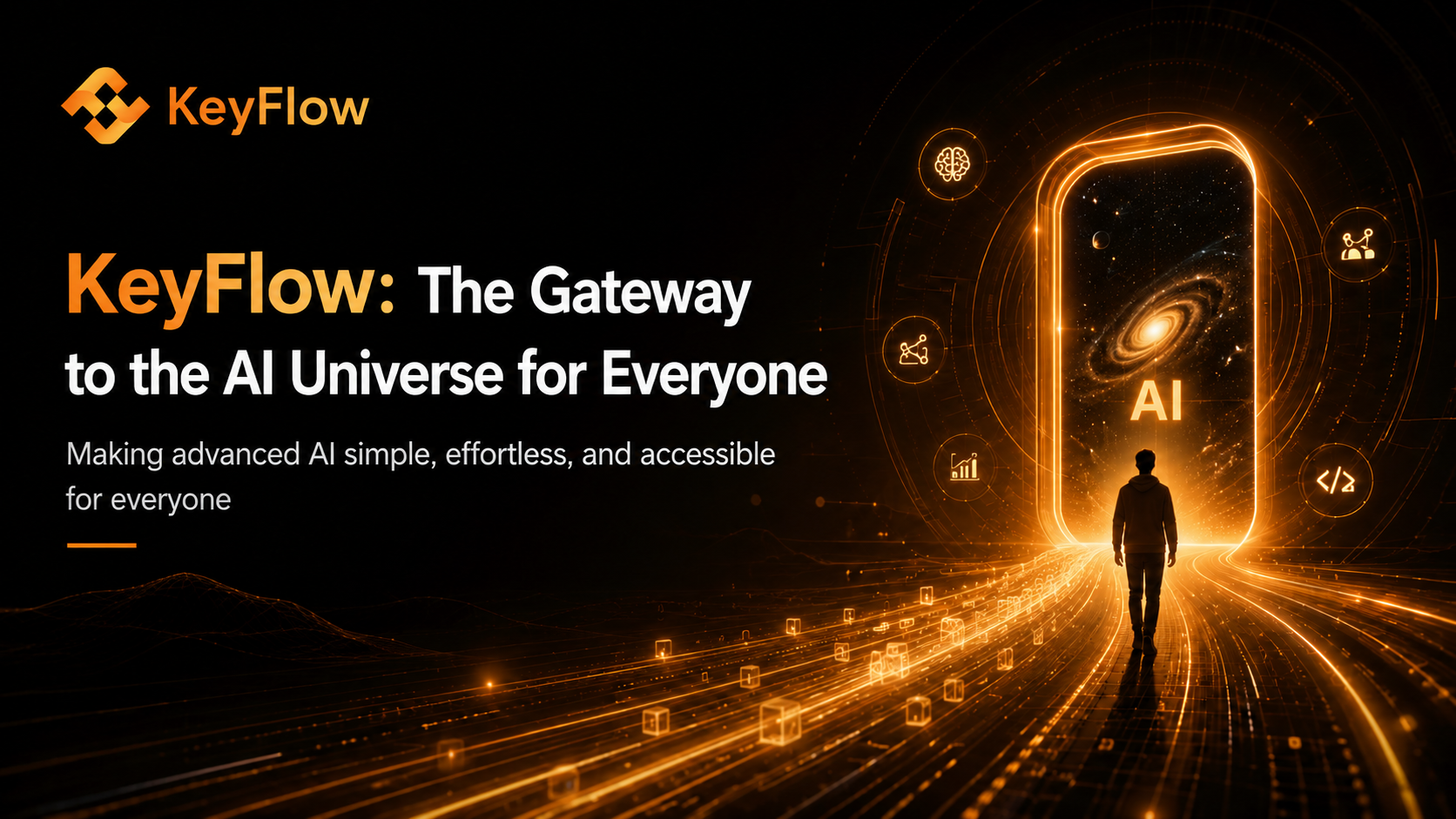
Make Professional AI Simple, Accessible, and Participatory
Artificial intelligence is transitioning from the “tool era” to the “agent era.” In the past, when ordinary users interacted with AI, they mainly used a specific chatbot, generated an image, or wrote a piece of content. AI was more like a passive tool that was called upon when needed. However, as large language models, AI Agents, Skills, Workflow systems, API gateways, and automated task systems continue to mature, AI is evolving into a massive intelligent capability network. It is no longer just a tool, but a new type of intelligent infrastructure capable of continuous production, collaboration, settlement, and value circulation.
The challenge is that the more professional AI capabilities become, the harder they are for ordinary users to truly access and utilize. Too many models, fragmented tools, complicated processes, unclear costs, high API barriers, and difficult-to-understand Agent usage logic have kept many users at the stage of “knowing AI is powerful, but not knowing how to use it.” The purpose of KeyFlow is to transform complex AI usage relationships and value circulation mechanisms into a simpler, clearer, and more accessible gateway for participation.
KeyFlow aims to become the gateway for everyone to enter the AI Universe. It enables users to access professional AI capabilities through a unified entry point without needing to understand all underlying technical details. AI usage is no longer just a one-time consumption, but an entry into a value system that enables settlement, value return, accumulation, and sustainable growth. For everyday users, KeyFlow provides a simpler gateway to AI adoption; for developers and ecosystem builders, KeyFlow serves as an essential infrastructure layer for enabling the circulation of intelligent service value.
KeyFlow Is Not a Single Tool, but the Value Engine Behind AI
The core positioning of KeyFlow is not to create another ordinary AI application, nor is it simply providing a single model tool. What KeyFlow truly aims to solve is the issue of value circulation within the AI access network. In the future, users interacting with AI will not simply open a chat interface, but will involve multiple processes including model invocation, Agent execution, Skill subscription, Workflow orchestration, API consumption, computing resource allocation, task distribution, and result settlement. KeyFlow is designed to establish a unified value circulation mechanism behind these complex relationships.
Within the entire ecosystem, UniKey serves as the infrastructure gateway connecting global AI capabilities, while KeyFlow is responsible for transforming the utilization activities behind these AI capabilities into a clear value circulation loop. What users experience is a simple AI usage experience, while the system behind it handles routing, settlement, value return, incentives, and dynamic adjustment. In other words, KeyFlow does not only enable users to “access AI,” but more importantly, enables the value generated from AI utilization to be structured and organized.
This is also the fundamental difference between KeyFlow and traditional AI tools. Traditional tools solve the efficiency of individual usage scenarios, while KeyFlow solves the long-term circulation of value. Every model invocation, every Agent task, every Skill service, and every API consumption is no longer an isolated action, but becomes part of KeyFlow’s value system, contributing to ecosystem growth, revenue return, and KEY value accumulation.
Making Professional AI More Accessible for Everyone
Many people do not lack the need for AI; they are simply blocked by complex barriers. For ordinary users who want to create content, design, perform data analysis, manage communities, or improve workplace efficiency, they often need to switch between multiple platforms, determine which model is suitable for specific tasks, and even learn prompts, APIs, workflows, and automation tools. For non-technical users, these processes themselves have already become barriers to AI adoption.
What KeyFlow aims to achieve is to make professional AI capabilities as naturally accessible as everyday internet services. Users do not need to become AI experts first, nor do they need to understand underlying computing resources or differences between models. They only need to enter the system based on their actual needs, while the platform handles capability matching and intelligent routing behind the scenes. The complexity of AI is abstracted within the backend infrastructure, providing users with a simpler, smoother, and more direct experience.
When the barriers to AI adoption are lowered, everyone can truly enter the AI Universe. Creators can leverage AI to improve content production efficiency, entrepreneurs can use AI to build business workflows, enterprises can optimize services and operations through AI, and developers can integrate their own Skills and Agents into the ecosystem. The value of KeyFlow is to enable different participants to enter the AI era in a more accessible way and contribute to ecosystem growth through real-world utilization.
KEY Is the Core Value Carrier Connecting AI Utilization and Ecosystem Value
Within the KeyFlow ecosystem, KEY is not an isolated symbol, but the core carrier connecting AI utilization, value settlement, ecosystem contribution, and revenue return. When users utilize AI Credits, invoke models, subscribe to Skills, create Agents, execute Workflows, or access API services within the ecosystem, real AI utilization demands are generated. Behind these demands are corresponding platform revenue, service consumption, task settlement, and ecosystem contributions.
The core role of KeyFlow is to connect these real AI utilization activities with the value circulation mechanism of KEY. The more AI capabilities are utilized, the more active the service circulation within the platform becomes, and the stronger the demand for value settlement will be. As real business revenue becomes increasingly stable, the value return, accumulation, and ecosystem support capabilities of KEY become more clearly defined. Here, KEY does not only carry asset circulation functions, but also serves as the value connection within the entire AI utilization network.
This means that the value of KEY is not based on an abstract narrative, but is directly connected to AI utilization scale, platform revenue growth, and ecosystem participation depth. Through this mechanism, KeyFlow aims to create a synchronized growth cycle between AI utilization, platform expansion, and KEY value. Users utilize AI, and the ecosystem generates value; value enters the settlement system, driving value return and reinvestment; reinvestment further expands AI capabilities and application scenarios, creating a long-term growth flywheel.
From AI Utilization to a Value Loop
In traditional AI tools, once users complete a single interaction, the service process ends. Users pay for the service, platforms provide the output, and the entire process operates in a one-way model. However, within the KeyFlow ecosystem, every AI interaction can be integrated into a broader value loop. A single content generation task may involve model invocation; an Agent task may connect multiple Skills; an enterprise API usage scenario may generate continuous computing consumption; and an intelligent Workflow execution may involve collaboration among multiple nodes.
These activities collectively form the value flow within the AI ecosystem. Through its settlement mechanism, KeyFlow connects multiple stages including user utilization, service provision, revenue accumulation, buyback and burn, and ecosystem reinvestment, transforming fragmented AI utilization activities into a complete value loop. In this way, AI is no longer simply “being used,” but continuously accumulates ecosystem value throughout the utilization process.
The significance of this closed-loop mechanism is that platform growth no longer relies solely on short-term traffic, but on real utilization. Only through continuous AI usage by users, continuous service integration by enterprises, and continuous contribution of Skills and Agents by developers, can KeyFlow’s value circulation continue to strengthen. The stronger the real demand, the healthier the system; the greater the real revenue, the stronger the foundation for value return; the more prosperous the ecosystem, the more evident KEY’s value-carrying capability becomes.
Intelligent Computing Routing Enables Efficient AI Capability Flow
AI capabilities cannot create value simply by accumulating more models. Different tasks require different models, different scenarios require different tools, and different utilization demands correspond to different cost and performance requirements. If ordinary users are required to evaluate models, combine tools, and estimate costs by themselves, not only will efficiency be reduced, but resource waste may also occur. KeyFlow’s intelligent computing routing mechanism is designed to enable AI capabilities to be allocated and utilized in a more efficient manner.
The essence of intelligent computing routing is to establish a more precise connection path between user demands and AI capabilities. When users initiate tasks, the system can select the most suitable AI service path based on task type, cost efficiency, response speed, and capability matching. Users experience a simple access point, while the underlying platform performs comprehensive coordination across models, Skills, Agents, Workflows, and API capabilities.
This mechanism enables KeyFlow to become not only an entry point for AI capabilities, but also an intelligent resource coordination layer for AI infrastructure. It helps users lower the barriers to AI adoption, improves resource efficiency for the platform, and enables developers and service providers to be more easily discovered and utilized based on real demand. In the long term, intelligent computing routing will become a core infrastructure capability for KeyFlow to support the intelligent agent economy.
Value Settlement Makes Complex Relationships Transparent
The emergence of the intelligent agent economy will make collaboration relationships within the AI ecosystem increasingly complex. One Agent may invoke multiple models, one Workflow may connect multiple tasks, one enterprise-level service may generate a large number of high-frequency interactions, and one Skill provider may serve different users and scenarios. Without a unified settlement mechanism, these value relationships can easily become fragmented and difficult to coordinate.
KeyFlow’s value settlement capability is designed to address this complexity. It integrates users, developers, Agents, Skills, APIs, platform revenue, and ecosystem value return into a unified framework, ensuring that every utilization, every contribution, and every settlement has a clear path. Settlement is not simply a payment process, but a mechanism for organizing value relationships among all participants within the ecosystem.
For ordinary users, the settlement mechanism makes AI utilization more transparent; for developers, the settlement mechanism enables contributions to be recognized and valued; for the ecosystem, the settlement mechanism allows real revenue to enter the value return system. Through its settlement layer, KeyFlow aims to make complex intelligent agent economy relationships clearer, more stable, and more sustainable.
Dynamic Supply and Long-Term Self-Healing Mechanism
A long-term AI ecosystem cannot rely solely on growth narratives, nor can it depend only on short-term incentives. A truly sustainable system requires dynamic adjustment capabilities across different stages of development. The dynamic supply and value return mechanism built around KEY by KeyFlow is designed to maintain ecosystem stability throughout early expansion, mid-stage balancing, and long-term growth.
During the early stage of ecosystem development, the system needs to support user adoption, application scenarios, and ecosystem bootstrapping, meaning the supply side must support large-scale expansion. In the mid-stage, as AI utilization demand increases and real platform revenue grows, the value return mechanism gradually offsets the pressure from additional supply. In the long-term stage, as AI business scale continues to expand, revenue return and burn mechanisms will drive the system toward a healthier net supply adjustment model.
This mechanism can be understood as KeyFlow’s “self-healing capability.” It does not simply rely on external market attention, but enables the system to gradually achieve self-balancing through real AI utilization, real revenue return, supply adjustment, and ecosystem reinvestment. The goal of KeyFlow is not to create short-term volatility, but to build a value system that can continuously circulate, continuously recover, and continuously grow.
The True Value of KeyFlow Is to Make AI an Accessible Capability Network for Everyone
The future AI landscape will not be defined only by competition among several major models, but by an intelligent agent economy network jointly formed by models, Agents, Skills, Workflows, APIs, users, developers, and enterprises. Within this network, what truly matters is not only “whose model is more powerful,” but also “who can connect more application scenarios, who can organize value circulation, who can enable settlement, and who can achieve long-term ecosystem growth.”
KeyFlow is building its product positioning around this vision. It enables ordinary users to enter the AI ecosystem more easily, allows developers to unlock the value of intelligent services more effectively, enables enterprises to integrate AI capabilities more efficiently, and establishes KEY as the core value carrier within the AI utilization network. What it connects is not only tools, but also users, intelligent agents, services, revenue, and value.
For ordinary users to awaken into the AI Universe, they do not need to begin by understanding every technical detail, but by truly utilizing AI. What KeyFlow aims to achieve is to transform professional artificial intelligence into a gateway that everyone can open. Behind this gateway are models, intelligent agents, workflows, ecosystem value, and a new intelligent era that is taking shape.


All Comments