

Cointime

Download App
iOS & Android

Hacking Private Data in Smart contracts | QuillAudits

Validated Project

In solidity, “Private” variables can only be read by the contracts and is not accessible to the outside world. But, it is possible to access these data from outside the blockchain. Let’s see how we can read private data from smart contracts.

Table of Contents:

1. State Variable Visibility2. Storage layout in EVM3. Accessing private data using Ethers4. A small challenge5. Remediation6. Reference

State Variable Visibility

According to Solidity Docs, There are three visibility modifiers that users can use: public, internal, or private.

  1. Public: Public means that the variable can be accessed by the contract and by other smart contracts.
  2. Internal: Internal means that the variable can only be used with the contract it is defined in and its subclasses.
  3. Private: Private means that the variable can only be accessed within the contract it is defined. Trying to access it outside this contract gives a compilation error.

In Solidity, “Private” variables are not accessible to the outside world. But wait, if private data can only be accessed within the contract then how can we access these data from outside of the blockchain?We will come to it but let’s first understand storage layout in solidity.

Storage Layout in EVM:

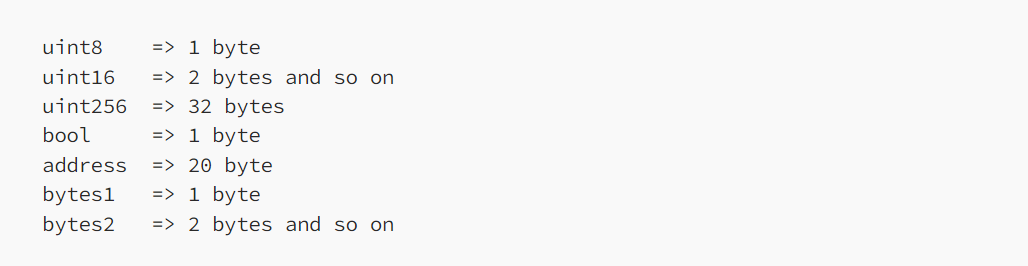
The EVM (Ethereum Virtual Machine) stores smart contract data in a large array with a length of 2**256 in slots on the blockchain. Each memory slot can hold up to 32 bytes of data. The EVM stores smart contract state variables in the order that they were declared in slots on the blockchain. The default value of each slot is always 0, so we do not need to assign a value to 0 when the new declaration is.

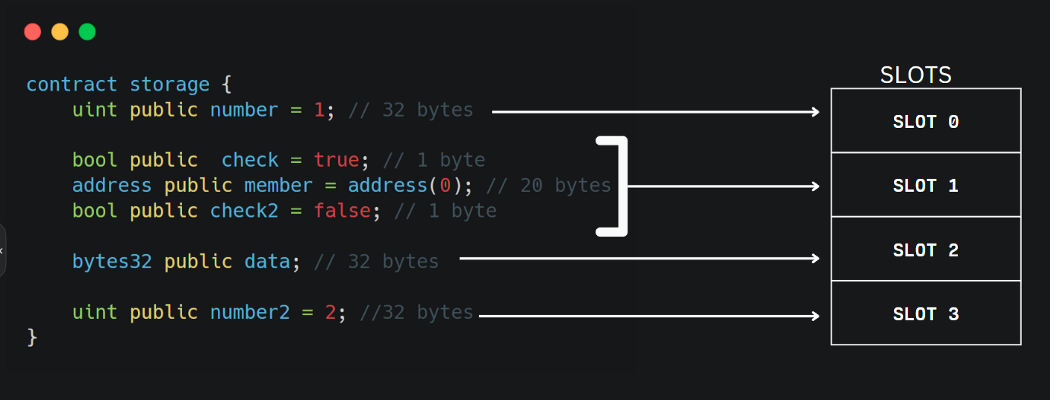
Smart contract storage is optimized to minimize space. If two or more variables fit into a single 32-byte slot, they are packed into the same slot, beginning on the right.
Look at the following example for a better understanding of how storage works in EVM.
Storage for Dynamic data types:

Mappings and dynamically-sized array types cannot be stored “in-between” the state variables before and after. Instead, they are considered to occupy only 32 bytes and a different storage slot that is computed using a Keccak-256 hash of the elements they contain.

Accessing Private data from Blockchain:

To access Solidity smart contract private data we can follow the following steps. Here we will be using ethers.js for extracting data.

  1. First, we need to read the contract and understand the order in which the state variables are declared. Let’s suppose we want to access slot0.
  2. We can use ethers.js to read the memory slots of the contract on the blockchain. Use the below function:await ethers.provider.getStorageAt(contract_address, 0);
  3. It will return hex encoded value, we can simply decode it or use ethers utils functions or some sort of hex decoder to decode it.

Ethers.js Script:

You can also use the following js script to fetch private data from the blockchain.
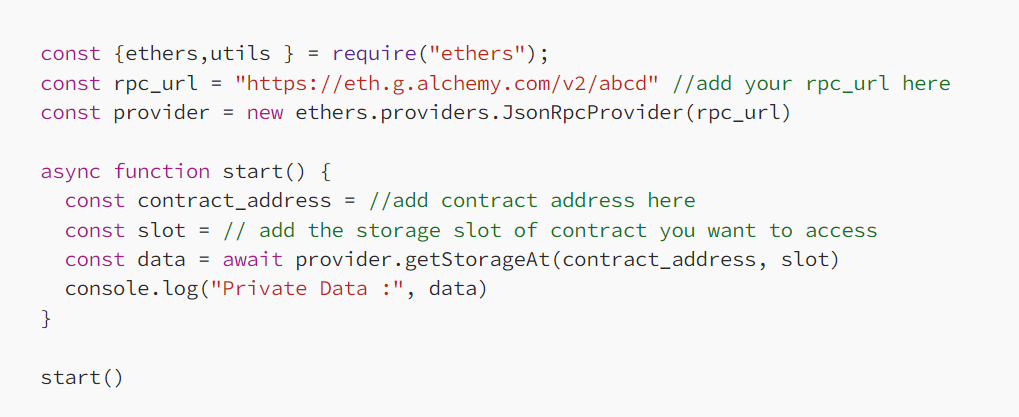
Guide for running script:

  1. Install ethers from npm: npm install ethers
  2. Get a rpc_url of the required network from alchemy and add it to the above script.
  3. Change the contract address and slot in the below script and simply run the js code. Decode the returned hex value.

A small challenge:

Goerli link: 0x4c77de8a0ec0390826f87f227bb8762ab2189194

Objective: Change the value of pwned to true. You can use the above script to extract private data.

Remediation:

In the current state of the blockchain, do not keep sensitive private data in smart contracts. The safest method to keep your private information safe is to avoid storing it on a public blockchain.


Further Reads:

Comments

All Comments

Recommended for you

  • U.S. July Nonfarm Payrolls Fall by 23,000, Missing Market Expectations

    On August 7, U.S. nonfarm payrolls decreased by 23,000 in July, compared with market expectations of an increase of 80,000, and the previous value was an increase of 57,000.

  • US May and June Nonfarm Payroll Additions Revised Down by 103,000 Combined

    On August 7, the US Bureau of Labor Statistics: May nonfarm payroll additions were revised down from 129,000 to 63,000; June nonfarm payroll additions were revised down from 57,000 to 20,000. After the revisions, the combined additions for May and June were 103,000 lower than previously reported.

  • U.S. Rate Futures Market Sees Lower Odds of Fed September Hike

    On August 7, the probability of a Fed rate hike in September as priced by U.S. interest rate futures declined.

  • New York Gold Futures Top $4,400 per Ounce

    New York gold futures topped $4,400 per ounce, up 2.36% on the day.

  • Japan Finance Minister: FX Market Affected by Moves Not Driven by Actual Demand

    Japanese Finance Minister Satsuki Katayama said she and U.S. Treasury Secretary Bessent agreed that the foreign exchange market has been affected by moves not driven by actual demand.

  • BTC Breaks Through $65,000

    Market data shows BTC has broken through $65,000, currently reported at $65,007.44, with a 24-hour increase of 0.6%. The market is highly volatile, please exercise risk control.

  • Brent Crude Drops 2.00% Intraday to $81.07/Barrel

    Brent crude oil fell 2.00% during the day, now at $81.07 per barrel. (Jin Shi)

  • Trump: Data Centers May Be More Important Than Oil

    August 7 news, U.S. President Trump said in an interview with Punchbowl News, "I saw the other day that Texas seems to be opposed to building data centers. I think that's a mistake. I'm not taking a position—I just think it's a mistake, because there are other communities that want to build data centers. When a community is willing to accept data centers, it means a lot of money will flow into that community. I don't think they're ugly. Some of the data centers I've seen are the most incredible buildings I've ever seen. They are very important to the economy. If Texas says no to data centers, that's a mistake, because data centers may be more important than oil."

  • Trump to Meet with Mining Executives

    On August 7, according to CCTV International News, US President Trump will convene executives from some of the world's largest mining companies at the US State Department on August 7 local time, in an effort to take action to 'secure critical mineral supplies for the US and its allies.' Reuters reported that the US urgently needs critical minerals to replenish weapons inventories depleted during the war against Iran. During the more than five-month war with Iran, the US military expended large quantities of precision-guided missiles and air defense interceptors. US defense officials and lawmakers have warned that given existing production capacity constraints, replenishing some stockpiles could take years—although the Trump administration has denied reports of a so-called 'severe shortage of ammunition stockpiles.' According to Pentagon officials and defense companies, supplies of minerals such as rare earths, tungsten, germanium, and scandium are essential for manufacturing precision-guided missiles, fighter jets, armored vehicles, infrared sensors, and other advanced weapons systems. Expected attendees include industry giants such as global mining giant Rio Tinto Group, Australia's BHP, US Freeport-McMoRan, US Mountain Pass Materials, US Rare Earths, US Energy Fuels, and Canada's Metals Company. According to sources, the Trump administration plans to announce multiple deals and memorandums of understanding.

  • US Regulators Systematically Review Chinese AI Firms' Third-Country Computing Power Leasing

    August 7 news, according to Bloomberg, people familiar with the matter revealed that the U.S. government department responsible for investigating chip export control violations is reviewing Chinese AI companies' leasing of computing power in third countries to obtain Nvidia advanced chips.