

Cointime

Download App
iOS & Android

FTX Conspired With the SEC for Special Treatment

Validated Individual Expert

According to Tom Emmer, a crypto advocate and U.S. congressional representative for Minnesota, the SEC has been offering FTX special treatment and turning a blind eye to the exchange’s practices despite holding multiple meetings with the exchange’s Executives earlier this year.

The politician has said that SBF attempted to get “special treatment” from the SEX through meetings with the agency, and aimed to push legislation to the same effect.

The collapse of FTX leaves a big question mark as to how the SEC, or rather, any regulatory body within the financial system failed to see this coming. Just to be clear, FTX did not fail because of one or two bad calls and hard luck. FTX was in fact so disorganised that the new CEO, John Ray has said that:

“Never in my career have I seen such a complete failure of corporate controls”

The entire mind-numbing dumpster fire that is the internal FTX structure was outlined in the FTX bankcrupcy report. Go check it out if you haven’t already, it’s wild stuff. But basically:

FTX did not keep proper financial documents

Loans and expenses were being approved using emojis

SBF instructed the staff to use auto-destroying messages when communicating

In light of all this, along with SEC’s failure to act, Tom Emmer has said that:

“They [the SEC] were working, apparently, with Sam Bankman-Fried and others, to give them special treatment from the SEC that others aren’t getting, Sam Bankman-Fried was pushing special-treatment legislation through congress. when it was finally revealed what it was, and the industry started raising red flags all over the place, that’s when this thing came apart,”

Emmer also drew attention at the regulator’s failure to protect investors from some of the other crypto collapses that took place this bear cycle such as: Terra, Celsius and Voyager. Emmer added that the regulators seem to be preoccupied with going after the good actors in the industry and working backroom deals, instead of focusing on the ones that are doing nefarious things.
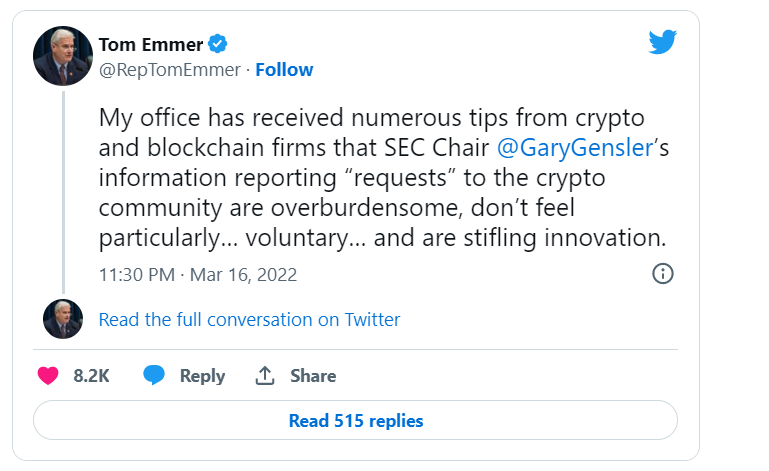
This highlights the lack of understanding from regulators, not just of how cryptocurrency itself works, but also of business practices in themselves. Yes, crypto can be confusing, but some concepts are universally true. Being able to identify ponzi schemes / scams and shady business practices should be a skill that the SEC employ gracefully and efficiently. Instead, they battle out the Ripple lawsuit until the observable universe ceases to exist.

Coinbase CEO Brian Armstrong argued that the regulator’s inaction has pushed trading activity to unregulated areas overseas, contributing to investor harm.

In addition to the damage caused by inaction, there is also the consideration of enabling such reckless business practices in the first place. Regarding the SEC’s stance on this whole situation, it’s either incompetence or favouritism that allowed FTX to cause the chaos it did. Whichever one it is, it highlights that financial regulators need to be regulated themselves, and held accountable when they fail to do their job.


SEC
Comments

All Comments

Recommended for you

  • U.S. July Nonfarm Payrolls Fall by 23,000, Missing Market Expectations

    On August 7, U.S. nonfarm payrolls decreased by 23,000 in July, compared with market expectations of an increase of 80,000, and the previous value was an increase of 57,000.

  • US May and June Nonfarm Payroll Additions Revised Down by 103,000 Combined

    On August 7, the US Bureau of Labor Statistics: May nonfarm payroll additions were revised down from 129,000 to 63,000; June nonfarm payroll additions were revised down from 57,000 to 20,000. After the revisions, the combined additions for May and June were 103,000 lower than previously reported.

  • U.S. Rate Futures Market Sees Lower Odds of Fed September Hike

    On August 7, the probability of a Fed rate hike in September as priced by U.S. interest rate futures declined.

  • New York Gold Futures Top $4,400 per Ounce

    New York gold futures topped $4,400 per ounce, up 2.36% on the day.

  • Japan Finance Minister: FX Market Affected by Moves Not Driven by Actual Demand

    Japanese Finance Minister Satsuki Katayama said she and U.S. Treasury Secretary Bessent agreed that the foreign exchange market has been affected by moves not driven by actual demand.

  • BTC Breaks Through $65,000

    Market data shows BTC has broken through $65,000, currently reported at $65,007.44, with a 24-hour increase of 0.6%. The market is highly volatile, please exercise risk control.

  • Brent Crude Drops 2.00% Intraday to $81.07/Barrel

    Brent crude oil fell 2.00% during the day, now at $81.07 per barrel. (Jin Shi)

  • Trump: Data Centers May Be More Important Than Oil

    August 7 news, U.S. President Trump said in an interview with Punchbowl News, "I saw the other day that Texas seems to be opposed to building data centers. I think that's a mistake. I'm not taking a position—I just think it's a mistake, because there are other communities that want to build data centers. When a community is willing to accept data centers, it means a lot of money will flow into that community. I don't think they're ugly. Some of the data centers I've seen are the most incredible buildings I've ever seen. They are very important to the economy. If Texas says no to data centers, that's a mistake, because data centers may be more important than oil."

  • Trump to Meet with Mining Executives

    On August 7, according to CCTV International News, US President Trump will convene executives from some of the world's largest mining companies at the US State Department on August 7 local time, in an effort to take action to 'secure critical mineral supplies for the US and its allies.' Reuters reported that the US urgently needs critical minerals to replenish weapons inventories depleted during the war against Iran. During the more than five-month war with Iran, the US military expended large quantities of precision-guided missiles and air defense interceptors. US defense officials and lawmakers have warned that given existing production capacity constraints, replenishing some stockpiles could take years—although the Trump administration has denied reports of a so-called 'severe shortage of ammunition stockpiles.' According to Pentagon officials and defense companies, supplies of minerals such as rare earths, tungsten, germanium, and scandium are essential for manufacturing precision-guided missiles, fighter jets, armored vehicles, infrared sensors, and other advanced weapons systems. Expected attendees include industry giants such as global mining giant Rio Tinto Group, Australia's BHP, US Freeport-McMoRan, US Mountain Pass Materials, US Rare Earths, US Energy Fuels, and Canada's Metals Company. According to sources, the Trump administration plans to announce multiple deals and memorandums of understanding.

  • US Regulators Systematically Review Chinese AI Firms' Third-Country Computing Power Leasing

    August 7 news, according to Bloomberg, people familiar with the matter revealed that the U.S. government department responsible for investigating chip export control violations is reviewing Chinese AI companies' leasing of computing power in third countries to obtain Nvidia advanced chips.