

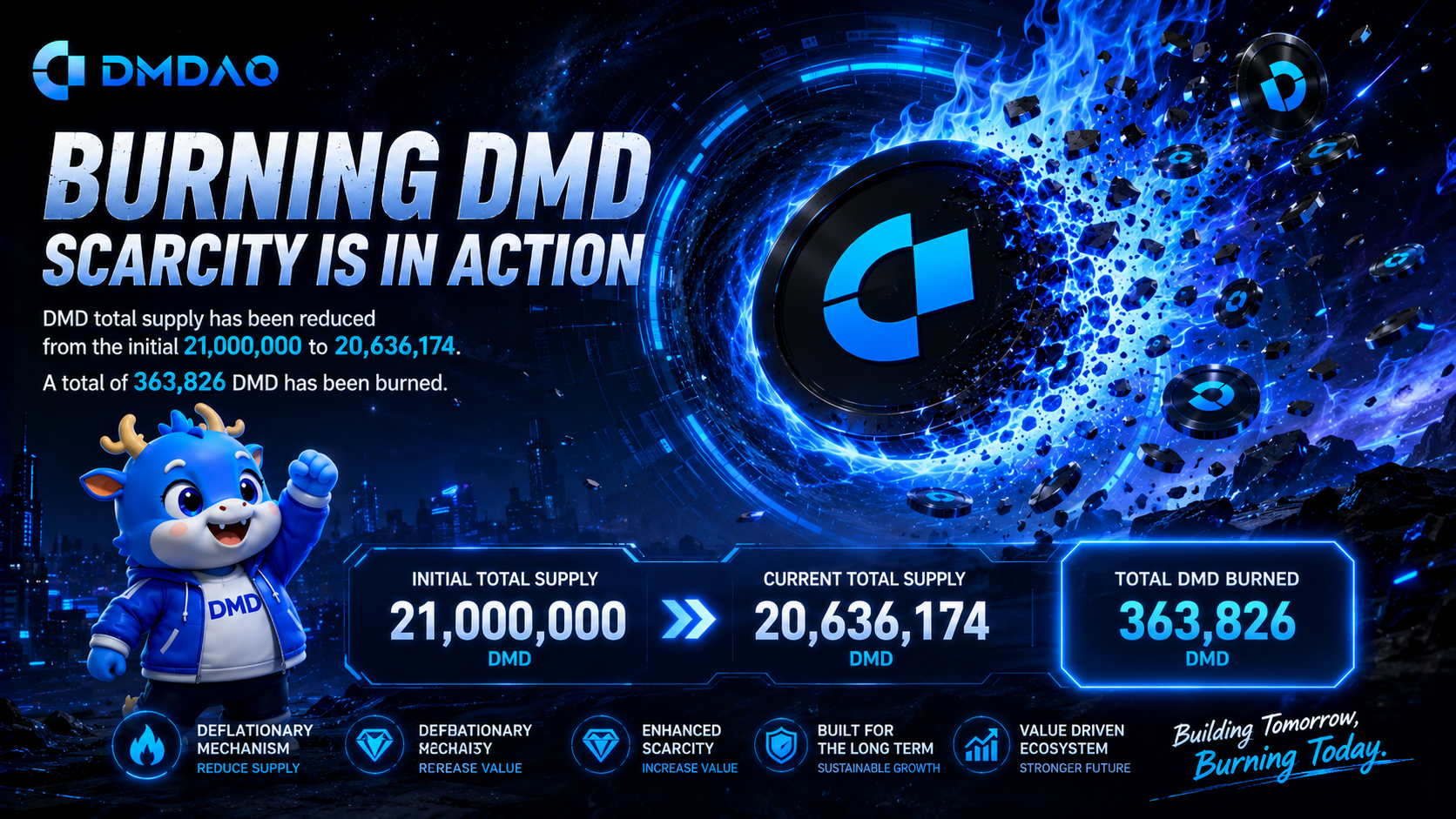
From 21 Million to 20.636 Million: Deflation Is No Longer Just a Concept
In the digital asset industry, "deflation" is often used as a narrative. However, what truly earns long-term market confidence is not the concept itself, but whether the mechanism is actually operating, whether the data continues to evolve, and whether the value model can stand the test of time. This is exactly where DMDAO is making a meaningful difference—transforming deflation from an idea into measurable execution.
The total supply of DMD has now decreased from its initial 21,000,000 tokens to 20,636,173.473825 tokens. This means that 363,826.526175 DMD has already been permanently burned. While this represents only the beginning of the deflationary journey, it marks an important milestone: DMDAO's burn mechanism is no longer theoretical—it is actively reshaping the supply structure of DMD.
For an ecosystem designed around long-term value, deflation is not simply about reducing numbers. It is about continuously lowering the circulating supply, strengthening scarcity, and building stronger market expectations for future value. Every completed burn is permanently recorded, every reduction in supply becomes visible, and every step further reinforces the long-term foundation of DMD.
A Deflationary Mechanism Designed to Strengthen Scarcity
The long-term value of any digital asset is ultimately driven by supply and demand. Unlimited supply dilutes value, while controlled supply strengthens scarcity. DMDAO places its burn mechanism at the center of its economic model to ensure that DMD is not merely a circulating token, but a scarce digital asset with sustainable long-term value.
The reduction from 21,000,000 to 20,636,173.473825 DMD is far more than a numerical change. It represents a structural optimization of the ecosystem's circulating supply. Every DMD permanently removed from circulation reduces future market supply, while every burn strengthens the scarcity that supports long-term value.
More importantly, the burn mechanism encourages a long-term mindset across the entire community. Participants who focus on sustainable growth care less about short-term price movements and more about whether the ecosystem continues to execute, whether its mechanisms continue to operate, and whether value continues to flow back into the network. The continuously updated burn data provides transparent evidence that DMDAO is steadily moving in that direction.
Every Burn Represents Value Returning to the Ecosystem
Token burning is not an isolated event—it is the result of value flowing back into the ecosystem. When an economic system continuously generates value and allocates part of that value toward reducing supply, it creates a healthy cycle of value creation, value return, supply optimization, and increasing scarcity.
What DMDAO emphasizes is not a one-time burn, but an ongoing deflationary process. The permanent removal of 363,826.526175 DMD demonstrates that the ecosystem has already entered a positive cycle where value generation and supply reduction work together. As the community expands, ecosystem adoption grows, and consensus strengthens, the burn mechanism is expected to create even greater long-term impact.
Every token locked strengthens long-term scarcity. Every value return reinforces the foundation of DMD. Rather than simply reducing supply, DMDAO is building a healthier economic structure where long-term value is continuously accumulated through sustainable deflation.
Deflation Is Driving the Growth of the DMD Value Network
A truly sustainable digital asset ecosystem cannot rely solely on short-term market enthusiasm or temporary narratives. It requires mechanisms that continue to operate, a community that continues to grow, and transparent data that demonstrates real progress. The current burn progress of DMDAO represents one of the most important milestones on that journey.
The reduction from 21,000,000 to 20,636,173.473825 DMD marks the beginning of a continuously evolving deflationary model. As additional tokens are permanently burned over time, the total supply will continue to decline while scarcity continues to increase. For ecosystem participants, this is not only a change in circulating supply—it is the gradual formation of a stronger, more resilient value network.
As consensus continues to expand and the deflationary mechanism continues to operate, DMD is evolving beyond a simple ecosystem token into a core digital asset designed to support long-term scarcity, sustainable growth, and lasting value. Burning is only the beginning; what truly matters is the stronger economic foundation that DMDAO is building through consistent execution.
Conclusion
DMDAO's deflationary journey is demonstrating the effectiveness of its economic model through transparent and verifiable data. With 363,826.526175 DMD already permanently burned, circulating supply continues to decline, scarcity continues to strengthen, and the long-term value proposition of the ecosystem becomes increasingly evident.
The true value of DMD will never be defined solely by short-term market fluctuations. Instead, it is built upon continuously executed mechanisms, growing community consensus, and an increasingly optimized supply structure. As the deflationary process moves forward, DMDAO will continue building a stronger, scarcer, and more sustainable value network for the future.


All Comments