

Recently, in-depth industry analysis has pointed out that global crypto market makers are entering a collective wave of “transformation and adaptation.” As market competition intensifies, high-quality assets become increasingly scarce, and global regulations continue to tighten, the profit margins of traditional centralized market makers that rely on information asymmetry and liquidity premiums have been severely compressed. Many established market-making institutions are adjusting their strategies, gradually shifting toward full lifecycle consulting, asset management, and compliant investment banking services.
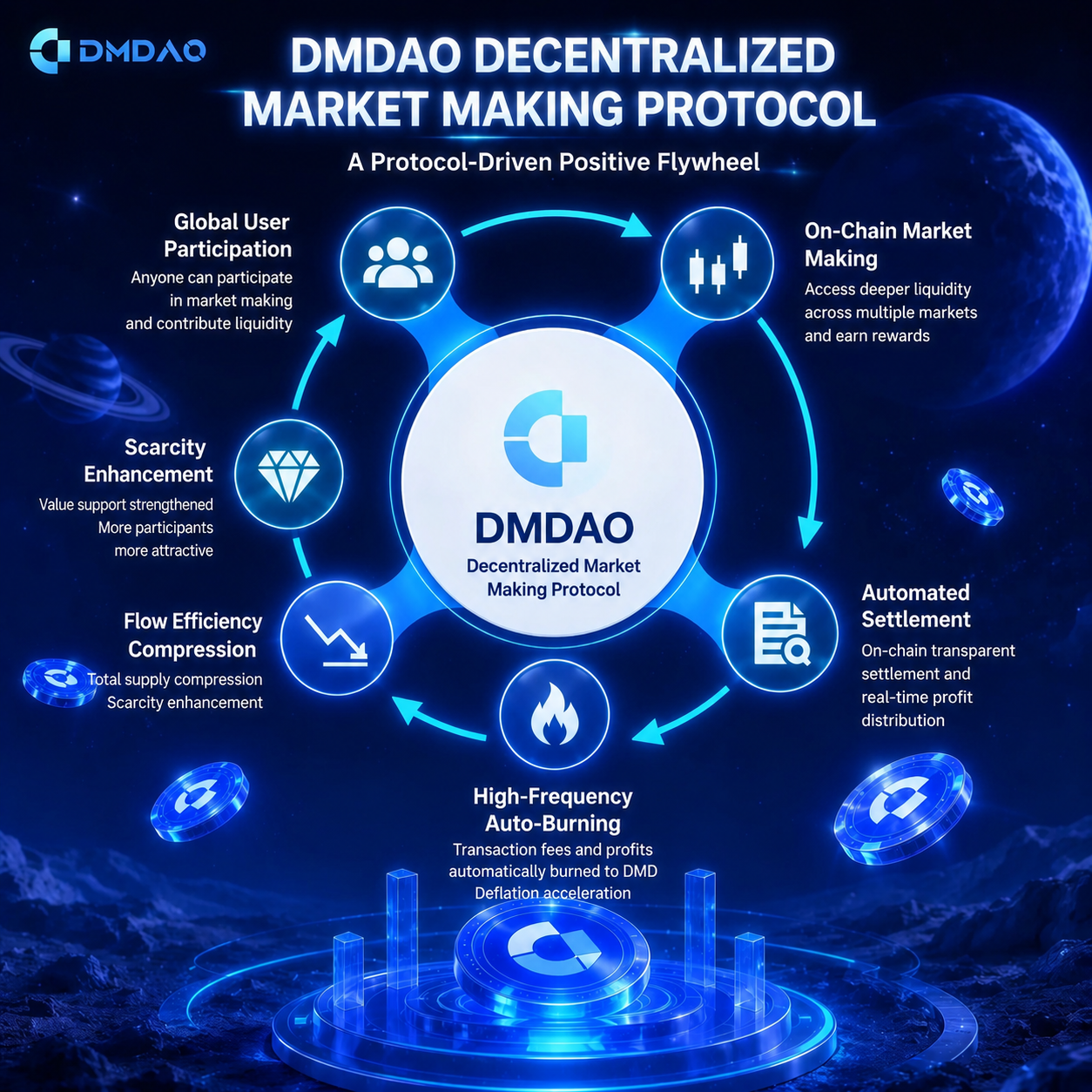
The industry’s profit margins are narrowing, and the reality that “market making is becoming increasingly difficult to profit from” has become undeniable. However, while traditional market-making institutions are undergoing a painful transformation phase through frequent mergers, acquisitions, and business expansion in search of breakthroughs, the decentralized distributed market-making protocol — DMDAO — is carving out a completely different high-growth trajectory through its unique on-chain medium- and long-term liquidity accumulation mechanism and extreme deflationary algorithmic logic.
The Industry Faces a “Liquidity Dilemma”: Traditional Market Makers Rely on Centralized M&A, While DMDAO Relies on Protocol Mechanisms
The core challenge currently facing the market-making industry lies in the imbalance between supply and demand: project teams’ market-making budgets have significantly declined, valuable high-quality projects have become increasingly scarce, and many assets are neither profitable nor capable of generating sustainable long-term growth.
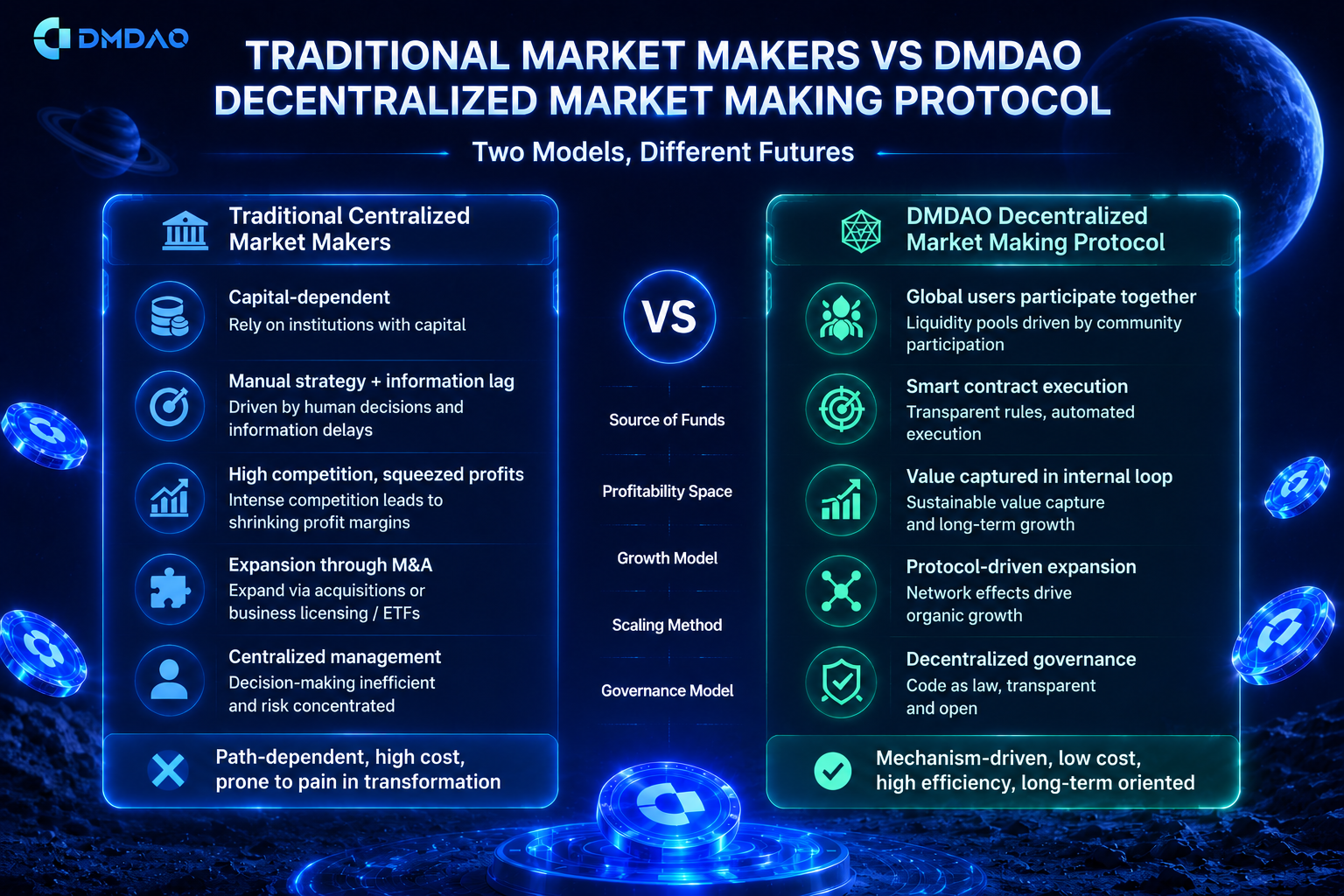
Many traditional centralized market makers have adopted a strategy of “moving services forward and extending services backward,” expanding their service chains by using substantial capital to acquire consulting firms, develop long-term asset management services, and enter ETF-related businesses.
Compared with centralized market makers that rely on large-scale capital acquisitions and institutional networks to piece together ecosystems, DMDAO, as a distributed market-making protocol, starts directly from underlying algorithms and organizational mechanisms. It returns market-making power and liquidity development to global users, using decentralized smart contracts to address the industry’s long-standing challenges of “insufficient long-term liquidity” and “unstable token structures.”
Previously, DMDAO officially launched the “D1 Pioneer Challenge.” Once introduced, the campaign attracted widespread attention across the industry. Unlike centralized market makers that rely on their own liquidity pools and matching networks, DMDAO, as a distributed market-making protocol, directly connects global ecosystem participants’ market-making activities with medium- and long-term cycles of 180 days or 360 days through clearly defined dual on-chain assessment indicators: “individual market making” and “associated market performance.”
Through this “exchanging time for space” locking mechanism, DMDAO has successfully transformed short-term speculative capital into long-term deep liquidity supporting ecosystem growth, proactively establishing a highly resilient distributed capital foundation on-chain.
Ecosystem Resilience Through Data: Over 36,000 DMD Burned in the Past 7 Days, Scarcity Builds a Distributed Value Moat
When competition intensifies, centralized market makers are often constrained by severe volatility in secondary markets. Extreme market conditions and the recent overall decline of certain token markets have eliminated many teams lacking systematic risk management capabilities.
The reason DMDAO’s distributed market-making protocol can maintain stable performance amid market fluctuations is not only the stable token structure created by medium- and long-term locking mechanisms, but also its powerful high-frequency on-chain automated burn mechanism.
According to the latest on-chain data monitoring report released by DMDAO, from July 17, 2026 to July 23, 2026, DMD’s on-chain burn mechanism maintained strong operational momentum, with a cumulative burn of 36,313.28 DMD over the past seven days.
This burn rate is driven by the efficient operation of its underlying Matrix Prime intelligent computing market-making protocol. While many projects are gradually becoming marginalized due to insufficient liquidity, DMD’s total circulating supply is steadily converging toward the ultimate target supply of 1,000,000 tokens.
As a distributed protocol, every market-making interaction drives automatic token burns, continuously strengthening the value structure of the remaining token supply. This technology-driven extreme deflation mechanism has become DMDAO’s strongest protective barrier in a volatile market.
Transparent Rules and Decentralized Auditing: Responding to the Demand for “Fairness and Trust”
As global crypto regulatory frameworks continue to take shape, compliance and risk management have become essential survival requirements. The market-making industry is being reshaped by both “client structures and asset models.”
In other words, market expectations for “trading fairness” and “data authenticity” have reached unprecedented levels, while the room for opaque operations among centralized market makers is being significantly reduced.
In this regard, DMDAO fully leverages the inherent advantage of distributed protocols: “code is law.”
During the “D1 Pioneer Challenge,” the protocol allocated a dedicated MMT reward pool to provide qualified market-making partners with 500 USDT-equivalent MMT token rewards per participant.
To prevent common issues in traditional market making, such as “wash trading” and malicious arbitrage, DMDAO’s technical team has clearly stated that all associated on-chain addresses will undergo comprehensive audit verification. Any violations, including splitting existing assets for self-trading or artificial volume manipulation, will result in disqualification.
At the same time, reward conversion will be fully based on the actual market price provided by on-chain oracles and decentralized exchanges (DEXs) at the campaign deadline. Rewards will be distributed rapidly through on-chain airdrops within 2 business days after the campaign concludes.
This operational model, where rules are written directly into code and decisions are determined by on-chain data, eliminates human intervention and earns the trust of global distributed market-making partners through genuine transparency.
Conclusion: A Pioneer Reshaping the Landscape
The rules of crypto market making have indeed changed. Traditional centralized approaches are becoming increasingly ineffective.
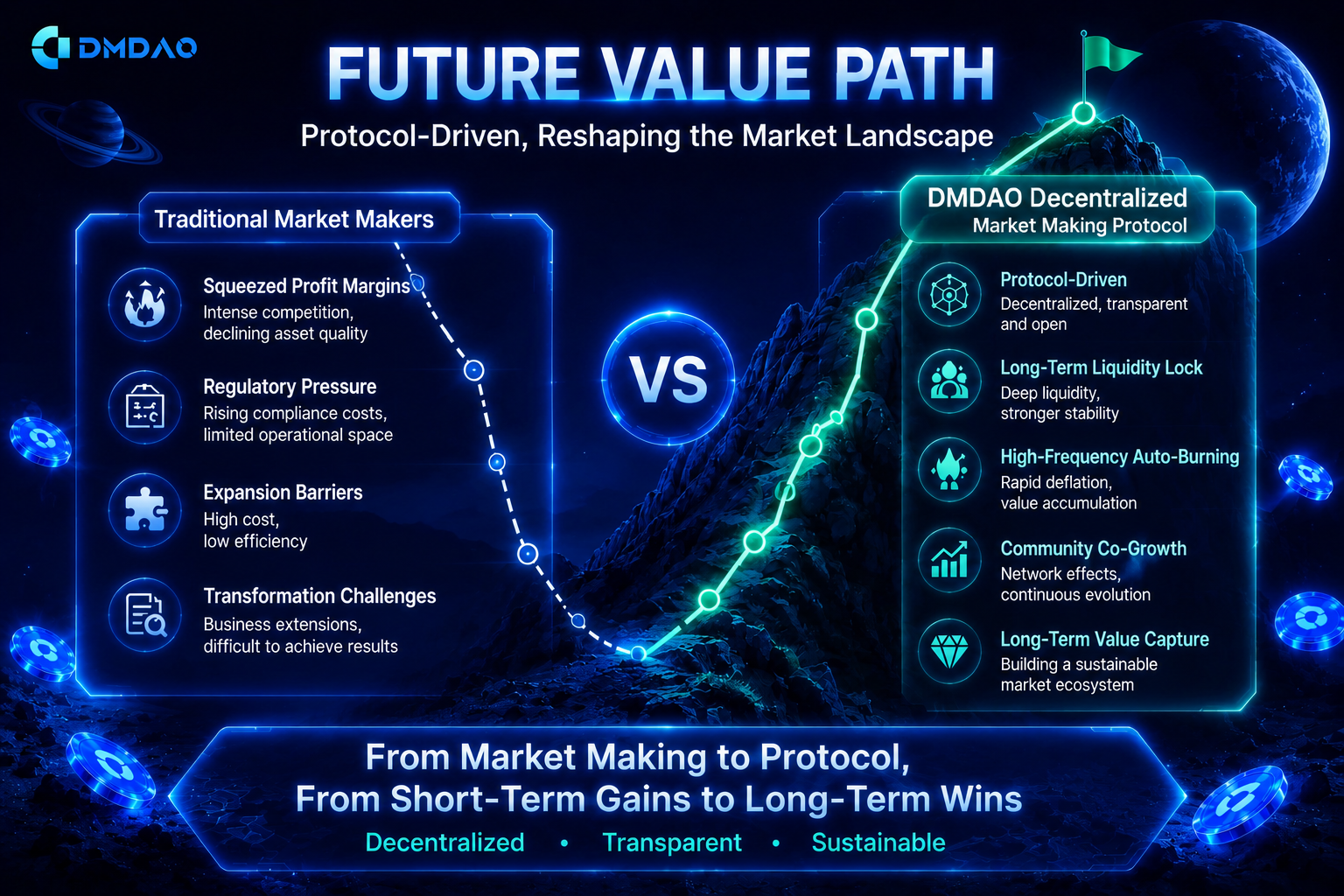
While industry participants are still struggling with shrinking profit margins and attempting to transition through traditional finance-style “investment banking models,” DMDAO has already delivered a compelling answer through the self-driven nature of distributed market-making protocols, powered by the dual engines of high-frequency deflation and medium- to long-term on-chain market making.
This is not merely a limited-time incentive program for outstanding market-making partners, but also a successful demonstration of how distributed market-making protocols can achieve sustainable and healthy long-term development.
As DMD’s scarcity continues to emerge and liquidity foundations continue to strengthen, DMDAO is using algorithms and code to demonstrate a more resilient and sustainable path forward for the entire decentralized finance industry.


All Comments