


Main Takeaways
- Options and futures contracts are derivatives that offer exposure to an underlying asset.
- Crypto futures contracts are agreements between traders to buy or sell a particular asset at a predetermined price and on a specified date in the future.
- Crypto options contracts provide the contract holder with the right but not the obligation to buy or sell an asset at a predefined price and date.
Derivatives are financial instruments that offer exposure to an underlying asset, such as a commodity like oil or gold, or cryptocurrency like bitcoin. The value of derivatives is tied to that of the underlying asset. Options and futures are two different types of derivatives that investors use to speculate on market prices, hedge risks, and diversify their portfolios.
While futures and options contracts have similar trading fundamentals, they are employed for distinct trading strategies, as provided by the key differences between the two instruments.
What Are Crypto Futures Contracts?
Crypto futures contracts represent the value of a specific cryptocurrency at a specified time. These are agreements between traders to buy or sell a particular asset at a predetermined price on a specified date in the future. In a traditional futures contract, the holder of the position is under an obligation to buy or sell the underlying asset at the contract price at expiry.
Traders may gain or lose depending on their positions, i.e., long or short, and futures price. You can take a long position when you predict a price increase in the asset and a short position when you anticipate a price decrease. For instance, if bitcoin's current market price is $10,000, you may buy (go long) or sell (go short) a futures contract in anticipation of a price increase or decrease.
If you choose to buy this contract and the price of bitcoin increases to $20,000 by the contract's expiration date, you will have realized $10,000 in profit. Alternatively, if the price decreases to $5,000 by the contract's expiration date, you incur a loss of $5,000. Liquidation in futures happens when you incorrectly predict the movement of the market which results in termination of your open position.
Binance Futures offer traders the ability to trade quarterly and perpetual futures contracts. Quarterly futures contracts expire after three months, while perpetual futures contracts don’t have an expiration date.
What Are Crypto Options?
Similar to cryptocurrency futures contracts, the value of options contracts is tied to that of the underlying asset. Options are derivatives that allow traders to buy or sell the asset at a pre-established price on a future date. However, unlike futures, options contracts’ holders can choose not to buy or sell the underlying asset at expiry.
In other words, crypto options provide the holder with the right but not the obligation to buy or sell an asset at a predefined price and date. Options typically allow traders to reduce the risks of loss and avoid potential liquidation associated with futures contracts. For this right, the buyer pays an upfront fee to the option writer known as the premium.
There are multiple types of options, the most common being call and put options. Call options give traders the choice to buy an asset on a specific date, while put options allow them to sell an asset on a specific date.
For instance, you purchase a call option for bitcoin at $10,000, anticipating a rise in the asset’s price. Because it is an options contract, you will have to pay a premium, $400 in this example.
Let’s now assume that bitcoin's price drops to $5,000 at the contract's expiration date. In this case, you have the choice not to exercise your options right. However, the premium of $400 that you paid to buy the contract won’t be returned.
Futures vs. Options: Key Similarities
Derivatives
Both options and futures contracts are derivative instruments that don’t require ownership of the underlying asset. In the case of digital assets, this mechanism allows investors to get exposure to cryptocurrencies without the need to buy and store them.
Instruments for hedging
Traders and investors can use options and futures contracts as hedging instruments. Hedging is a risk management strategy used to minimize or eliminate financial losses. This is usually done by opening two offsetting positions.
For example, let’s say that Bob purchases a token at $20 per share predicting that its price will go up. But, to hedge against the event of the token’s value plummeting, Bob purchases a put option at a strike price of $16 by paying a fee (premium) of $2 per token. Strike price in options contract is the price at which the underlying asset can be bought or sold. Now, in case the price of the token plummets to $10, Bob can exercise his contract and sell the token at $16, thus reducing his losses. In the event that the market turns bullish, he doesn’t need to exercise his contract and would only lose the premium of $2 per token.
Futures contracts also help business owners and investors to hedge against market risks. For instance, there is an apparel company that knows it will need to buy 10,000 pounds of cotton in three months’ time in order to fulfill a consumer’s order. Let’s assume that the current price of cotton is $10 per pound. To guard against potential market volatility, the company can purchase a cotton futures contract at $9 per pound. This secures the company’s purchase, allowing it to buy cotton at $9 per pound in three months regardless of the commodity’s market price at that time. If the company hadn’t purchased the futures contract and the price of cotton had gone up, say, from $10 to $14 per pound in three months, the company would have to incur a higher expense for securing the order.
Leveraged contracts
Both types of derivatives contracts allow traders to gain exposure to the underlying asset at a fraction of the cost through leverage. This enables traders to buy or sell a large contract with relatively little capital. Please note that leverage carries increased risks, and it’s important to practice risk management strategies when dealing with derivatives.
Crypto Futures vs. Options – Key Differences
Rights and obligations
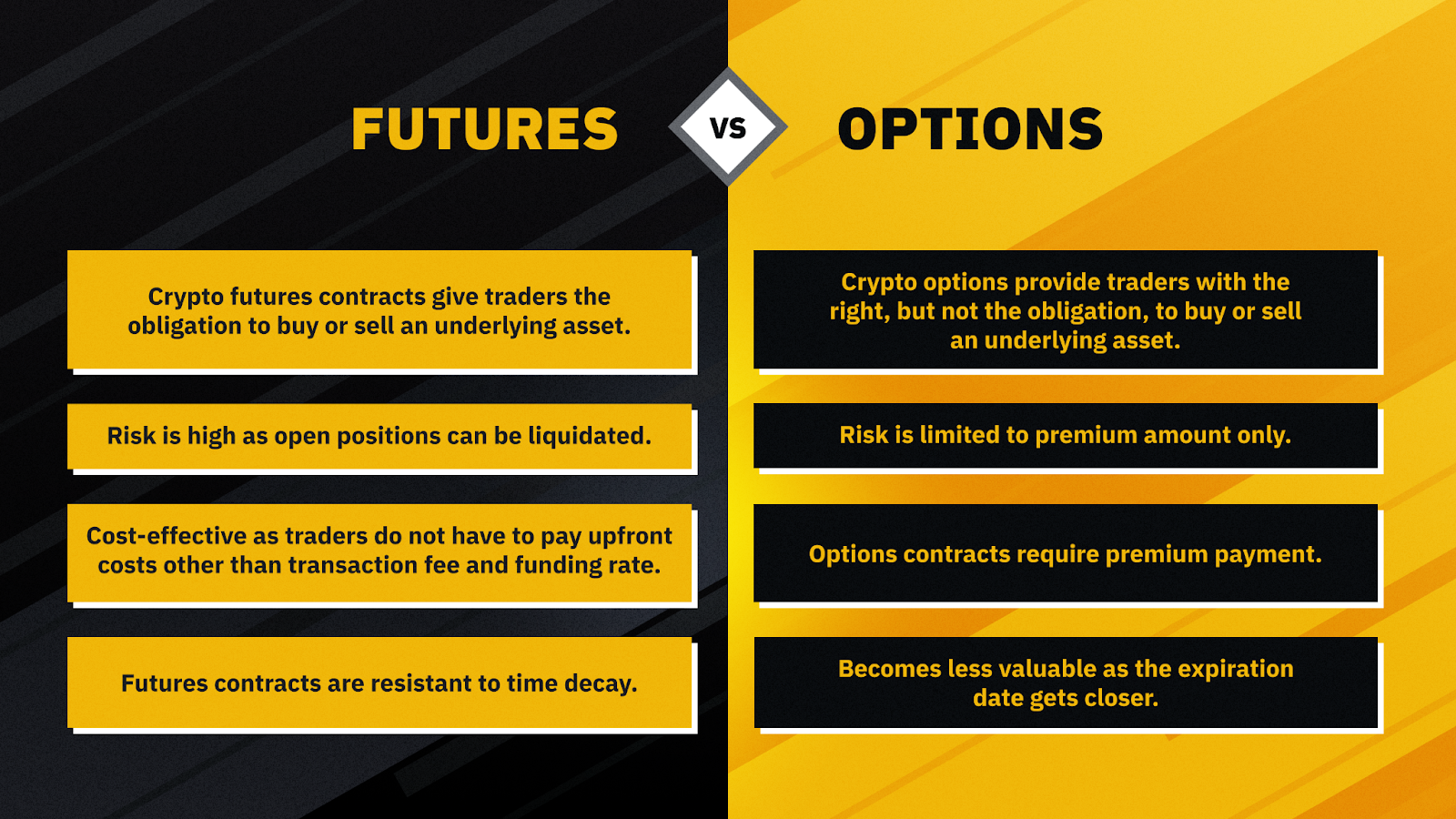
One of the primary differences between the two instruments is their method of execution. An options buyer has the choice not to exercise the contract if the market moves against their position. In contrast, a futures contract holder must execute the contract at expiry, regardless of the market conditions.
Cost structures
Options buyers have to pay an upfront fee, i.e., the premium, to the seller upon purchase. A futures contract allows you to open a position without paying any upfront fee. Importantly, you will likely have to pay some commissions including trading fees and funding rates for crypto futures depending on the exchange.
Time decay
Time decay refers to the decline in value of an options contract as it nears the date of expiration. The time decay accelerates as the expiration date of a contract draws closer as there's less time to realize a profit. In the case of futures, the passage of time doesn’t adversely affect the valuation of the contract.
Potential risks
Since options traders have the choice not to exercise their contracts, their loss is constricted to the premium they have to pay for the contract. Buyers benefit as the maximum loss is capped at the fixed premium irrespective of how much the underlying asset moves. In contrast, futures contracts carry liquidation risks as leveraged positions are prone to volatile price swings and may deplete a trader's initial investment with little to no effort. Forced liquidation may happen when your wallet balance is unable to meet the margin requirements of your open position. These contracts are riskier because there’s no way to evaluate how much you’ll make or lose, which makes it challenging to hedge your risks.
Conclusion
Crypto futures and options have become widely popular trading instruments in the digital asset markets, and both have their unique set of advantages. While options tend to be less risky, futures offer better liquidity and are more cost-effective. The decision to trade futures or options depends on a trader's preferences, such as risk tolerance and available capital. In any case, it is important to keep certain factors in mind, including your comfort with leverage, your understanding of the instruments, and the need to always conduct an in-depth analysis before you trade.


All Comments