

Cointime

Download App
iOS & Android

Analysis of the Bitwise Bitcoin ETF and its Impact on the Market

From tftc

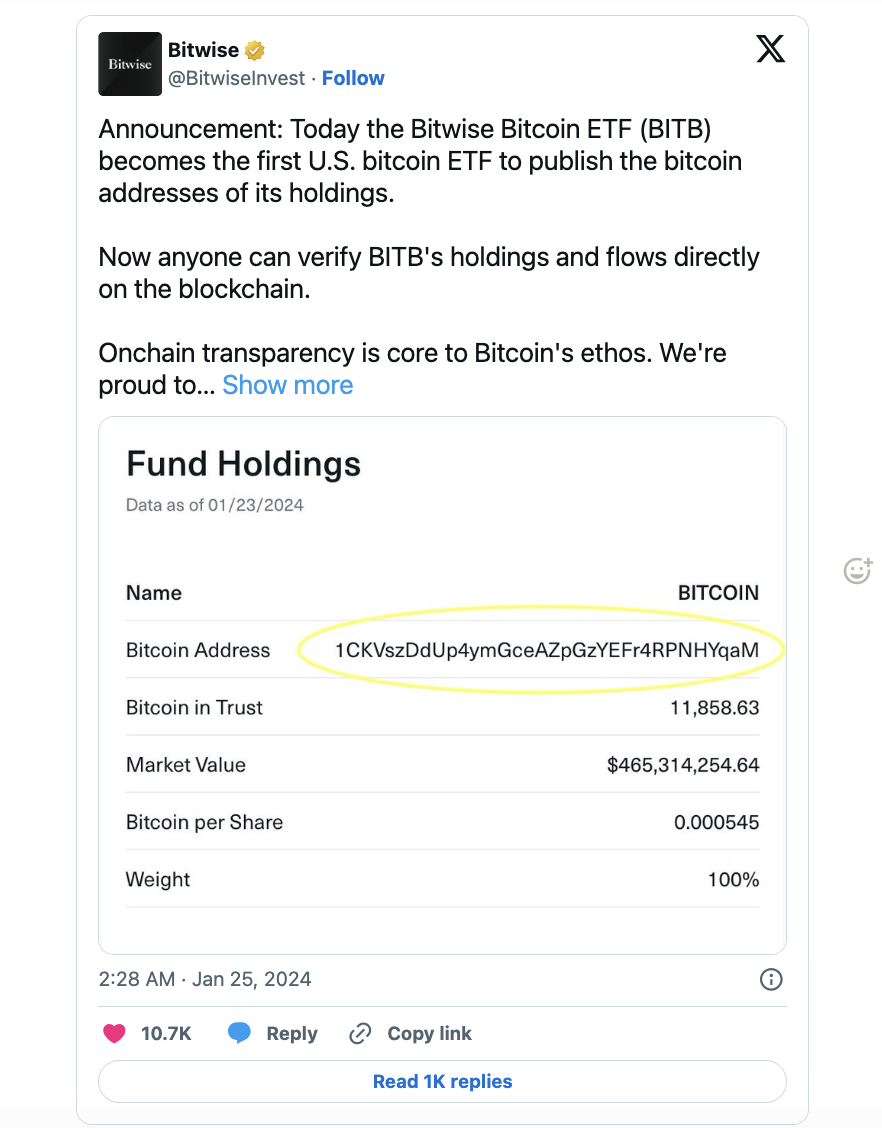
The Bitwise Bitcoin ETF (ticker: BITB) has recently marked a significant milestone in the cryptocurrency industry by becoming the first US Bitcoin ETF to publicly disclose the Bitcoin addresses holding its assets. This transparency move allows for verification of actual Bitcoin holdings, a critical factor in assessing the trustworthiness and security of such financial products.

Bitcoin ETFs and Asset Backing

A Bitcoin ETF is an exchange-traded fund that tracks the price of Bitcoin and allows investors to trade shares of the ETF on traditional stock exchanges. One of the concerns with Bitcoin ETFs has been whether they are backed by real BTC as collateral, or if they represent shares backed by "imaginary" BTC, drawing parallels to suspicions around gold ETFs.

The Bitwise Bitcoin ETF has demonstrated a robust approach to collateralization, as it appears to be holding more Bitcoin than required for the underlying shares. This makes it an over-collateralized ETF, arguably one of the safest based on collateral measures.

Public Address Disclosure

Bitwise has published the relevant Bitcoin addresses, which can be verified through blockchain explorers. As of the reporting, these addresses held approximately 12,338 Bitcoin, with a market value of around $510 million. The transparency of Bitcoin's blockchain allows anyone to view the transactions, including the meme-inspired amounts of 69 or 42069 satoshis (satoshis being the smallest Bitcoin unit).
Potential Risks

Despite the increased transparency, there are potential risks to consider. Public addresses expose the ETF to unsolicited transactions, which could include bitcoins from addresses sanctioned by the OFAC. Additionally, the use of a single signature address, as opposed to native Bitcoin multisig, may pose security concerns. Moreover, proof of reserves does not necessarily guarantee exclusive access or prevent the double pledging of collateral.

Bitcoin's Transparency vs. Privacy

The discussion around Bitwise's ETF also touches on the broader debate between transparency and privacy within the crypto ecosystem. Bitcoin's design favors transparency at the base layer, with privacy-enhancing tools available as additional layers or options. This transparency is contrasted with privacy-focused cryptocurrencies or account-based models like Ethereum, which inherently offer less transparency and auditability.

Towards Enhanced Verification

Bitwise has indicated that publishing on-chain addresses is just the beginning of their efforts to increase public transparency. Future plans include working with firms like Hoseki to provide real-time cryptographic attestations of reserves, further solidifying the trust in their ETF.

Comparison with Gold ETFs

The Bitwise Bitcoin ETF exemplifies the transparency advantage of Bitcoin over traditional assets like gold. Unlike gold ETFs, which rely on assumed safety and physical storage, a Bitcoin ETF can demonstrate actual holdings in real-time, showcasing the benefits of digital assets in terms of transparency and verifiability.

Conclusion and Recommendations

While direct ownership of Bitcoin is generally recommended for those seeking the full benefits of cryptocurrency, the Bitwise Bitcoin ETF represents a viable option for investors constrained to stock-like instruments. The ETF's commitment to transparency and its support for open-source Bitcoin development through profit donations to organizations like Brink, OpenSats, and the Human Rights Foundation, offer additional incentives to consider BITB as an investment vehicle.

Final Thoughts

The Bitwise Bitcoin ETF's public disclosure of Bitcoin addresses marks a significant step towards transparency in the cryptocurrency investment space. With its over-collateralized status and efforts to increase verifiability, BITB sets a new standard for Bitcoin ETFs, despite the inherent risks and challenges associated with the format. This development may serve as a model for future products and contribute to the broader acceptance and integration of cryptocurrencies within traditional financial systems.

Comments

All Comments

Recommended for you

  • U.S. July Nonfarm Payrolls Fall by 23,000, Missing Market Expectations

    On August 7, U.S. nonfarm payrolls decreased by 23,000 in July, compared with market expectations of an increase of 80,000, and the previous value was an increase of 57,000.

  • US May and June Nonfarm Payroll Additions Revised Down by 103,000 Combined

    On August 7, the US Bureau of Labor Statistics: May nonfarm payroll additions were revised down from 129,000 to 63,000; June nonfarm payroll additions were revised down from 57,000 to 20,000. After the revisions, the combined additions for May and June were 103,000 lower than previously reported.

  • U.S. Rate Futures Market Sees Lower Odds of Fed September Hike

    On August 7, the probability of a Fed rate hike in September as priced by U.S. interest rate futures declined.

  • New York Gold Futures Top $4,400 per Ounce

    New York gold futures topped $4,400 per ounce, up 2.36% on the day.

  • Japan Finance Minister: FX Market Affected by Moves Not Driven by Actual Demand

    Japanese Finance Minister Satsuki Katayama said she and U.S. Treasury Secretary Bessent agreed that the foreign exchange market has been affected by moves not driven by actual demand.

  • BTC Breaks Through $65,000

    Market data shows BTC has broken through $65,000, currently reported at $65,007.44, with a 24-hour increase of 0.6%. The market is highly volatile, please exercise risk control.

  • Brent Crude Drops 2.00% Intraday to $81.07/Barrel

    Brent crude oil fell 2.00% during the day, now at $81.07 per barrel. (Jin Shi)

  • Trump: Data Centers May Be More Important Than Oil

    August 7 news, U.S. President Trump said in an interview with Punchbowl News, "I saw the other day that Texas seems to be opposed to building data centers. I think that's a mistake. I'm not taking a position—I just think it's a mistake, because there are other communities that want to build data centers. When a community is willing to accept data centers, it means a lot of money will flow into that community. I don't think they're ugly. Some of the data centers I've seen are the most incredible buildings I've ever seen. They are very important to the economy. If Texas says no to data centers, that's a mistake, because data centers may be more important than oil."

  • Trump to Meet with Mining Executives

    On August 7, according to CCTV International News, US President Trump will convene executives from some of the world's largest mining companies at the US State Department on August 7 local time, in an effort to take action to 'secure critical mineral supplies for the US and its allies.' Reuters reported that the US urgently needs critical minerals to replenish weapons inventories depleted during the war against Iran. During the more than five-month war with Iran, the US military expended large quantities of precision-guided missiles and air defense interceptors. US defense officials and lawmakers have warned that given existing production capacity constraints, replenishing some stockpiles could take years—although the Trump administration has denied reports of a so-called 'severe shortage of ammunition stockpiles.' According to Pentagon officials and defense companies, supplies of minerals such as rare earths, tungsten, germanium, and scandium are essential for manufacturing precision-guided missiles, fighter jets, armored vehicles, infrared sensors, and other advanced weapons systems. Expected attendees include industry giants such as global mining giant Rio Tinto Group, Australia's BHP, US Freeport-McMoRan, US Mountain Pass Materials, US Rare Earths, US Energy Fuels, and Canada's Metals Company. According to sources, the Trump administration plans to announce multiple deals and memorandums of understanding.

  • US Regulators Systematically Review Chinese AI Firms' Third-Country Computing Power Leasing

    August 7 news, according to Bloomberg, people familiar with the matter revealed that the U.S. government department responsible for investigating chip export control violations is reviewing Chinese AI companies' leasing of computing power in third countries to obtain Nvidia advanced chips.
