



In the volatile cycles of the crypto market, projects that rely solely on conceptual expectations often struggle to maintain sustained price performance. Assets that truly break out with independent trends on the secondary market typically possess two characteristics: first, the circulating chip structure has undergone thorough turnover and sedimentation; second, there is genuine business revenue backed by rigid token burn mechanisms.
As the four major ecosystem sectors—SuperPay, SuperLine, the decentralized on-chain platform, and the prediction market—are about to land within the SuperStrike system, this article will deeply analyze STRIKE’s value reassessment logic from the perspectives of industry trends, the commercial closed loops of the four sectors, capital camps, and secondary market chip games.
I. Era Trends: The “Hash Power Consumption Tsunami” Brought by the Explosion of AI Agents
To evaluate the long-term value of a crypto asset, one must first examine the fundamental changes occurring in the industry it belongs to.
Artificial intelligence applications are evolving from mere Q&A chatbots into fully autonomous AI Agents (autonomous intelligent agents) with independent execution capabilities. Future network interactions will no longer involve humans frequently manually clicking software; instead, countless AI Agents will run 24/7 in the background on behalf of humans.
This brings a critical underlying logic shift for the secondary market:
- Model Training: A one-time, phased hash power expenditure;
- Agent Operation (Inference): High-frequency, long-term, ubiquitous real-time hash power consumption.
When tens of thousands of AI Agents worldwide begin automatically scraping data, allocating funds, and executing contracts, every instance of their thinking and interface calling represents rigid consumption of underlying hash power.
The expensive and rigid time-based billing models of centralized cloud providers simply cannot meet such high-frequency, micro-amount settlement needs. The market urgently requires infrastructure capable of flexibly matching global idle GPUs and settling on-demand micro-amounts with tokens. This is precisely the hundred-billion-level hash power settlement track that SuperStrike is entering.
II. Synergy of the Four Sectors: From Peripheral Commercial Cash Flow to Token Value Capture

Addressing the landing needs of hash power scheduling, SuperStrike has built four business sectors covering social, payment, trading, and hedging. Many investors are concerned about how these four sectors ultimately convert peripheral cash flow into value capture for the token.
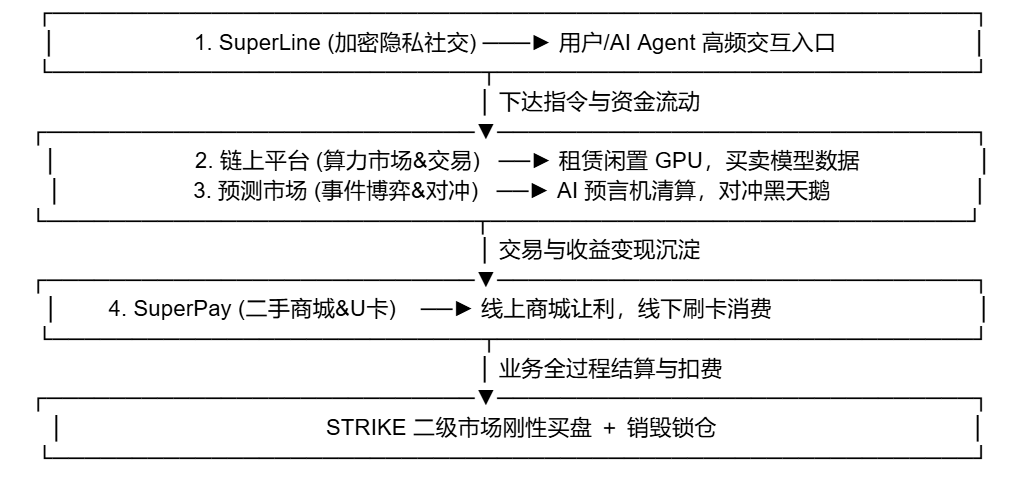
The four sectors achieve a highly closed loop in the transmission path of funds and demand:
- SuperLine (Social Traffic Entry): Protects privacy through zero-knowledge proofs and embeds AI intelligent assistants. Users can directly instruct AI to allocate assets and issue trading commands within the chat interface. Every agent invocation directly deducts STRIKE.
- Decentralized On-chain Trading Platform (Hash Power Trading Hall): Aggregates global idle GPUs for listing and rental. Developers rent hash power and purchase datasets on demand; the entire hash power market’s leasing and trading are settled entirely in STRIKE.
- Decentralized Prediction Market (Hedging and Gaming Center): Introduces AI Agents as unbiased referees for second-level settlement, attracting long-term capital to participate in event hedging. Oracle settlement services and the gaming process continuously extract STRIKE as service fees.
- SuperPay (Real-world Consumption and Monetization Pipeline): Combines a second-hand luxury goods marketplace with global VISA/U Card payment channels. Profits earned by users on-chain can seamlessly transfer to U Cards for offline spending; merchant onboarding staking and channel settlements require locking STRIKE.
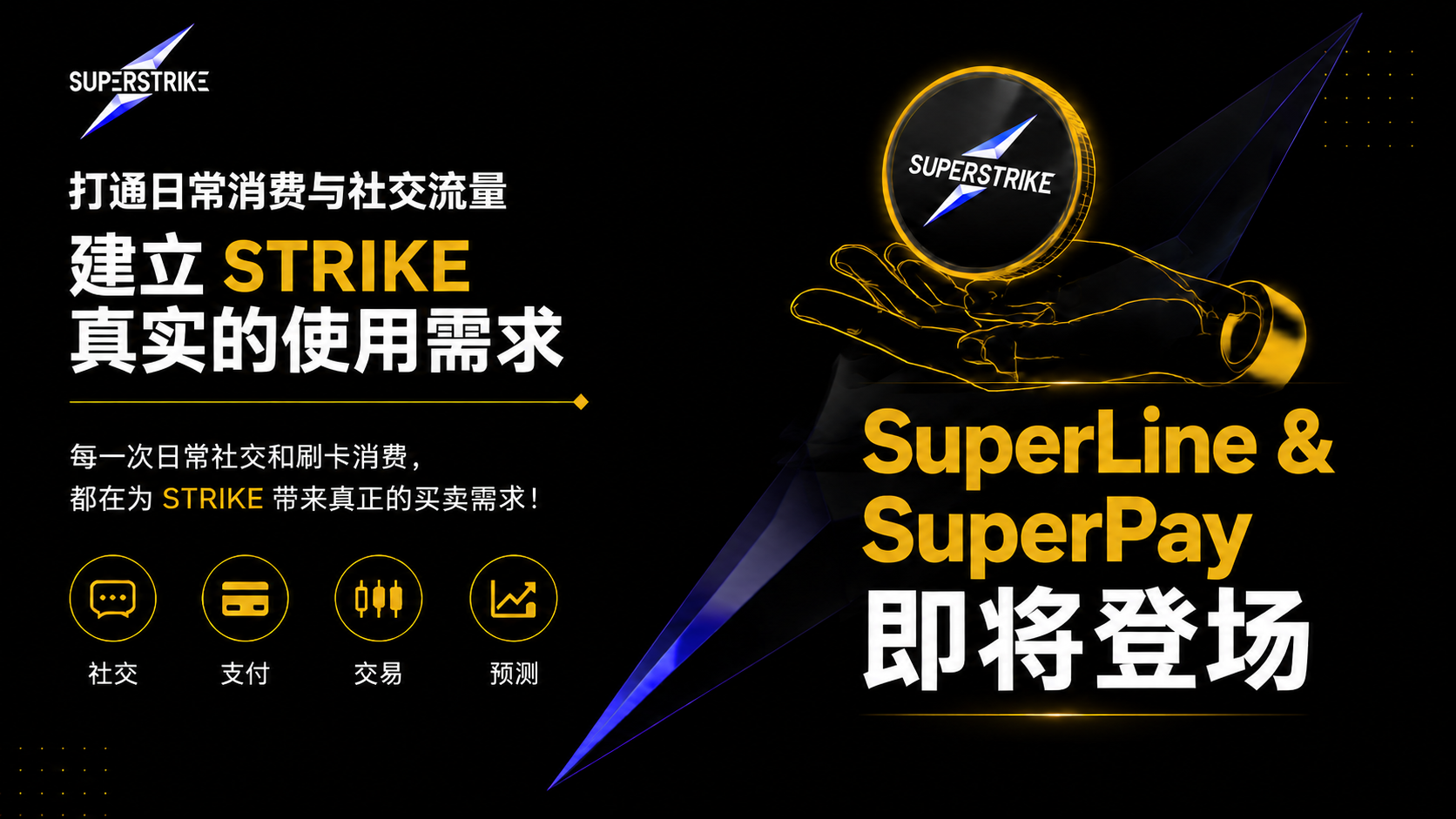
Within this system, the four sectors generate real Stablecoin and fiat cash flows, all of which require conversion into or deduction of STRIKE during underlying settlement.
Users and merchants do not even need to understand complex token economics—as long as they use the products of these four sectors, they will invisibly generate rigid buying pressure and burn demand for STRIKE on the secondary market through the underlying protocol. This design of converting real commercial cash flow into token buying pressure is the key for the project to break free from merely relying on air inflation to sustain the ecosystem.
III. Chip Structure and Game Perspective: Washout Completed and Valuation Repair
From the perspective of secondary market trading and chip structure, STRIKE is currently in a very typical bottom-chip sedimentation phase:
1. Earlier Impulse and Chip Sedimentation
Looking back at the previous price action, STRIKE steadily rose from the earlier low of 0.06 USDT, breaking through resistance to 0.13 USDT, fully demonstrating the strength of main force capital accumulation and market consensus. It then followed the broader market’s volatile pullback, relatively cleanly clearing out earlier short-term profit-taking floating chips.
This pullback completed turnover on the technical level, supplemented trading depth on the board, and formed a relatively healthy chip structure for the subsequent launch of the four sectors and the next wave of market movement.
2. Deflationary and Staking Effects on Circulating Supply
As the four businesses come online successively, the token will face dual locking and deflationary pressures:
- Node and Business Staking: Merchant onboarding for SuperPay, hash power node listings, and the system’s withdrawal protection net (T+1 verification buffer period) will lock up large amounts of circulating chips;
- Rigid Burn (Sburn): SuperLine agent invocation fees, prediction market oracle fees, and hash power consumption are directly proportionally sent to the black hole for burning.
The continuous contraction of circulating supply means that any subsequent new capital inflow can generate relatively strong upward price elasticity.
IV. Institutional Camp and Trading Platform Layout
Assessing a project’s risk resistance cannot be separated from its underlying capital and resource network:
- Backed by the technical origin of StrikeBit AI: SuperStrike inherits StrikeBit AI’s technical legacy in decentralized AI assembly, enabling low-cost invocation of global computing nodes and ensuring the stable operation of the four businesses at the technical level.
- Strategic bets from top-tier institutions: The project and its ecosystem have received investments from well-known institutions in the crypto and hardware infrastructure tracks, including FBG Capital, Waterdrip Capital, DePIN X, and IoTeX. These institutions not only bring capital but also overseas community resources and hardware node expansion.
- Expectations for mainstream trading platforms (CEX): With the advancement of the four businesses’ launches, the project’s liquidity matrix is also accelerating expansion. Leveraging the industry resources of top investment institutions, the team is actively advancing docking with major global mainstream leading trading platforms, providing clear expectations for future liquidity release.
V. Summary and Token Expectations
In the current crypto market, capital is increasingly focused on a project’s fundamentals and self-sustaining capabilities.
SuperStrike’s core logic is pure: supported by StrikeBit AI technology, it uses the four high-frequency application sectors—SuperPay, SuperLine, the on-chain trading platform (DEX), and the on-chain prediction market—to import real business cash flows, ultimately consolidating all revenue and consumption onto STRIKE as the “hash power Gas fee.”
When the token possesses genuine burn, staking, and buying demand, combined with the previously completed chip turnover on the board and the endorsement of the institutional camp, STRIKE has a clear foundation for value reassessment during the upcoming business landing verification period. The project’s subsequent business data and market performance deserve continuous attention.


All Comments