

Cointime

Download App
iOS & Android

Google targets 2029 post-quantum migration as threats draw nearer

Google has set a 2029 deadline for its post-quantum cryptography (PQC) migration, warning that “quantum frontiers” could be closer than they appear.

On Wednesday, Google said rapid progress in quantum computing hardware and quantum error correction, along with updated estimates of how quickly a quantum machine could break today’s encryption standards, has heightened the urgency to act sooner rather than later.

“Quantum computers will pose a significant threat to current cryptographic standards, and specifically to encryption and digital signatures,” Google said, while also noting that PQC migration is needed for users to use authentication services securely.

This is the first time Google has set a timeline to roll out post-quantum capabilities across its products. The 2029 timeline is earlier than some industry estimates for Q-Day — the point at which quantum computers become powerful enough to break current public-key encryption.

“It’s our responsibility to lead by example and share an ambitious timeline. By doing this, we hope to provide the clarity and urgency needed to accelerate digital transitions not only for Google, but also across the industry.”
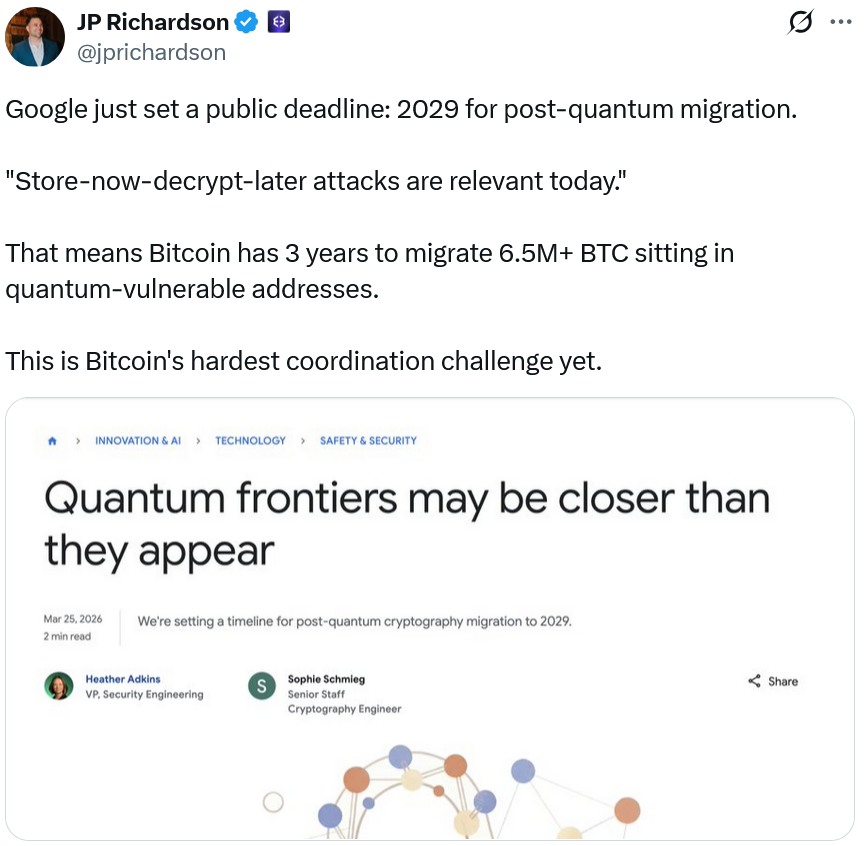
  Source: JP Richardson


Google’s call for urgency comes as it continues to develop its quantum chip, Willow, which has a computing capacity of 105 qubits, making it one of the most powerful in the industry.

There are also rising concerns that quantum computers could severely disrupt the crypto industry by breaking the cryptographic algorithms used to secure digital assets. However, there is still debate over whether only crypto wallets with exposed public keys are vulnerable or whether all coins are at risk.

Crypto networks also eye post-quantum upgrades

The Ethereum Foundation launched a “Post-Quantum Ethereum” resource hub on Tuesday, focused on protecting the blockchain from future quantum computing threats and securing the billions of dollars in value on the network.

The post-quantum team plans to implement quantum-resistant solutions in Ethereum at the protocol level by 2029, with solutions targeting the execution layer to follow.

In January 2025, Solana developers created a quantum-resistant vault on the Solana blockchain to protect user funds from quantum threats by implementing a complex hash-based signature system that generates new keys each time a transaction is made.

However, to access the feature, Solana users need to store their funds in Winternitz vaults rather than regular Solana wallets, as it isn’t a network-wide security upgrade.

Meanwhile, there has been increasing division in the Bitcoin ecosystem on what action developers should take, if any at all.

One of the Bitcoin ecosystem’s strongest voices, Blockstream CEO Adam Back, says quantum risks are widely overstated and that no action is needed for decades.

On the other hand, security researcher Ethan Heilman and others have proposed a new output type for Bitcoin, called Pay-to-Merkle-Root, through Bitcoin Improvement Proposal 360 (BIP-360), which seeks to protect Bitcoin addresses from potential short-exposure quantum attacks.

However, that implementation may take seven years, Heilman told Cointelegraph in February.

Comments

All Comments

Recommended for you

  • U.S. July Nonfarm Payrolls Fall by 23,000, Missing Market Expectations

    On August 7, U.S. nonfarm payrolls decreased by 23,000 in July, compared with market expectations of an increase of 80,000, and the previous value was an increase of 57,000.

  • US May and June Nonfarm Payroll Additions Revised Down by 103,000 Combined

    On August 7, the US Bureau of Labor Statistics: May nonfarm payroll additions were revised down from 129,000 to 63,000; June nonfarm payroll additions were revised down from 57,000 to 20,000. After the revisions, the combined additions for May and June were 103,000 lower than previously reported.

  • U.S. Rate Futures Market Sees Lower Odds of Fed September Hike

    On August 7, the probability of a Fed rate hike in September as priced by U.S. interest rate futures declined.

  • New York Gold Futures Top $4,400 per Ounce

    New York gold futures topped $4,400 per ounce, up 2.36% on the day.

  • Japan Finance Minister: FX Market Affected by Moves Not Driven by Actual Demand

    Japanese Finance Minister Satsuki Katayama said she and U.S. Treasury Secretary Bessent agreed that the foreign exchange market has been affected by moves not driven by actual demand.

  • BTC Breaks Through $65,000

    Market data shows BTC has broken through $65,000, currently reported at $65,007.44, with a 24-hour increase of 0.6%. The market is highly volatile, please exercise risk control.

  • Brent Crude Drops 2.00% Intraday to $81.07/Barrel

    Brent crude oil fell 2.00% during the day, now at $81.07 per barrel. (Jin Shi)

  • Trump: Data Centers May Be More Important Than Oil

    August 7 news, U.S. President Trump said in an interview with Punchbowl News, "I saw the other day that Texas seems to be opposed to building data centers. I think that's a mistake. I'm not taking a position—I just think it's a mistake, because there are other communities that want to build data centers. When a community is willing to accept data centers, it means a lot of money will flow into that community. I don't think they're ugly. Some of the data centers I've seen are the most incredible buildings I've ever seen. They are very important to the economy. If Texas says no to data centers, that's a mistake, because data centers may be more important than oil."

  • Trump to Meet with Mining Executives

    On August 7, according to CCTV International News, US President Trump will convene executives from some of the world's largest mining companies at the US State Department on August 7 local time, in an effort to take action to 'secure critical mineral supplies for the US and its allies.' Reuters reported that the US urgently needs critical minerals to replenish weapons inventories depleted during the war against Iran. During the more than five-month war with Iran, the US military expended large quantities of precision-guided missiles and air defense interceptors. US defense officials and lawmakers have warned that given existing production capacity constraints, replenishing some stockpiles could take years—although the Trump administration has denied reports of a so-called 'severe shortage of ammunition stockpiles.' According to Pentagon officials and defense companies, supplies of minerals such as rare earths, tungsten, germanium, and scandium are essential for manufacturing precision-guided missiles, fighter jets, armored vehicles, infrared sensors, and other advanced weapons systems. Expected attendees include industry giants such as global mining giant Rio Tinto Group, Australia's BHP, US Freeport-McMoRan, US Mountain Pass Materials, US Rare Earths, US Energy Fuels, and Canada's Metals Company. According to sources, the Trump administration plans to announce multiple deals and memorandums of understanding.

  • US Regulators Systematically Review Chinese AI Firms' Third-Country Computing Power Leasing

    August 7 news, according to Bloomberg, people familiar with the matter revealed that the U.S. government department responsible for investigating chip export control violations is reviewing Chinese AI companies' leasing of computing power in third countries to obtain Nvidia advanced chips.
